Info
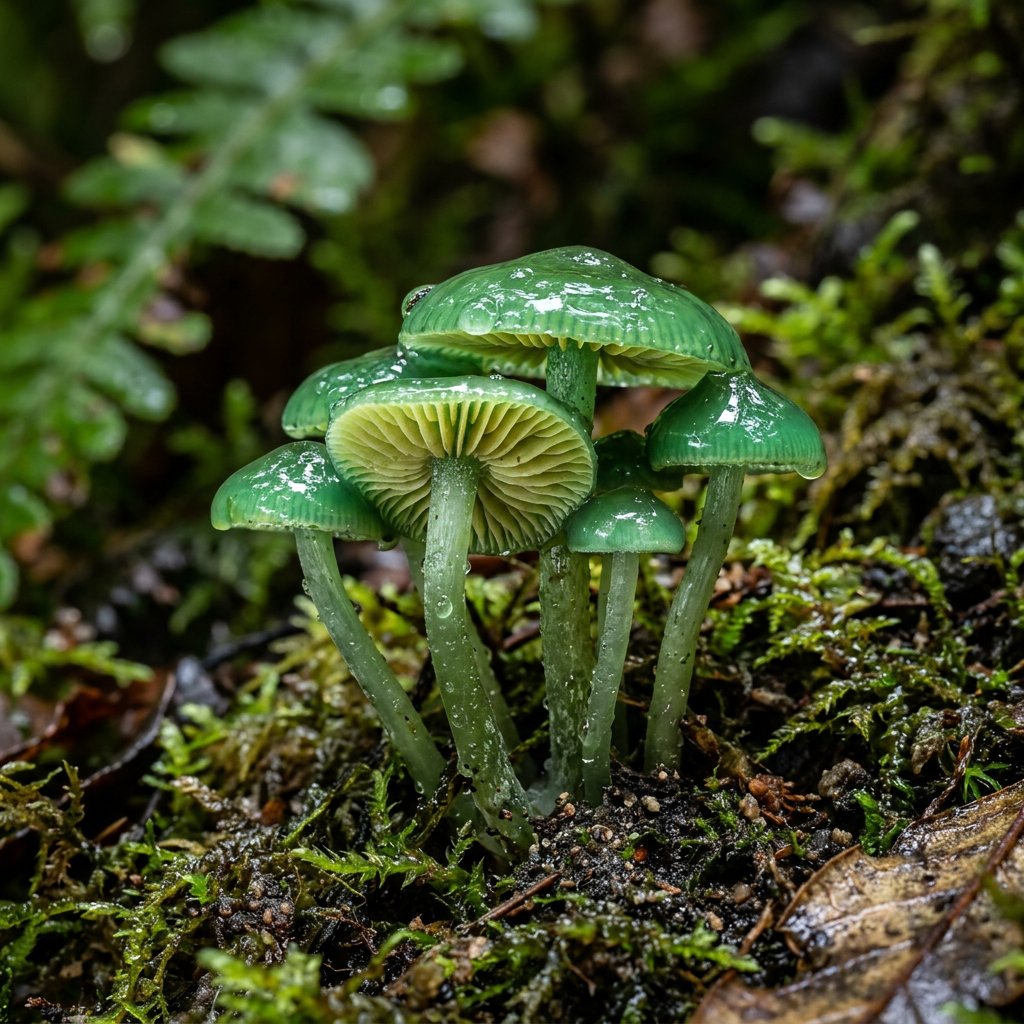
Often referred to as the "Green Waxcap" or "Verdigris Waxcap," this stunning fungus looks like a tiny emerald jewel dropped onto the forest floor. Found predominantly in the mossy woodlands of New Zealand and parts of Australia, it is famous for its vibrant, almost "radioactive" green hue that seems to defy nature. In local folklore, these bright mushrooms are sometimes called "spirit lights," guiding the way through the deep, damp southern beech forests.
🔍 How to Identify
- 🟢 The Cap: Small and convex, the cap is a brilliant lime to forest green. It has a distinctively slimy or "viscid" texture that makes it glisten when wet.
- 🌿 The Gills: Look underneath to find gills that are widely spaced and often a paler shade of green or yellowish-white, occasionally appearing translucent near the edges.
- 🧪 The Stem: The stalk is slender, fragile, and just as slimy as the cap. It lacks a ring or volva, maintaining a sleek, uniform appearance from top to bottom.
🌲 Habitat & Ecology
- 🍄 Mossy Preferences: This mushroom loves moisture. You will most likely find it nestled in thick carpets of moss or among damp leaf litter in native evergreen forests.
- 🌳 Tree Partners: While not strictly parasitic, it thrives in the rich, undisturbed soils of Southern Beech (Nothofagus) and Broadleaf forests, appearing most frequently during the cool, wet months of autumn.
⚠️ Safety & Toxicity
- 🚫 WARNING: Do not consume this mushroom. While many waxcaps are not necessarily "deadly," their edibility is largely unknown or considered poor due to their small size and slimy texture.
- 🐾 General Safety: As with all wild fungi, keep children and pets away. Ingesting unidentified wild mushrooms can lead to severe gastrointestinal distress or unpredictable allergic reactions.
✨ Fun Fact
The striking green color of Gliophorus viridis is remarkably stable; unlike many other green mushrooms that fade to brown or yellow as they age, this species often holds onto its "emerald" glow even as it begins to decay!
More Details







