Info
Often called the Yellow-Gilled Gym or the Gilded Gym, this mushroom is a vibrant gem of the forest floor. Known for its striking transition from deep purplish-pinks to golden yellows, it looks like something plucked from a psychedelic dreamscape. While it might look beautiful, it harbors chemical secrets that make it a fascinating—though strictly non-edible—specimen for fungal enthusiasts.
🔍 How to Identify
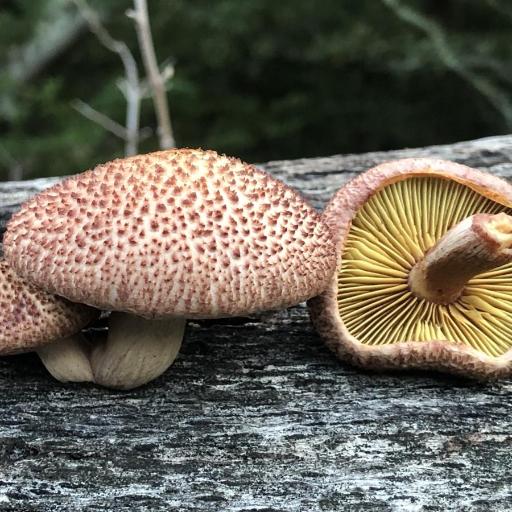
- 🍄 The Cap: Ranges from 2 to 8 cm wide, starting out with a beautiful reddish-purple or lilac hue and a dry, scaly texture. As it matures, it fades to a more golden-yellow or tawny color.
- 🟡 The Gills: True to its name (luteofolius means yellow-leaved), the gills are a brilliant, crowded yellow that eventually turns a rusty-orange as the spores mature.
- 🪵 The Stem: The stalk is fibrous and tough, often matching the cap color or appearing slightly paler, sometimes showing a faint ring (annulus) from where the veil was attached.
- 🖌️ The Bruising: If you handle or nick the stem, it may slowly develop bluish or teal-green stains, a characteristic common in mushrooms containing certain alkaloids.
🌲 Habitat & Ecology
- 🪵 Wood Recycler: This is a saprobic species, meaning it feeds on dead organic matter. You will almost always find it growing on rotting logs, stumps, or woody debris, particularly from hardwood trees or occasionally conifers.
- 👯 Social Growth: It rarely grows alone; look for it in dense, crowded clusters (gregarious growth) during the late summer and fall, especially after heavy rains.
⚠️ Safety & Toxicity
- 🚫 Status: TOXIC & PSYCHOACTIVE. This mushroom is strictly not for consumption. It contains psilocybin and psilocin, which cause powerful hallucinations, as well as bitter "gymnopilins" that can cause severe stomach upset.
- 🐾 Pet Warning: Keep a close eye on curious dogs. Ingesting this mushroom can lead to tremors, disorientation, and vomiting in pets. Always remove them if they sprout in a yard where animals play.
✨ Fun Fact
The Gymnopilus genus is often nicknamed "Flamecaps" because of the fiery orange and yellow spore prints they leave behind, which can coat the logs they grow on in a rusty, dust-like "fire."
More Details
| Hymenium Type | Lamella |
| Stipe Character | Ring Stipe |
| Spore Print Color | Bordeaux |
| Mushroom Cap Shape | Convex Mushroom Cap |
| Hymenium Attachment | Adnate Hymenium Attachment |
| Mushroom Ecological Type | Saprobiont |