Info
Known as the Alder Bolete, this mushroom is the faithful, lifelong companion of the Alder tree. While it might look like a typical sponge-bottomed mushroom at first glance, its life is deeply intertwined with the roots of its host in a complex subterranean partnership. If you spot these golden-hued caps in a marshy area, simply look up—you are almost certainly standing under an Alder.
🔍 How to Identify
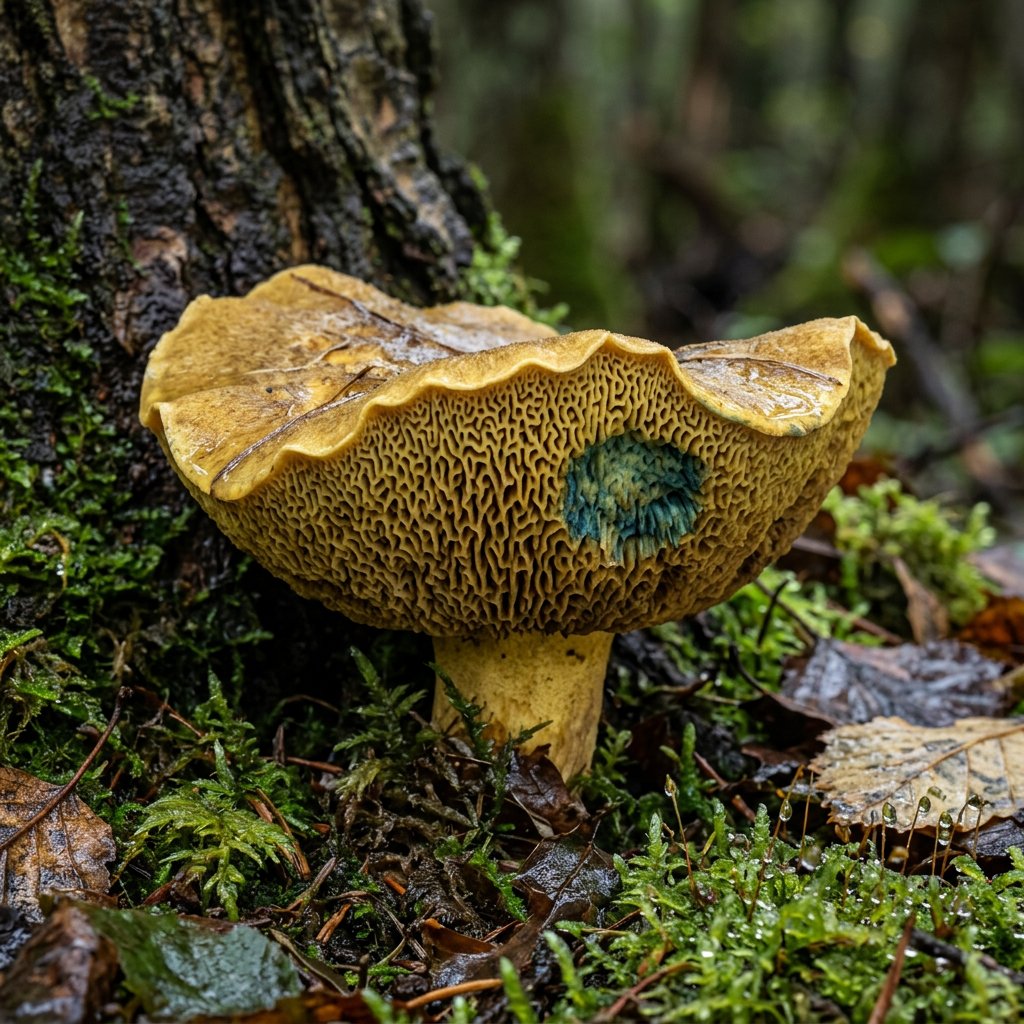
- 🍄 The Cap: Usually measuring 4–10 cm, the cap starts convex and flattens with age. It ranges from a pale straw-yellow to a dingy buff-brown and often feels slightly tacky or "greasy" when the weather is damp.
- 🧽 The Pores: Instead of gills, the underside features a shallow, sponge-like layer of pores. These are bright yellow and characteristically run slightly down the length of the stem (decurrent).
- 🎨 The Bruise: One of its most dramatic features is its reaction to touch. If you press the yellow pores or cut the flesh, the surface will slowly stain a murky blue-green or brownish-olive.
🌲 Habitat & Ecology
- 🌳 The Alder Bond: This species is strictly "mycorrhizal" with Alder trees (Alnus). It acts as a secondary root system for the tree, helping it absorb minerals in exchange for sugars. You will find them in damp, boggy woodlands or along riverbanks where Alders thrive.
- 🍂 Autumn Clusters: They typically fruit from late summer through late autumn. Unlike some solitary mushrooms, the Alder Bolete often grows in small, social clusters nestled among the nitrogen-rich leaf litter.
⚠️ Safety & Toxicity
- 🛑 WARNING: Never consume any wild mushroom unless you have had it verified in person by a professional mycologist. Accuracy in identification is a matter of life and death.
- 🍽️ Edibility: The Alder Bolete is generally classified as edible but of poor quality. Most foragers avoid it because the flesh becomes soft and unappealing when cooked, and some individuals report mild digestive upset after eating them.
- 🐾 Pets & Children: While not considered "deadly," ingesting raw wild mushrooms can cause significant vomiting and distress in dogs and small children. It is best to admire them from a distance.
✨ Fun Fact
Gyrodon lividus is considered an "evolutionary bridge." Scientists believe its shallow, elongated pores represent an intermediate step in fungal history, showing how mushrooms transitioned from having traditional gills to the sponge-like tubes seen in modern Boletes!
More Details