Info
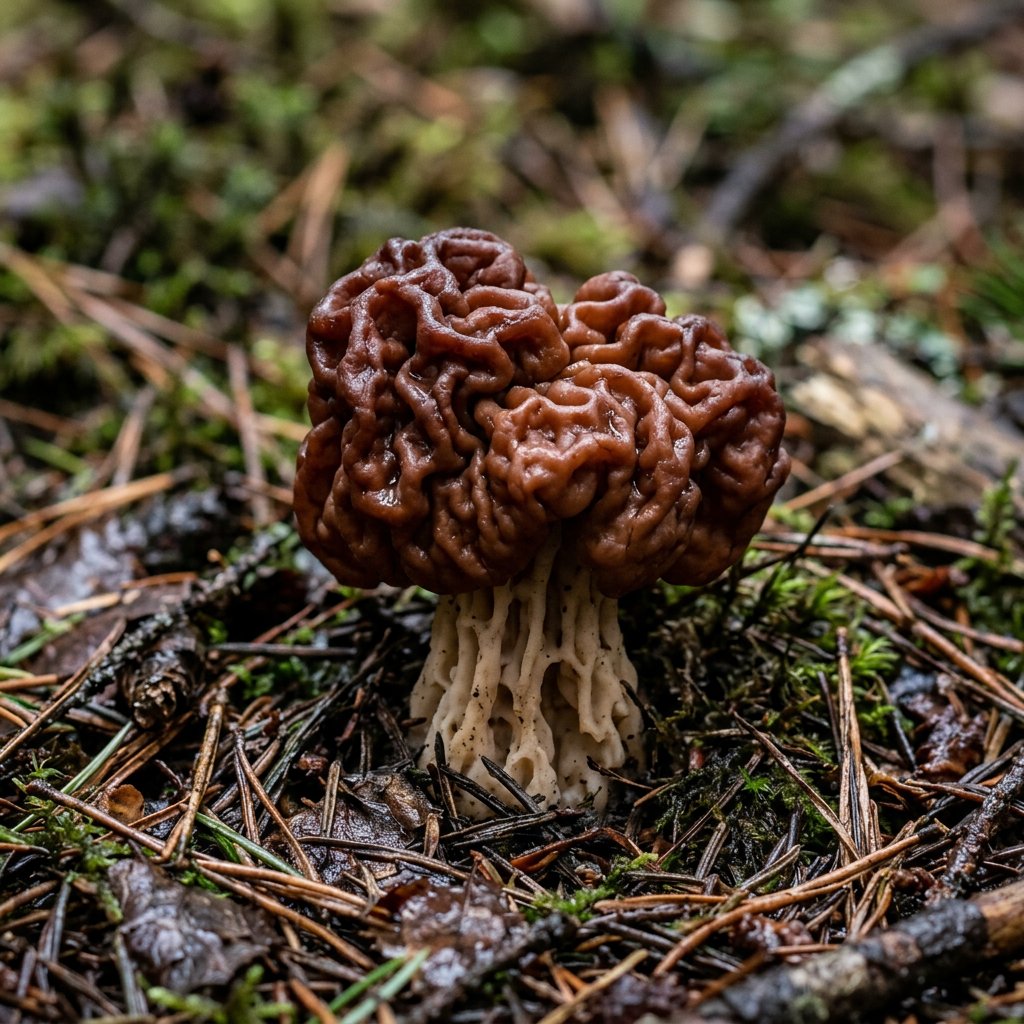
Known as the California False Morel or the Umbrella False Morel, this fungus looks like a peculiar architectural sketch brought to life on the forest floor. Unlike its "true" morel cousins, which boast honeycombed pits, this mushroom features a wavy, saddle-shaped cap that seems to float atop a deeply fluted pedestal. It is a signature find for hikers wandering through the damp, coniferous cathedrals of Western North America during the spring thaw.
🔍 How to Identify
- 🍄 The Cap: It is distinctively saddle-shaped or irregularly lobed, often appearing wrinkled but never honeycombed. The color ranges from a dusty tan to a rich, reddish-brown.
- 🏛️ The Stem: The most striking feature is the thick, whitish stem which is deeply "ribbed" or fluted with long, vertical grooves. It looks like a bundle of fused columns rather than a solid cylinder.
- 🧬 The Attachment: Unlike some other false morels, the edges of the Gyromitra californica cap are typically fused to the stem in several places, creating a folded, "tucked-in" appearance.
🌲 Habitat & Ecology
- 🏔️ Mountain Dweller: This species loves the high life, frequently appearing in the mountains of the Pacific Northwest and California. You’ll find it most often in late spring or early summer as the snow begins to melt.
- 🪵 Woodland Ties: It has a "saprobic" lifestyle, meaning it feeds on decaying organic matter. Look for it near rotting conifer logs, along stream banks, or in the disturbed soil of mountain trails where moisture lingers.
⚠️ Safety & Toxicity
- 🚫 WARNING: Do not consume. While some historical guides may list certain Gyromitra species as "edible if parboiled," modern mycology classifies them as dangerously toxic.
- 🧪 The Poison: This mushroom contains gyromitrin, which the human body converts into monomethylhydrazine (MMH)—the same chemical used in rocket fuel.
- 🤢 The Risks: Ingestion can cause severe gastrointestinal distress, liver damage, and neurological symptoms. The toxins are cumulative, meaning they build up in your system over time, and the fumes released during cooking can be just as toxic as the mushroom itself. Keep away from curious pets and children.
✨ Fun Fact
The chemical toxin found in this mushroom, MMH, is so volatile and potent that it was actually studied by NASA for use as a propellant. Eating this mushroom is quite literally like inviting a tiny rocket engine to ignite in your stomach!
More Details







