Info
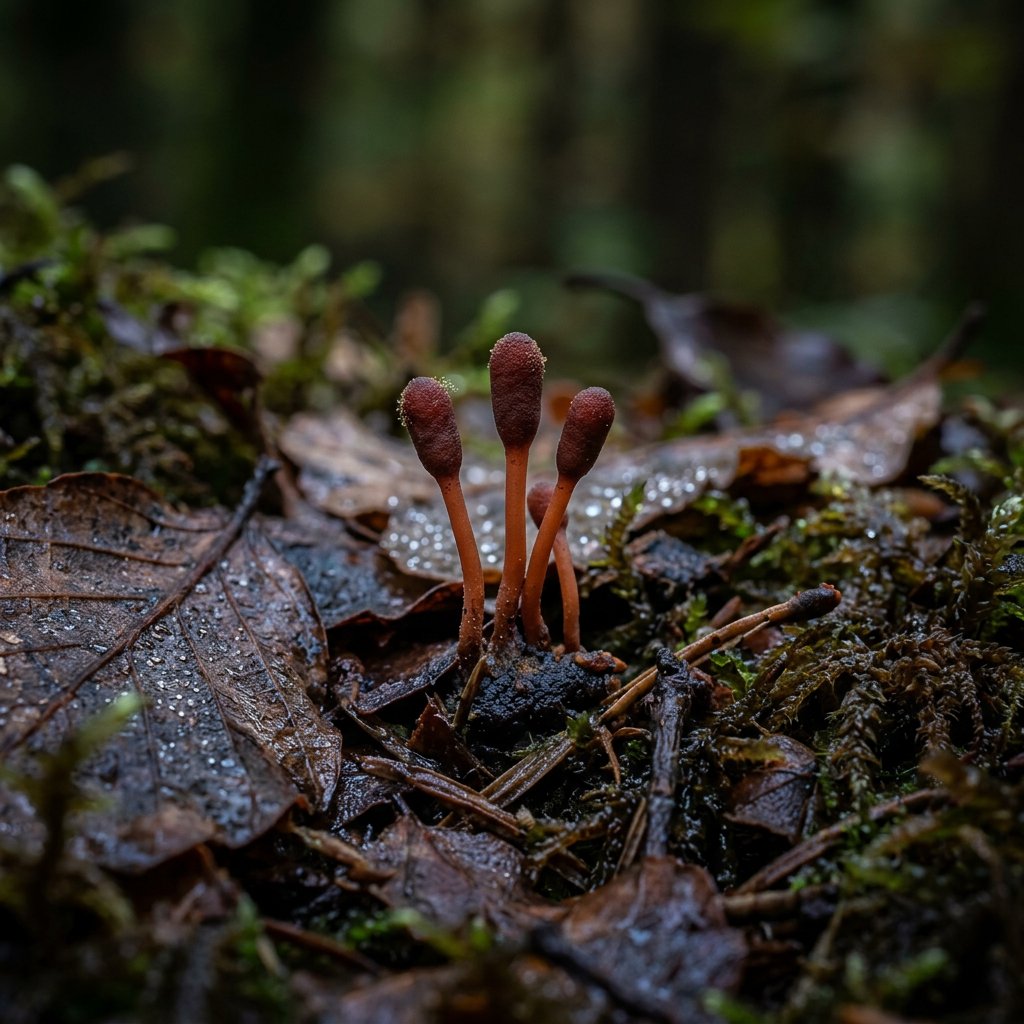
The Heyderia is a master of disguise, often appearing as a tiny, misplaced flame or a miniature club rising from a bed of pine needles. These "needle-loving" fungi are frequently overlooked by casual hikers due to their diminutive size, but they play a vital role in the secret life of coniferous forests. In folklore, such tiny, delicate fungi were often imagined as the walking sticks of woodland sprites or forest gnomes.
🔍 How to Identify
- 🍄 The "Cap": It lacks a traditional cap and gills; instead, it features a small, spatula-shaped or club-like head that is typically yellowish-tan to cinnamon-brown.
- 🧵 The Stem: A very slender, hair-like stalk that is usually darker than the head—often a deep reddish-brown or black—and slightly translucent.
- 📏 Miniature Stature: These are truly tiny specimens, rarely exceeding 15–20 millimeters in height, making them a rewarding "find" for macro-photography enthusiasts.
🌲 Habitat & Ecology
- 🌲 Needle Specialist: Heyderia species are highly specific; they grow almost exclusively on the fallen, decaying needles of conifers like Fir, Spruce, and Pine.
- 🍂 Forest Recycler: As a saprobic fungus, it performs the essential "grunt work" of the forest, breaking down tough needle fibers and returning nutrients to the soil to feed the giant trees above.
- 🌧️ Seasonal Emergence: They are most likely to be spotted during the damp, cool windows of late autumn or early winter, often appearing in "troops" of dozens on a single patch of forest floor.
⚠️ Safety & Toxicity
- 🛑 WARNING: Heyderia mushrooms are classified as Inedible.
- 🚫 Assessment: While they are not known to be aggressively poisonous, their tiny size and tough, leathery texture make them completely unsuitable for the kitchen.
- 🐾 Pet Safety: Because they are so small and grow in deep forest litter, they rarely pose a threat to pets, but it is always best to prevent curious dogs from grazing on unidentified forest fungi.
✨ Fun Fact
Heyderia belongs to the "sac fungi" group (Ascomycota). Unlike common mushrooms that drop spores from gills, these little clubs "fire" their spores into the air from microscopic pressurized sacs called asci, timed perfectly with passing breezes!
More Details