Info
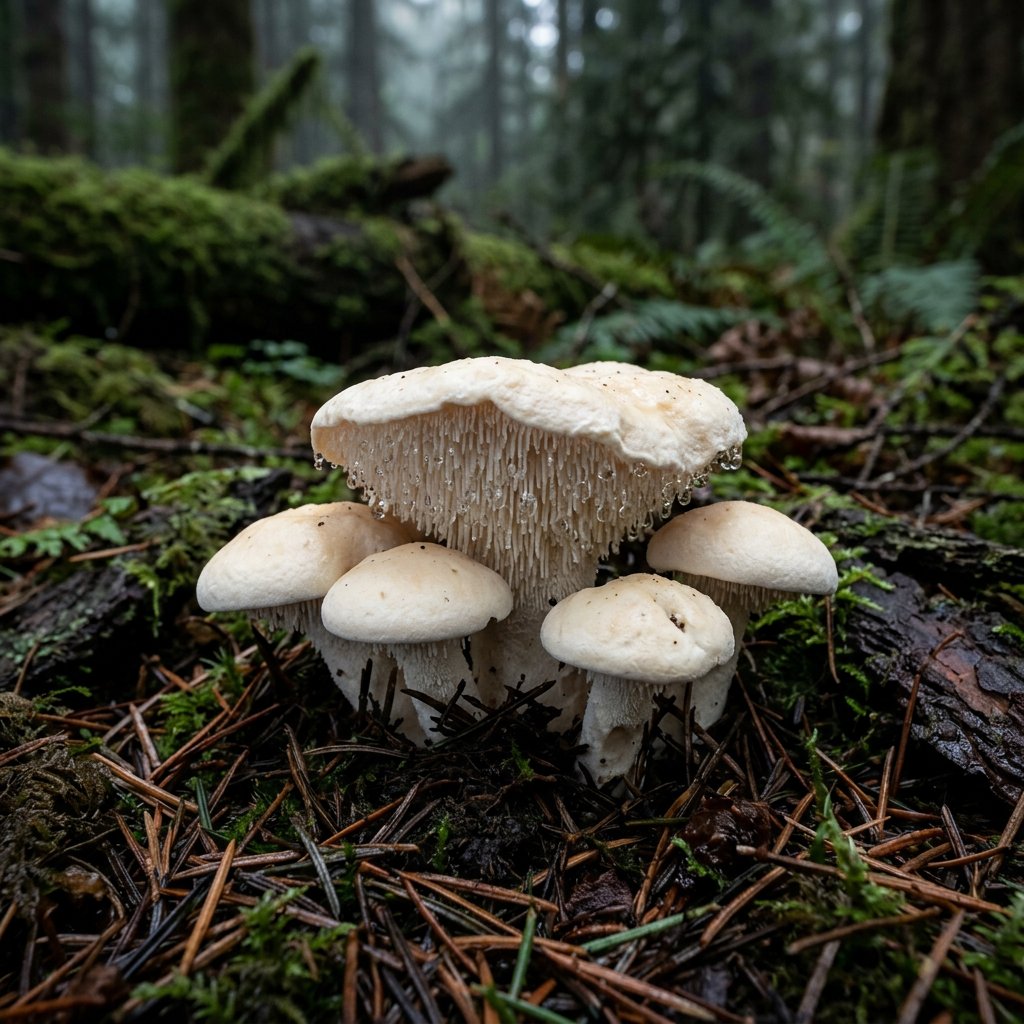
Often called the "White Hedgehog" or the "Ivory Wood-Tooth," this pristine fungus is the elegant, pale cousin of the more common orange Hedgehog mushroom. While many mushrooms use gills or pores to release their spores, this species belongs to a unique group that uses tiny, icicle-like "teeth" hanging from the underside of its cap. In the dim light of a damp forest floor, its ghostly white color makes it stand out like a fallen snowflake.
🔍 How to Identify
- 🦔 The Spines (Teeth): Instead of gills, the underside is covered in soft, fragile, white-to-cream colored "teeth" that are roughly 2–5mm long.
- ☁️ The Cap: A smooth, matte surface that ranges from pure white to pale ivory. It often has a slightly wavy or irregular edge and may develop yellowish stains as it ages.
- ❄️ The Flesh: The internal meat is brittle and pure white. When snapped, it doesn't exude milk, but it may slowly turn a pale ochre color if bruised.
🌲 Habitat & Ecology
- 🍂 Forest Friends: This mushroom is mycorrhizal, meaning it forms a "win-win" partnership with trees. It is most commonly found peeking through leaf litter in mixed forests, often favoring hardwoods like oak or beech, but also appearing near pines.
- ⛰️ Soil Preference: Unlike many fungi that prefer acidic soil, the White Hedgehog is frequently found in areas with limestone or calcareous (calcium-rich) soils, often appearing in small "troops" or fairy rings.
⚠️ Safety & Toxicity
- 🍄 WARNING: Never consume any wild mushroom unless you are 100% certain of its identity through expert consultation.
- 🍽️ Status: Generally considered a choice edible with a mild, nutty flavor. However, older specimens can become quite bitter and may cause mild digestive upset in sensitive individuals.
- 🚫 Look-alikes: While there are no deadly "toothed" mushrooms that look like this, beginners might mistake young, pale specimens for other white fungi. Always check for the "teeth" underneath—if it has gills, it is not a White Hedgehog.
✨ Fun Fact
The "teeth" on the underside of the cap are an ingenious evolutionary trick! By using hundreds of tiny spines instead of flat gills, the mushroom significantly increases the surface area available to produce spores, ensuring its "children" have the best chance of catching the wind.
More Details
| Hymenium Type | Teeth |