Info
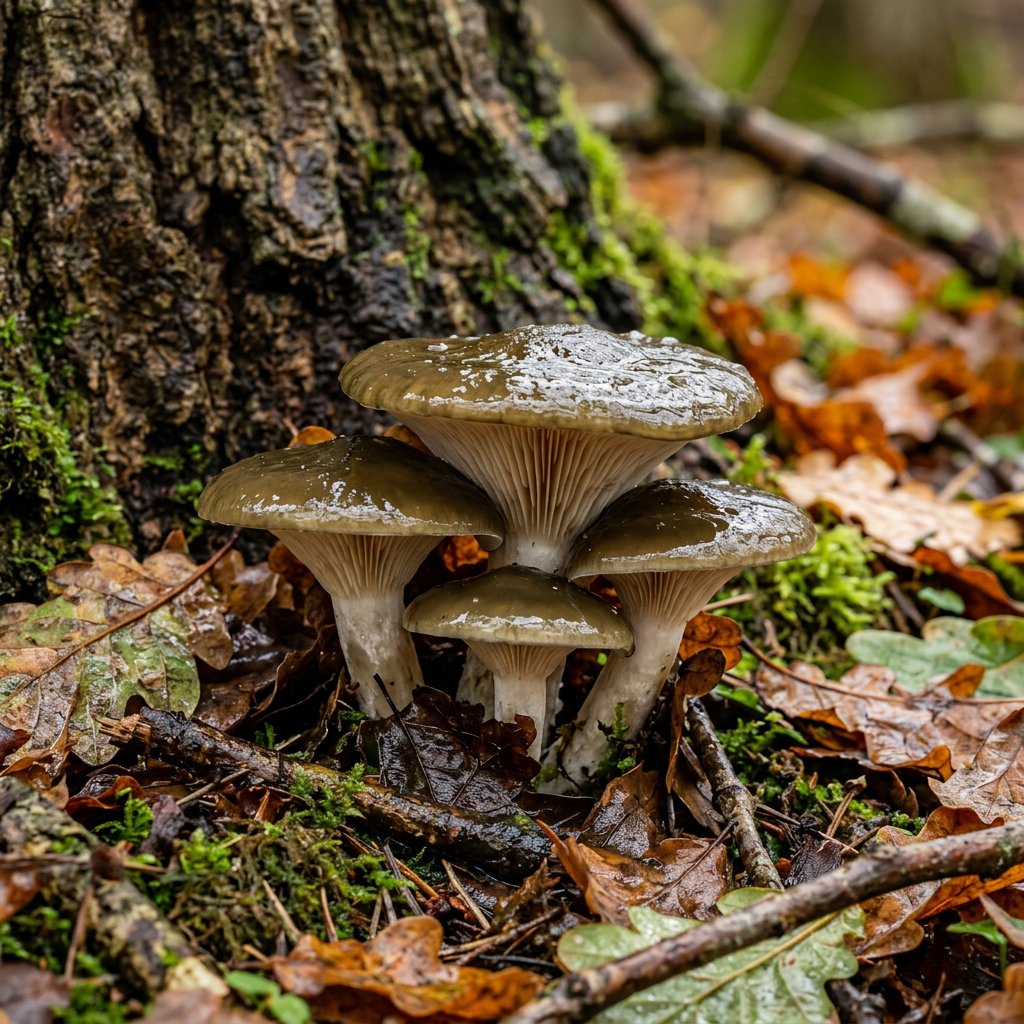
Often called Persoon’s Woodwax, this mushroom is a master of disguise in the autumn woods. Known for its strikingly slimy "olive-drab" coat and intricate "snakeskin" patterns on its stem, it is a favorite find for mycologists exploring ancient oak groves. It belongs to the Hygrophorus genus, a group famous for their thick, waxy gills that feel like soft candlelight to the touch.
🔍 How to Identify
- 🍄 The Cap: Usually 3–7 cm wide, it is deeply convex when young, flattening out with a slight central hump. The color ranges from olive-brown to a murky grey-brown, always coated in a thick, translucent layer of slime (viscid).
- 🕯️ The Gills: True to its "Woodwax" name, the gills are thick, distant from one another, and have a distinct waxy texture. They are typically white to creamy-white and slightly run down the stem (decurrent).
- 🐍 The Stem: The most unique feature; below a white "collar" at the top, the stem is covered in dark, olive-brown zig-zag scales or bands, giving it a texture reminiscent of a serpent’s skin.
🌲 Habitat & Ecology
- 🌳 The Oak Connection: This fungus is strictly mycorrhizal with broadleaf trees, specifically forming a symbiotic "soul-bond" with Oak trees. You will almost never find it far from an old Oak root system.
- 🍂 Late Season Performer: While many mushrooms vanish at the first sign of frost, Persoon’s Woodwax is a late-bloomer, often appearing in late autumn and persisting into early winter among the fallen leaf litter.
⚠️ Safety & Toxicity
- 🛑 WARNING: Never consume any wild mushroom unless identified by a certified expert. Many "little brown mushrooms" are deadly, and mistakes can be fatal.
- 🍽️ Edibility: Hygrophorus persoonii is generally considered edible, though it is rarely sought after for the table. The heavy slime layer makes it difficult to clean, and its flavor is considered mild and unremarkable.
- 🧪 Chemical Reaction: A key way to tell this apart from look-alikes is the "Ammonia Test." If a drop of ammonia is placed on the cap or stem base, it will typically turn a vivid emerald green or turquoise—a fascinating chemical "fingerprint."
✨ Fun Fact
This mushroom was named in honor of Christiaan Hendrik Persoon, a 19th-century botanist who is often called the "Father of Systematic Mycology." Before his work, the study of mushrooms was disorganized and chaotic; he was among the first to give them the scientific structure we use today!
More Details