Info
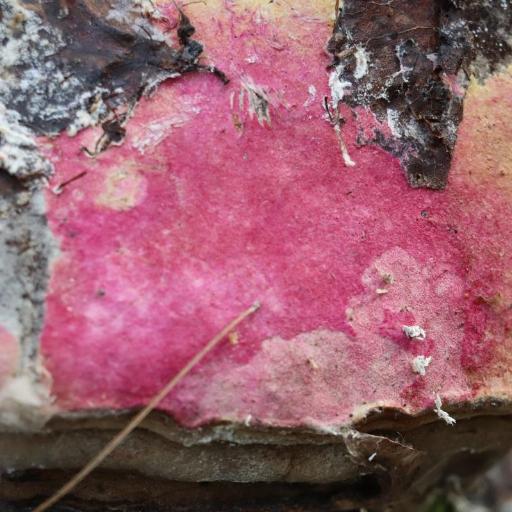
Often called the "Pink Mold" or "Rose-colored Hypomyces," this fungus is a master of disguise and a tiny predator of the forest floor. Instead of growing from the soil, Hypomyces rosellus is a parasite that cloaks other mushrooms in a velvet-like blanket, turning a mundane log into a splash of neon color. It is a fascinating example of nature’s "cannibalistic" side, where one fungus feeds entirely upon another.
🔍 How to Identify
- 🌸 Growth Form: It does not have a cap or stem. Instead, it appears as a fuzzy, rose-pink to reddish-purple "crust" or mat that spreads over its host.
- 🔍 Surface Texture: Upon close inspection, the pink mat is dotted with thousands of tiny, pimple-like bumps called perithecia, which are the spore-producing structures.
- 🕸️ The "Cobweb" Effect: In its early stages, it looks like a delicate, pale pink cobweb (a subiculum) before it thickens into a solid, vibrant carpet.
🌲 Habitat & Ecology
- 🪵 The Fungal Hunter: This is a parasitic fungus. You will only find it growing on the bodies of other fungi, specifically crust fungi (Stereum) and polypores found on decaying hardwood logs.
- 🍂 Seasonal Timing: It is most active in late summer and autumn. It thrives in high-humidity environments, especially in deep, shaded woodlands after a period of heavy rain.
⚠️ Safety & Toxicity
- 🛑 WARNING: Strictly inedible. Under no circumstances should this fungus be consumed.
- 🧪 Host Toxicity: Because Hypomyces rosellus grows on other mushrooms, it can absorb and concentrate toxins from its host. Consuming it means you are eating a "mystery cocktail" of two different fungal species, which is extremely dangerous for humans and pets.
- 🚫 Skin Sensitivity: While not typically caustic, handling "mold-like" fungi can trigger respiratory allergies in sensitive individuals due to spore release.
✨ Fun Fact
This fungus is a close cousin to the famous "Lobster Mushroom" (Hypomyces lactifluorum). While its cousin turns a bland mushroom into a gourmet orange delicacy, Hypomyces rosellus stays small and pink, proving that even in the fungal world, family members can have very different tastes!
More Details







