Info
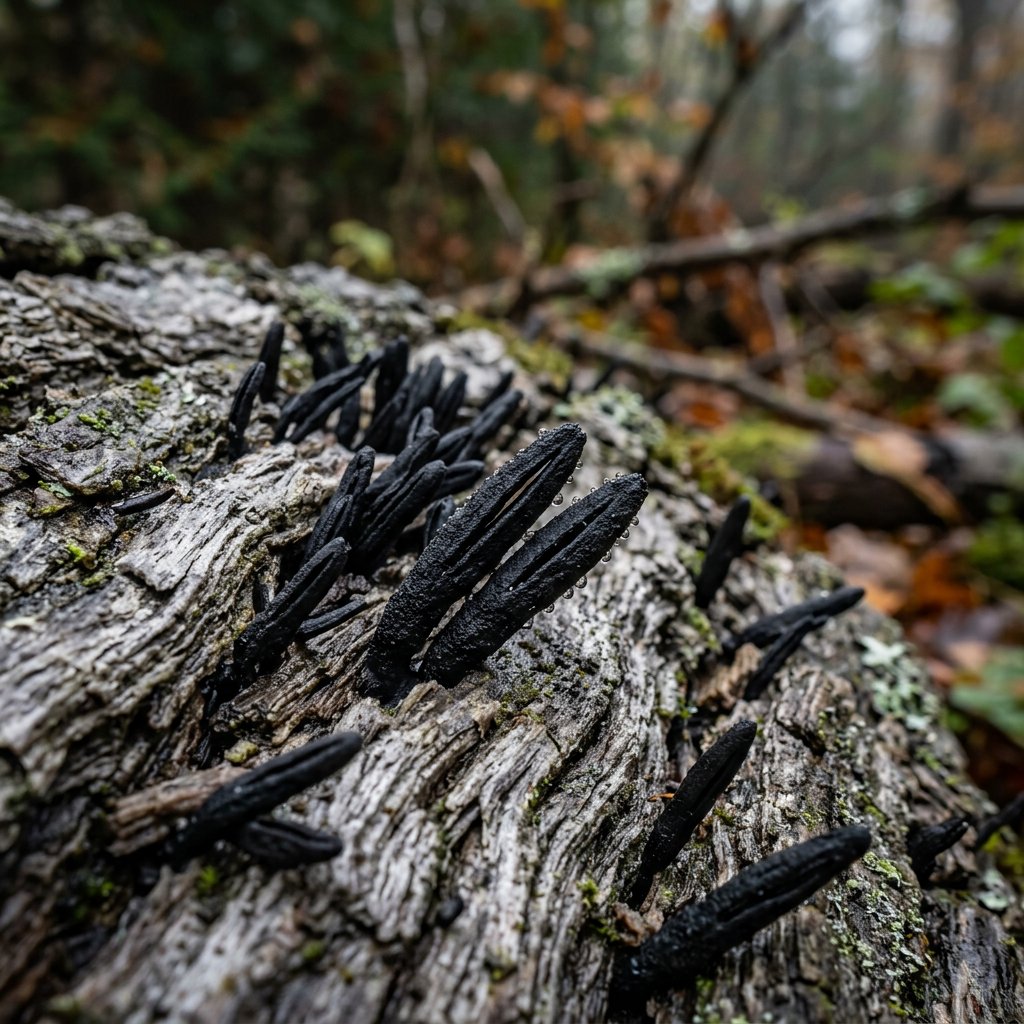
Often overlooked as mere "specks of soot" on a fallen branch, Hysterium angustatum is a fascinating member of the "carbon fungi" family. Known colloquially as "Carbon Lips" or "Elongate Hysterium," these tiny organisms look like miniature black coffee beans or microscopic mouths scattered across decaying wood. They are survivors, often appearing in the late autumn and winter when more colorful mushrooms have vanished.
🔍 How to Identify
- 👄 The Shape: These fungi form "hysterothecia," which are tiny, boat-shaped bodies that look like closed lips or grains of black rice.
- 🖋️ The Slit: A distinctive longitudinal furrow or slit runs down the center of each fruit body; this is where the spores are eventually released.
- 🖤 Color & Texture: They are deep matte black and have a hard, brittle, charcoal-like texture that feels gritty to the touch.
🌲 Habitat & Ecology
- 🪵 The Woodpile: You will almost always find them on dead, barkless wood. They are particularly fond of deciduous trees like Oak, Ash, and Beech, where they act as primary recyclers.
- 💧 Moisture Response: While they look dry and lifeless, they are actually quite dynamic. During wet weather, the central slit swells and opens slightly to allow spores to escape into the damp air.
⚠️ Safety & Toxicity
- 🚫 WARNING: Non-Edible. Hysterium angustatum is classified as inedible. Because of its tiny size and tough, woody consistency, it has no culinary value.
- 🧪 Chemical Profile: While not known to be "poisonous" in the sense of causing immediate organ failure, many carbon fungi contain compounds that are not fit for human digestion. They should be admired through a magnifying glass, not a fork.
✨ Fun Fact
These fungi are "hygroscopic" time-capsules; they can remain dormant and dried out for months, only "waking up" to breathe and release spores the moment a drop of rain hits their surface!
More Details







