Info
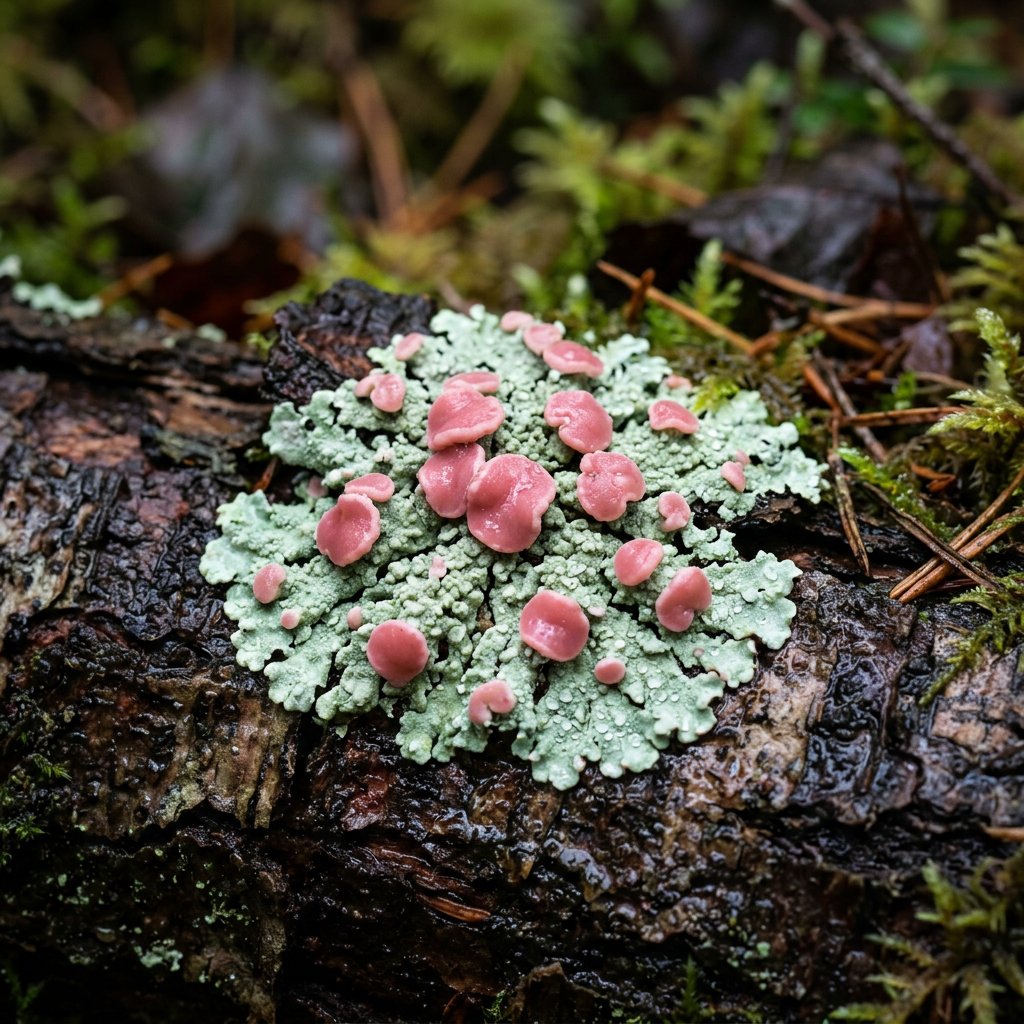
Commonly known by the whimsical—if slightly unappetizing—name "Fairy Puke," Icmadophila ericetorum is a crustose lichen that looks like it was pulled straight from a storybook. It is famous for its striking contrast of mint-green "crust" and tiny, bubblegum-pink fruiting bodies. Often found hugging damp, rotting logs or peaty soil, it acts as a colorful carpet in the cool, moist forests of the Northern Hemisphere.
🔍 How to Identify
- 🎨 The Thallus: The main body forms a thick, granular crust that ranges from a pale seafoam green to a greyish-white, often looking like a layer of spilled paint.
- 🍬 The Apothecia: Its most distinctive feature is the "fruiting disks," which look like tiny, stalkless pink mushrooms or flattened gumdrops scattered across the green surface.
- 🪵 Growth Pattern: It grows completely flat against its substrate (crustose) and lacks the leaf-like structures found in other common lichens.
🌲 Habitat & Ecology
- 🌧️ Moisture Lovers: You will almost always find this lichen in high-humidity environments, particularly on north-facing slopes, damp peat banks, or decaying coniferous wood.
- 🛡️ Soil Stabilizers: As a pioneer species, it plays a vital role in stabilizing bare, acidic soil and rotting wood, preventing erosion while slowly breaking down organic matter to create new soil.
⚠️ Safety & Toxicity
- 🚫 Non-Edible: While not famously "deadly" like some true mushrooms, Icmadophila ericetorum is not considered edible. Lichens often contain complex secondary metabolites (like icmadophilous acid) that can cause severe stomach upset if ingested.
- 🐾 Pets & Kids: Because of its bright, candy-like appearance, it may attract the curiosity of children. It is best to admire this lichen with your eyes only and keep pets from licking or chewing on the "pink buttons."
✨ Fun Fact
Despite its name "Fairy Puke," this lichen is actually a masterpiece of symbiotic architecture. It is a partnership between a fungus (the structure and pink disks) and an alga (the green color), where the alga provides food through photosynthesis while the fungus provides the home and protection!
More Details