Info
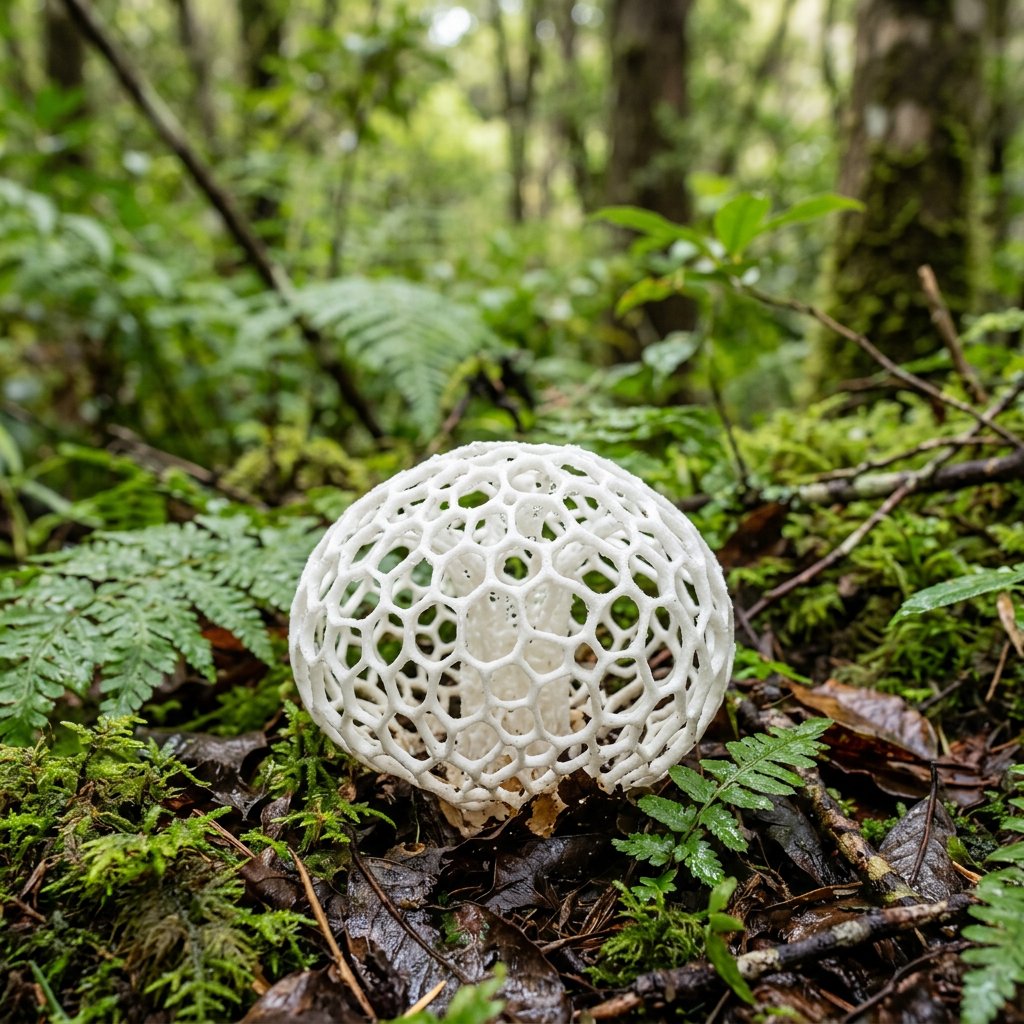
The Ileodictyon gracile, commonly known as the Smooth Cage Fungus, looks less like a mushroom and more like a discarded piece of futuristic architecture or a bleached, skeletal soccer ball. Appearing suddenly in gardens or mulch after rain, this "ghostly cage" has a habit of detaching from its base and rolling across the landscape like a fungal tumbleweed. While its geometric beauty is captivating, its scent is purposefully designed to mimic rotting meat.
🔍 How to Identify
- ⚪ The Cage: A white, hollow, lattice-like sphere composed of smooth, interconnected branches that form a "basket" shape.
- 🥚 The "Egg": Before the cage bursts out, it grows inside a leathery, white, gelatinous egg-like structure partially buried in the soil.
- 🪰 The Gleba: The inner surface of the cage is coated in a dark, olive-brown slime that emits a pungent, foul odor to attract flies.
- 💨 Smooth Texture: Unlike its close relatives, the arms of this species are perfectly smooth and rounded, lacking any wrinkles or "corrugated" textures.
🌲 Habitat & Ecology
- 🍂 Mulch Lover: You are most likely to find this fungus in suburban gardens, parks, or paths heavily treated with wood chips and organic mulch.
- 🌬️ The Tumbleweed: Once the cage fully expands, it often detaches from the "egg" base. This allows it to be blown by the wind, spreading its spores as it bounces across the ground.
- 🦟 Insect Interaction: The fungus relies entirely on flies and beetles to spread its spores. The insects are lured by the smell, eat the slime, and carry the spores elsewhere.
⚠️ Safety & Toxicity
- 🚫 Status: WARNING: While not listed as a deadly toxin, it is considered inedible.
- 🤢 Details: The smell alone is usually enough to deter anyone from a taste test. Consuming stinkhorns can cause severe stomach upset, and their gelatinous texture is highly unpalatable.
- 🐾 Pets & Kids: It is generally safe to have in a garden, as the smell keeps most pets away, though the "egg" stage may look curious to toddlers—always supervise them around wild fungi.
✨ Fun Fact
The Ileodictyon gracile is a master of "biological engineering"—the lattice structure is incredibly strong for its weight, allowing it to expand rapidly from its egg using nothing but internal water pressure (turgor) in just a few hours!
More Details