Info
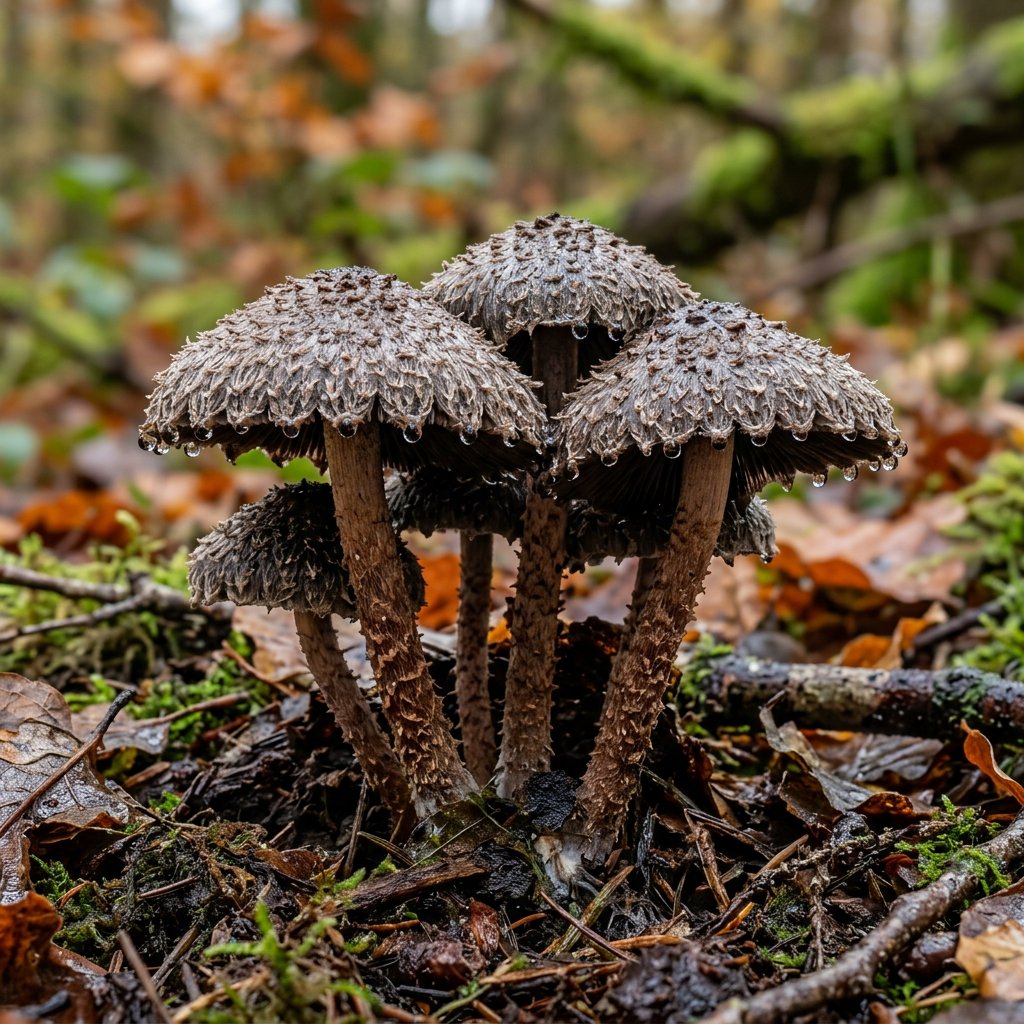
Known to many as the "Weeping Widow," this mushroom carries a name as dramatic as its appearance. It gets its melancholic nickname from the tiny, dark droplets of spore-filled liquid that often cling to the edges of its gills in humid weather, making it look as though it is crying. A common sight in gardens and along woodland paths, it is a master of disguise, often blending into the soil and dead leaves with its earthy, shaggy cap.
🔍 How to Identify
- 💧 The "Tears": The most distinct feature is the moisture on the gill edges. In damp conditions, these gills exude blackish droplets that dry into dark, soot-like spots.
- 🎩 Shaggy Cap: The cap is typically 3–10 cm wide, brownish-ochre, and covered in tiny, fibrous scales that give it a woolly or "hairy" texture, especially near the rim.
- 🌑 Mottled Gills: Underneath, the gills start out pale but quickly turn dark brown or black. Because the spores mature at different times, the gills often look patchy or "mottled" rather than a solid color.
- 🧣 The Veil: When young, a cobweb-like veil (cortina) connects the cap to the stem. As it grows, this veil breaks, leaving dark, shaggy remnants around the middle of the stem.
🌲 Habitat & Ecology
- 🏘️ Disturbed Ground: Unlike many forest-dwelling fungi, the Weeping Widow loves gardens, parklands, and the edges of gravel paths. It thrives where the soil has been turned or where wood chips have been buried.
- 🍂 The Decomposer: It is a saprobic mushroom, meaning it plays a vital role in the ecosystem by breaking down dead organic matter and returning nutrients to the soil.
- 🌱 Sociable Growth: You will rarely find a "Widow" alone; they usually sprout in small, dense clusters or scattered groups from late summer through autumn.
⚠️ Safety & Toxicity
- 🛑 WARNING: While some guidebooks list the Weeping Widow as edible, it is not recommended for consumption. Its bitter, earthy flavor is generally unpleasant, and it can be easily confused with several toxic "Little Brown Mushrooms" (LBMs).
- 🤢 Digestive Risk: Some individuals report mild stomach upset after eating this species. Because it looks so similar to poisonous members of the Inocybe or Psathyrella families, foraging it for the table is considered high-risk.
- 🐾 Pets & Kids: Keep a close eye on curious pets or toddlers in the garden; while not known to be deadly, ingesting raw wild mushrooms can cause significant distress.
✨ Fun Fact
The specific epithet lacrymabunda comes from the Latin word for "full of tears." If you want to confirm its identity, you can perform a "spore print" at home—the Weeping Widow will leave behind a beautiful, jet-black powdery starburst on a piece of white paper!
More Details