Info
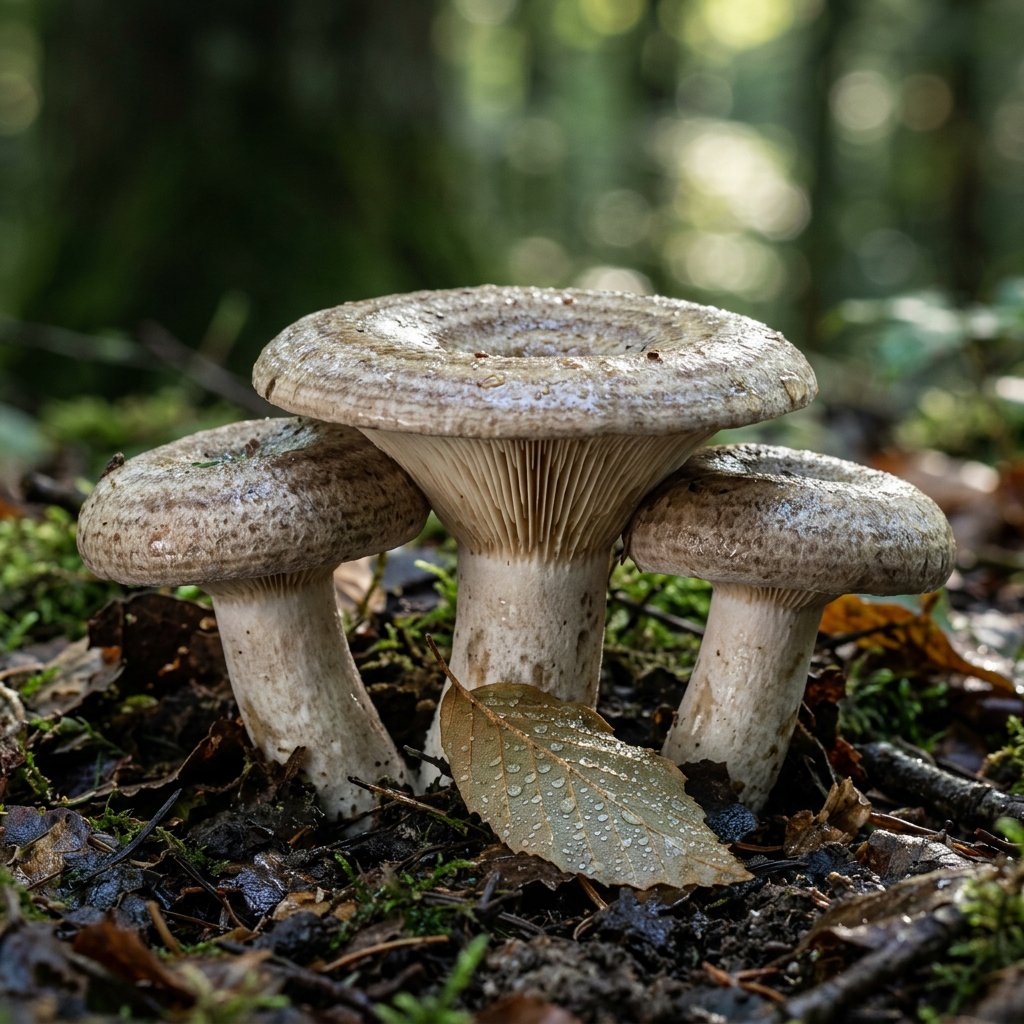
Known for the beautiful, target-like rings decorating its cap, Lactarius circellatus—often called the Hornbeam Milkcap—is a quintessential woodland find. It plays a vital role in the forest floor ecosystem, forming a secret underground partnership with specific hardwood trees. While its muted, lead-grey tones make it a master of camouflage among fallen leaves, its "bleeding" white latex reveals its true identity to the curious forager.
🔍 How to Identify
- 🌀 The Cap: Displays distinct concentric zones or "rings" of grey, hazel, and brownish-lilac. It usually starts convex and flattens out, often developing a slight depression in the center as it matures.
- 💧 The "Milk": When the gills are nicked, the mushroom exudes a white, creamy latex (milk). This liquid remains white but can dry into a pale yellowish hue on the flesh.
- 🎨 The Gills: The gills are crowded and range from a pale cream to a deep ochre-yellow. They are "decurrent," meaning they slightly run down the length of the stem.
🌲 Habitat & Ecology
- 🌳 The Hornbeam Connection: This mushroom is a "specialist." It is almost exclusively mycorrhizal with Hornbeam trees (Carpinus betulus). If you find a ringed grey milkcap in a purely pine or oak forest, it is likely a different species.
- 🍂 Seasonal Appearance: You will typically spot these emerging from the leaf litter in late summer through autumn, especially after heavy rains that "wake up" the underground mycelium.
⚠️ Safety & Toxicity
- 🚫 Status: WARNING! Inedible.
- 👅 The Acrid Test: While not considered deadly, Lactarius circellatus has an extremely acrid, peppery, and bitter taste. This chemical defense mechanism is a warning from nature; consuming it can lead to significant gastrointestinal upset, including nausea and stomach cramps. It is strictly for observing, not for the kitchen.
✨ Fun Fact
The specific epithet circellatus comes from the Latin word for "small circles." This refers to the "zonate" pattern on the cap, which looks like the ripples created when a pebble is dropped into a still pond.
More Details