Info
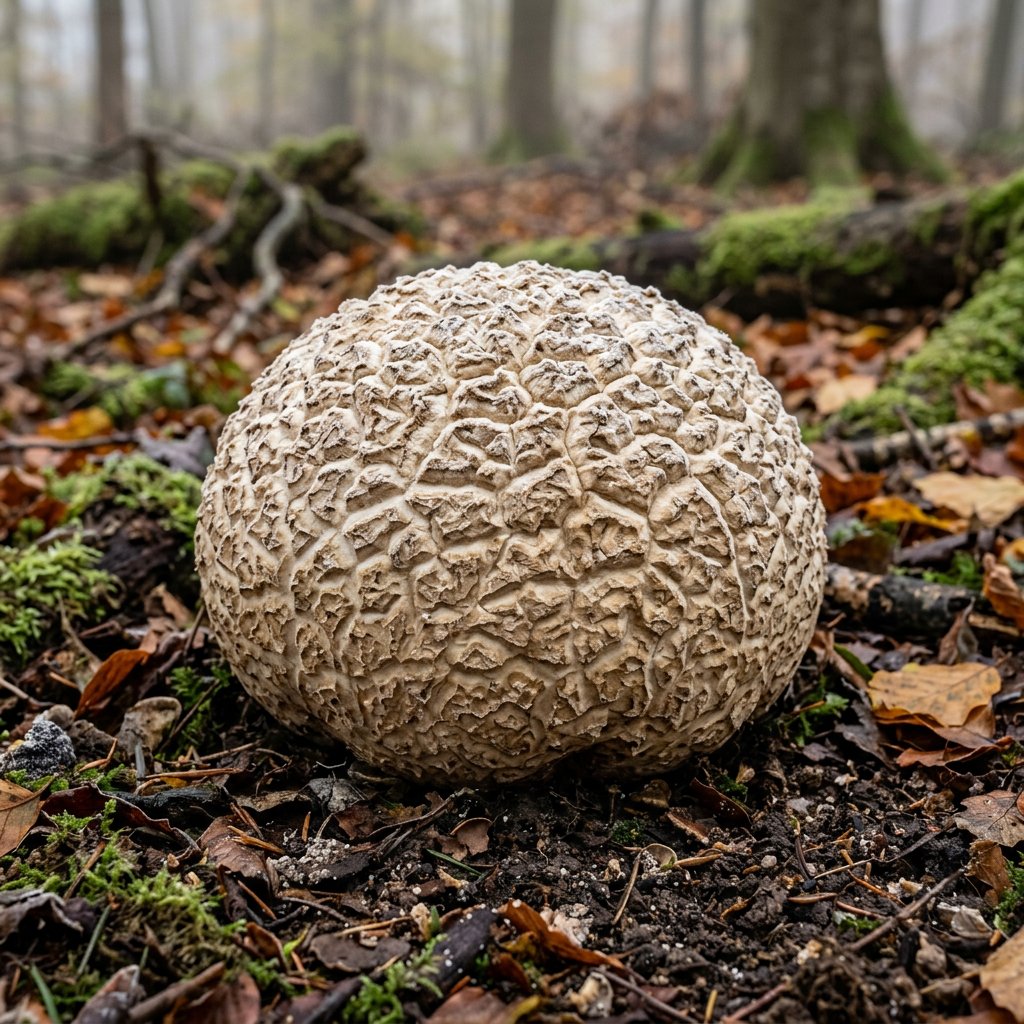
Commonly known as the "Giant Puffball," this mushroom often looks like a misplaced volleyball or a giant marshmallow resting in a meadow. Throughout history, these fungal giants were used by shepherds and travelers as natural bandages or tinder for fire-starting due to their absorbent and flammable interior. Finding one is often a magical experience, as they can grow to massive sizes almost overnight after a heavy autumn rain.
🔍 How to Identify
- ☁️ The Body: A large, round, or slightly flattened globe that lacks a distinct stem, gills, or a cap.
- ⚪ Color & Texture: The exterior is smooth and leathery, starting as a brilliant, snowy white and maturing into a dull yellowish-brown.
- 🔪 The Interior: When sliced vertically, the inside (the gleba) must be solid, firm, and pure white throughout, resembling the texture of a dense marshmallow or cream cheese.
🌲 Habitat & Ecology
- 🌿 Meadow Dwellers: These fungi are saprobic, meaning they break down organic matter. They are most commonly found in nutrient-rich grassy areas, old orchards, and damp meadows.
- ⭕ Fairy Rings: They often grow in large "fairy rings" or clusters, though it is not uncommon to find a single, massive specimen weighing over 20 pounds.
⚠️ Safety & Toxicity
- 🚨 WARNING: Only the pure white, immature stage is considered edible. Once the interior begins to turn yellow, green, or brown, the mushroom is producing spores and can cause severe digestive upset.
- 🍄 The Deadly Lookalike: Always slice the specimen open. If you see the faint "outline" of a developing mushroom (cap and gills) inside, you have found a deadly young Amanita (like the Destroying Angel) rather than a Puffball. Never consume if the interior is not perfectly uniform.
✨ Fun Fact
A single large Giant Puffball can contain several trillion spores. If every single spore from one mushroom successfully grew into a new Puffball, the resulting fungi would outweigh the mass of the entire Earth!
More Details