Info
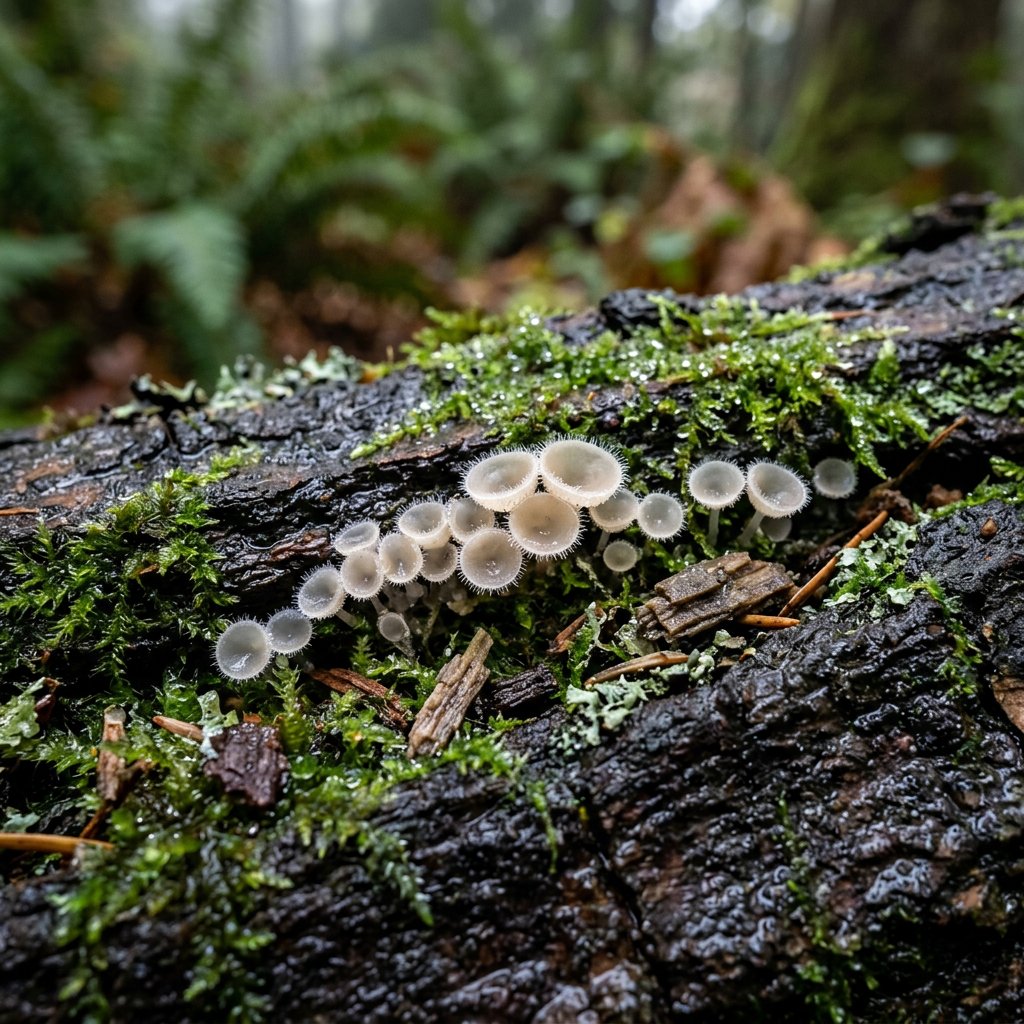
Often referred to as "Hairy Cup Fungi," the Lasiobelonium genus consists of tiny, velvet-like treasures hidden on the forest floor. These miniature cups look like something crafted for a woodland fairy’s tea party, often appearing as fuzzy white or tan dots on decaying wood. Because of their microscopic size, they are frequently overlooked, but they play a massive role in recycling the forest's nutrients.
🔍 How to Identify
- 🪶 The Hairy Exterior: The most striking feature is the dense covering of fine, stiff hairs (cilia) on the outside of the cup, giving it a woolly or "bearded" texture.
- 🥣 The Cup Shape: They form tiny, disc-like or bowl-shaped fruiting bodies (apothecia) that are rarely larger than 1–3 millimeters in diameter.
- 🎨 The Inner Surface: While the outside is fuzzy, the inner "bowl" is smooth and usually ranges in color from creamy white to pale yellow or tan.
🌲 Habitat & Ecology
- 🪵 Woodland Recyclers: These fungi are saprobic, meaning they live by breaking down dead organic matter. You will almost exclusively find them growing on damp, decaying twigs, bark, or the stalks of dead herbaceous plants.
- 💧 Moisture Seekers: They prefer the "micro-climate" of the forest floor—the damp, shaded areas beneath leaf litter where humidity remains high even when the sun is out.
⚠️ Safety & Toxicity
- 🚨 WARNING: Identification of small cup fungi requires expert knowledge and often a microscope. Never consume wild fungi.
- 🍽️ Edibility: Lasiobelonium is classified as inedible. Due to its microscopic size and tough, hairy consistency, it has no culinary value and its chemical properties are not well-studied for consumption.
- 🐾 Pets & Kids: While not known to be dangerously toxic, these fungi grow on decaying wood which may harbor other molds or bacteria; it is best to keep pets and children from "sampling" forest debris.
✨ Fun Fact
Under a microscope, the hairs on a Lasiobelonium are not just fuzz—they are often intricately shaped and can even be encrusted with tiny crystals of calcium oxalate, which help the fungus deter tiny insects from eating it!
More Details







