Info
Often called the "King of the Meadows," the Parasol Mushroom stands tall and elegant like a miniature Victorian umbrella. Its impressive height and scaly, textured cap make it a favorite for both foragers and nature photographers. In many European cultures, it is celebrated as a "giant" among fungi, appearing in folklore as a natural stool for woodland spirits.
🔍 How to Identify
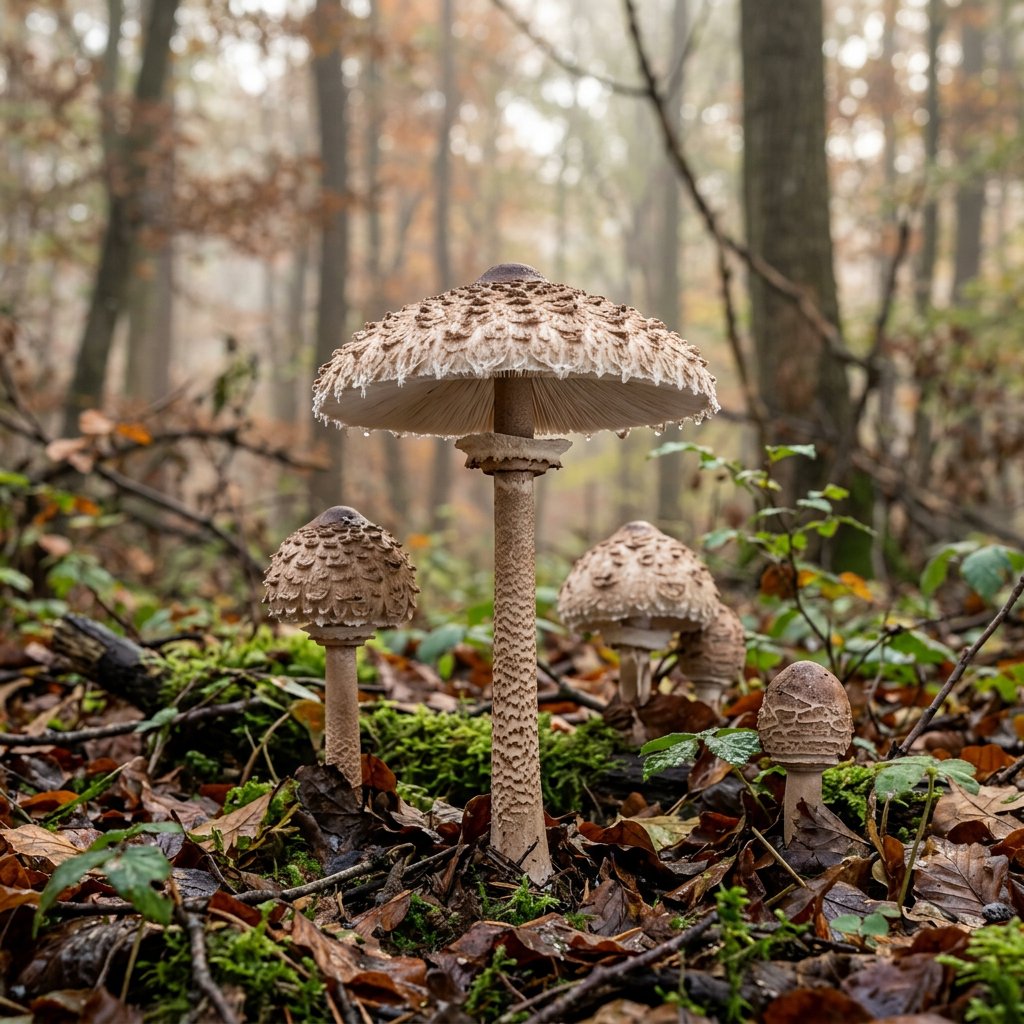
- 👒 The Cap: Starts out shaped like a rounded "drumstick" before flattening into a wide, scaly disc that can reach the size of a dinner plate, featuring a prominent dark bump (the umbo) at the center.
- 🦴 The Stem: Remarkably tall and slender, the stem is covered in a distinct "snakeskin" or zig-zag pattern of brownish scales over a cream-colored background.
- 💍 The Sliding Ring: It possesses a thick, double-edged ring that is unique because it can be slid up and down the stem like a hula hoop without breaking.
- ⚪ The Gills: The underside features crowded, soft white gills that stay white even as the mushroom ages and do not quite touch the stem.
🌲 Habitat & Ecology
- 🌿 Open Spaces: Unlike many mushrooms that hide in dense, dark woods, the Parasol thrives in sunny clearings, grassy pastures, and along the edges of forests where light filters through.
- 🍂 Nutrient Recycler: It is a saprobic species, meaning it performs the vital job of breaking down dead organic matter in the soil, often popping up in "fairy rings" after heavy summer or autumn rains.
⚠️ Safety & Toxicity
- 🚨 WARNING: While highly prized as an edible by experts, it has a dangerous "look-alike" called the False Parasol (Chlorophyllum molybdites). The False Parasol has a green spore print and causes severe vomiting and diarrhea.
- 🍄 The Size Rule: Never pick small mushrooms that look like the Parasol. Several small species in the Lepiota genus are scaly and similar in appearance but contain deadly amatoxins.
- 🐾 Pets: Raw wild mushrooms of any kind should be kept away from dogs and cats, as their digestive systems are much more sensitive to fungal fibers and compounds.
✨ Fun Fact
In many parts of Central Europe, the massive caps are breaded in flour and egg and fried whole like a steak, earning this mushroom the nickname "The Forest Schnitzel."
More Details