Info
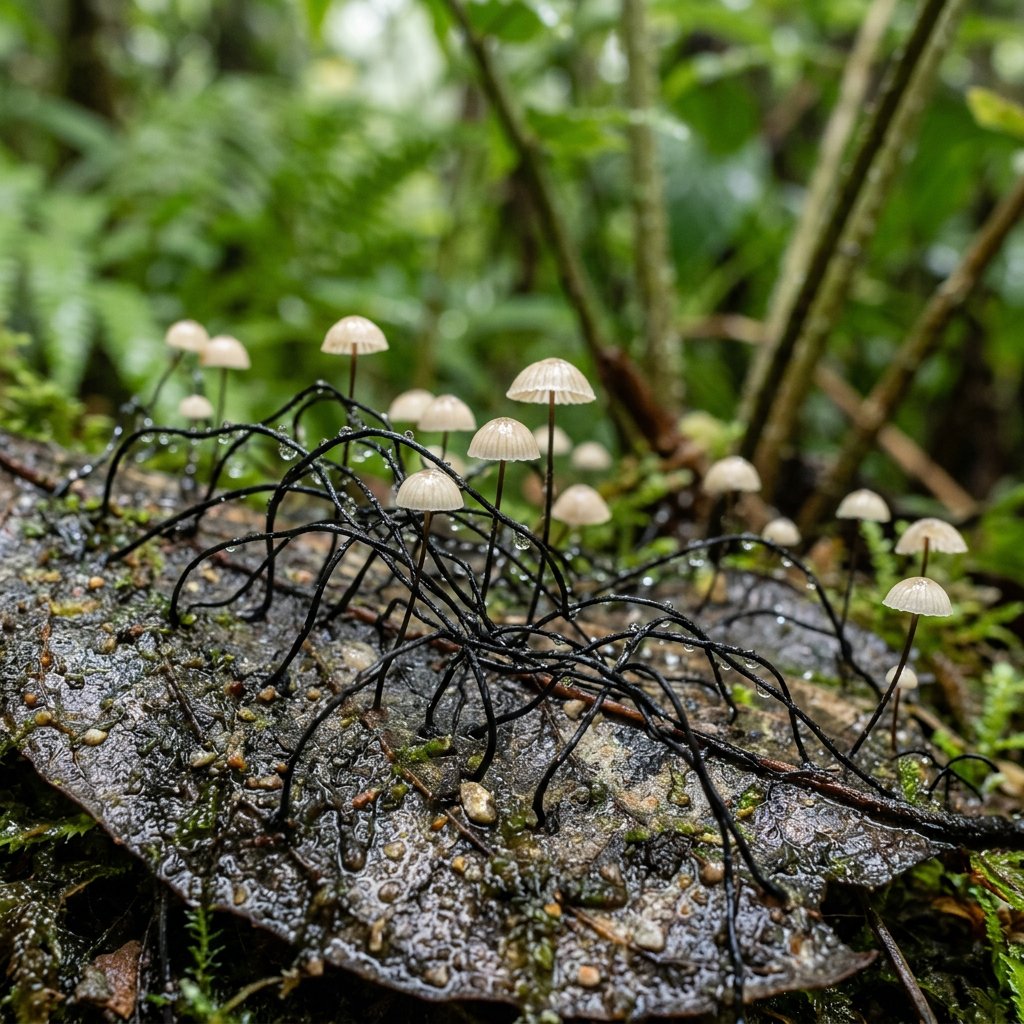
Commonly known as the Horsehair Fungus or Horsehair Blight, this peculiar organism looks less like a traditional mushroom and more like a tangled mess of black fishing line or coarse horse mane snagged on a branch. Found in humid forests and damp gardens, it acts like a miniature suspension bridge, catching falling leaves mid-air to consume them. It is a master of the "minimalist" look in the fungal kingdom, often leaving hikers wondering if they've stumbled upon a lost wig or a bird's nest.
🔍 How to Identify
- 🍄 The Cap: Extremely tiny (usually 2–5mm), parachute-shaped, and brownish-tan with distinct radial ridges or pleats.
- 🧶 The Stem (Rhizomorphs): Its most famous feature—long, tough, wiry, and shiny black "hairs" that can grow several inches long and weave through foliage.
- 🎋 The Gills: Very few and widely spaced, usually attached to a tiny "collar" that surrounds the stem rather than touching the stem directly.
🌲 Habitat & Ecology
- 🕸️ The Aerial Net: Unlike ground-dwelling mushrooms, this species is an aerial acrobat. It uses its wiry black strands to "trap" falling leaves before they hit the ground, allowing the fungus to decompose them in the humid air.
- 🌦️ Humid Specialist: It thrives in high-humidity environments, such as tropical rainforests or very damp, shaded corners of temperate gardens, typically growing on dead twigs and leaf litter.
⚠️ Safety & Toxicity
- 🚫 Status: WARNING! Not Edible.
- 🧶 Details: While there is no evidence that this fungus is deadly, it is considered "inedible" due to its microscopic size and tough, wire-like consistency. It has no culinary value and should not be consumed by humans or pets.
✨ Fun Fact
The black "hairs" are incredibly durable and rot-resistant. Because of this, many species of tropical birds specifically seek out Marasmius crinis-equi to use as a sturdy, moisture-proof lining for their nests!
More Details







