Info
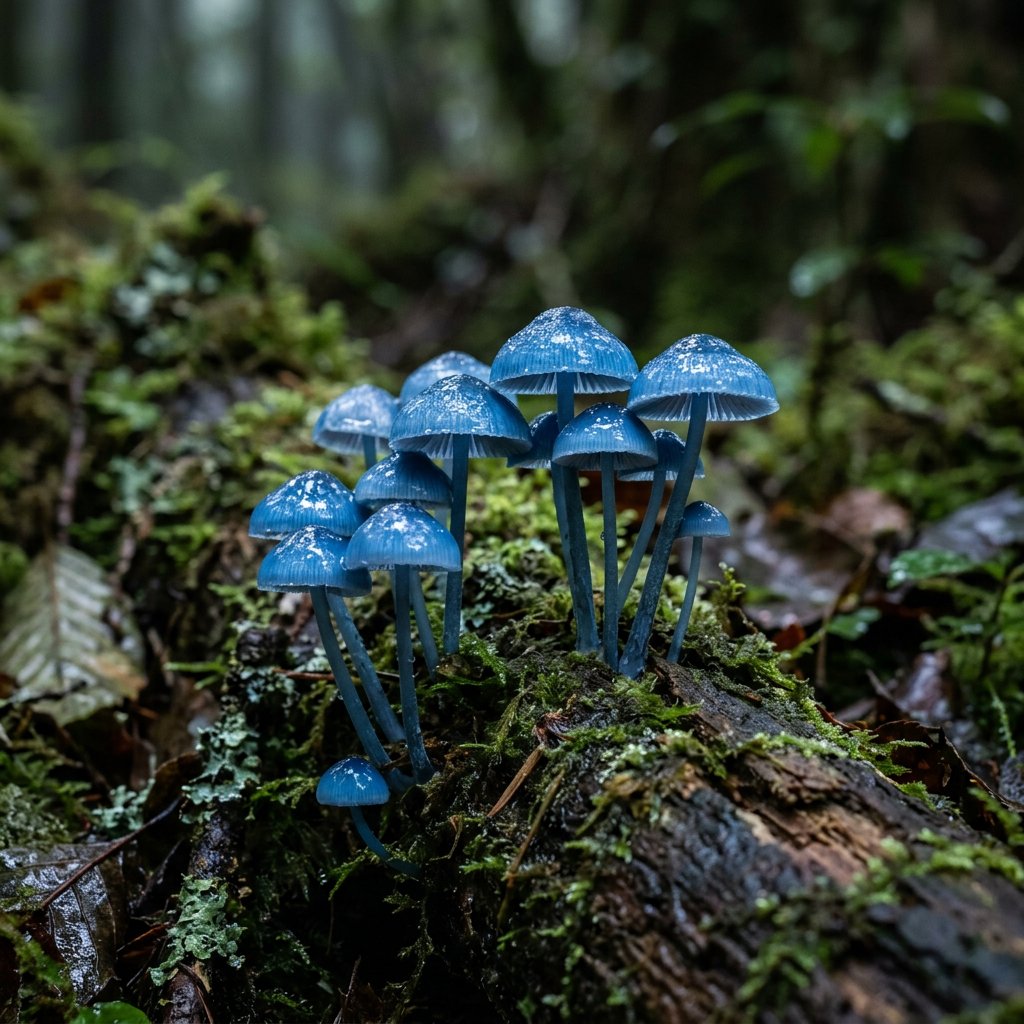
Imagine finding a tiny sapphire dropped onto the damp forest floor. Mycena lazulina, often called the "Azure Bonnet," is a miniature marvel that looks like something straight out of a Studio Ghibli film. Its name is derived from "Lapis Lazuli," the deep blue semi-precious stone, perfectly describing the intense, ethereal pigment of its tiny cap.
🔍 How to Identify
- 🔵 The Cap: Extremely small (usually 2 to 5 millimeters), bell-shaped, and a vibrant, saturated cobalt or azure blue. The color is most intense at the center and becomes slightly paler or more translucent toward the streaked edges.
- ❄️ Surface Texture: When young, the cap is often covered in a delicate, white "frosting" or fine powder (pruinose), which disappears as it matures.
- 🕯️ The Stem: A thin, almost hair-like stalk that is translucent and fragile. It often has a slight blue tint near the top and a small, disk-like base where it attaches to its home.
🌲 Habitat & Ecology
- 🎋 Specific Taste: This species is quite picky; it is most commonly found growing on fallen, decaying bamboo leaves or the rotting leaf litter of broadleaf evergreen trees.
- 🍄 The Decomposer: As a saprobic fungus, it plays a vital role in the ecosystem by breaking down tough organic matter (like silica-rich bamboo leaves) and returning nutrients to the soil.
⚠️ Safety & Toxicity
- 🚫 WARNING: This mushroom is considered Inedible.
- 🧪 Unknown Profile: While not specifically listed as deadly, many species in the Mycena genus contain muscarine or other undiagnosed toxins. Furthermore, its microscopic size makes it entirely impractical for food. It is best enjoyed through a macro lens rather than a fork.
✨ Fun Fact
The "blue" in the fungal world is incredibly rare. While most blue mushrooms (like the Indigo Milky Cap) use specific pigments, the Mycena lazulina is so small and vibrant that it is often used by nature photographers to test the "macro" capabilities of their cameras!
More Details







