Info
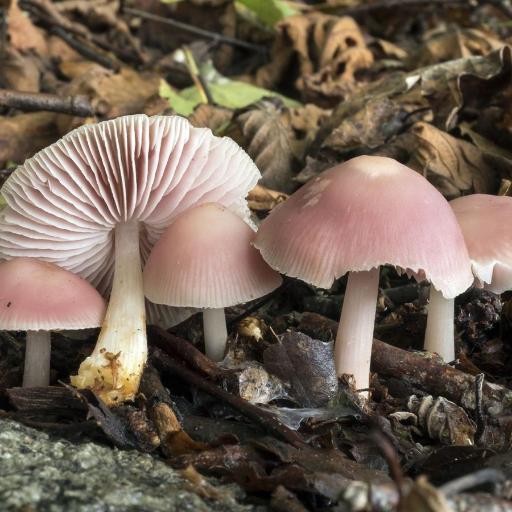
Commonly known as the Rosy Bonnet, this delicate woodland gem looks like something plucked straight from a fairytale illustration. Its soft, pastel-pink hues stand out vividly against the damp, earthy tones of the forest floor, making it a favorite find for nature photographers and hikers alike. Despite its dainty and "sweet" appearance, this mushroom is a deceptive beauty that carries a chemical warning for the unwary.
🔍 How to Identify
- 🌸 The Cap: Usually 2 to 6 cm wide, the cap starts as a bell shape before flattening out. It is characterized by a beautiful rosy-pink to pale lilac color, often with a slight bump (umbo) in the center.
- ⚪ The Gills: Underneath, the gills are broad and crowded. They are typically white or very pale pink and are narrowly attached to the stem.
- 🍦 The Stem: The stalk is relatively stout compared to other Mycena species. It is smooth, hollow, and usually white or tinged with the same pink as the cap.
- 👃 The Scent: If you gently crush a small piece of the cap, it releases a very distinct, sharp aroma that smells exactly like freshly sliced radishes.
🌲 Habitat & Ecology
- 🍂 Leaf Litter Lover: You will most likely spot the Rosy Bonnet in deciduous forests, particularly where Beech and Oak trees grow. It thrives by breaking down fallen leaves, playing a vital role in recycling nutrients back into the soil.
- 🍄 Social Growth: While they can grow alone, they are most often found in small, scattered groups or "troops" peeking through the leaf mulch during the damp months of autumn.
⚠️ Safety & Toxicity
- 🚫 WARNING: This mushroom is toxic and must not be eaten. It contains muscarine, a toxin that affects the central nervous system.
- 🤢 The Risks: Ingestion can lead to severe stomach cramps, nausea, blurred vision, and excessive sweating. Because of its bright, "candy-like" color, it is important to keep children and pets away from it during forest walks.
✨ Fun Fact
For a long time, mycologists thought the Rosy Bonnet was just a color variant of the Lilac Bonnet (Mycena pura). However, modern DNA "fingerprinting" has proven that Mycena rosea is a distinct species, proving that in the fungal world, looks aren't everything—genetics are!
More Details
| Hymenium Type | Lamella |
| Stipe Character | Bare Stipe |
| Spore Print Color | White |
| Mushroom Cap Shape | Conical Mushroom Cap |
| Hymenium Attachment | Adnate Hymenium Attachment |
| Mushroom Ecological Type | Saprobiont |