Info
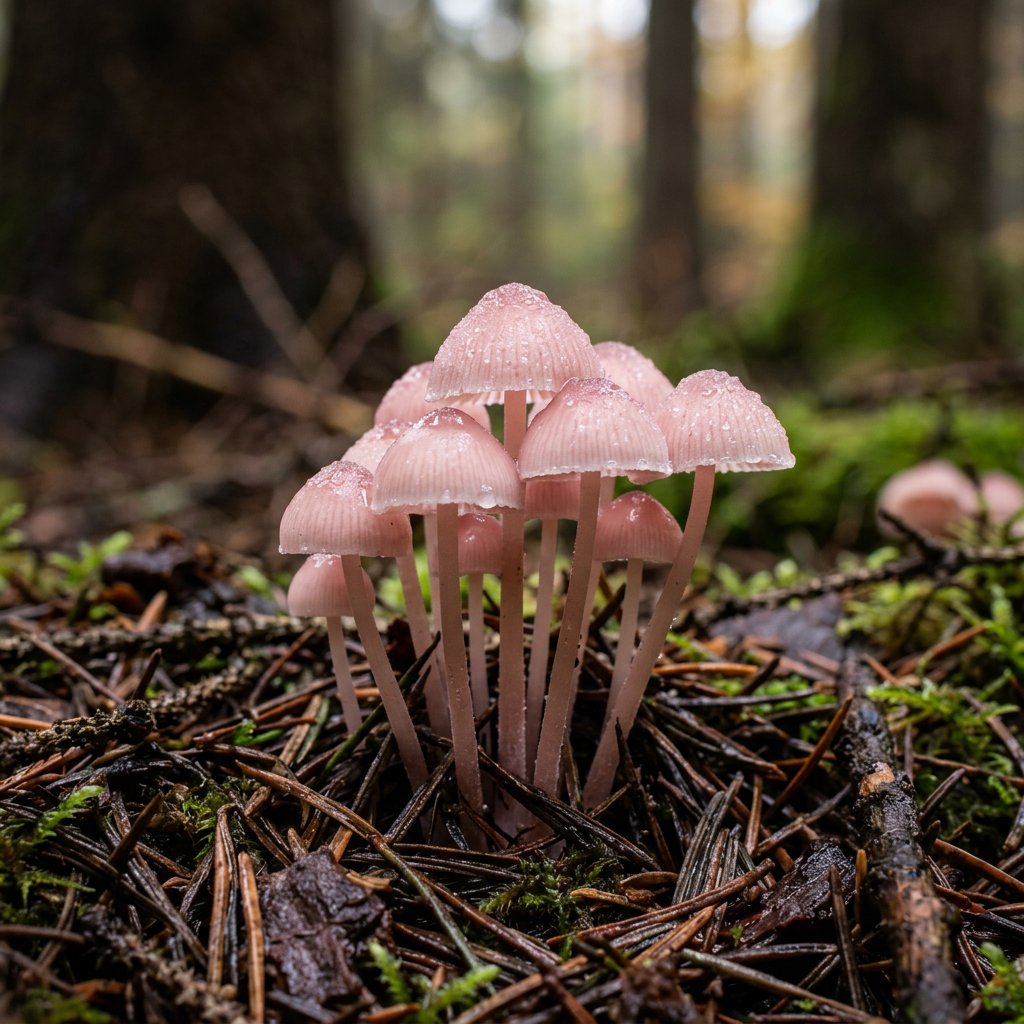
Known as the "Pink Bonnet," this delicate fungus looks like a tiny, rose-colored umbrella lost among the pine needles. It is one of the most vibrant members of the Mycena genus, painting the forest floor with splashes of soft pink and magenta. While small, its striking color makes it a favorite for nature photographers and forest foragers looking for a "jewel" in the mulch.
🔍 How to Identify
- 🌸 The Cap: Tiny and bell-shaped, usually measuring only 1 to 2 cm across. It features a stunning rose-pink hue that is darkest at the center and fades toward the edges, which are finely lined (striated).
- 💓 The Gills: Underneath the cap, the gills are a pale pink. A key identifying feature is the gill edge, which is often a darker, more vivid pink than the rest of the gill surface.
- 📏 The Stem: The stalk is incredibly slender, fragile, and hollow. It is typically smooth and matches the cap’s pinkish-white gradient, appearing almost translucent in bright light.
🌲 Habitat & Ecology
- 🍂 Litter Decomposer: This mushroom is a saprobic species, meaning it breaks down dead organic matter. It lives specifically on the fallen needles of coniferous trees like Pine, Spruce, and Fir.
- 👯 Strength in Numbers: You will rarely find a Pink Bonnet standing alone. They typically appear in scattered groups or large "troops," popping up after heavy rains in late summer and throughout the autumn months.
⚠️ Safety & Toxicity
- 🚫 WARNING: The Pink Bonnet is strictly Inedible. While it does not carry the same "deadly" reputation as some other forest fungi, it is too small to have culinary value and may contain trace toxins.
- 🐾 Pet Safety: Because it grows on the ground where pets roam, it is best to keep dogs away. Ingestion can lead to gastrointestinal upset or mild neurological symptoms in small animals.
- 🧼 Handling: While touching the mushroom is generally safe, it is extremely fragile and will bruise or break easily. Always wash your hands after handling any wild fungi.
✨ Fun Fact
In the world of mycology, the Pink Bonnet is considered a "littoral" specialist. Because it decomposes pine needles so efficiently, it plays a vital role in recycling nutrients back into the acidic soil of evergreen forests, essentially "cleaning" the forest floor to make room for new growth.
More Details
| Hymenium Type | Lamella |
| Stipe Character | Bare Stipe |
| Spore Print Color | White |
| Mushroom Cap Shape | Conical Mushroom Cap |
| Hymenium Attachment | Adnate Hymenium Attachment |
| Mushroom Ecological Type | Saprobiont |