Info
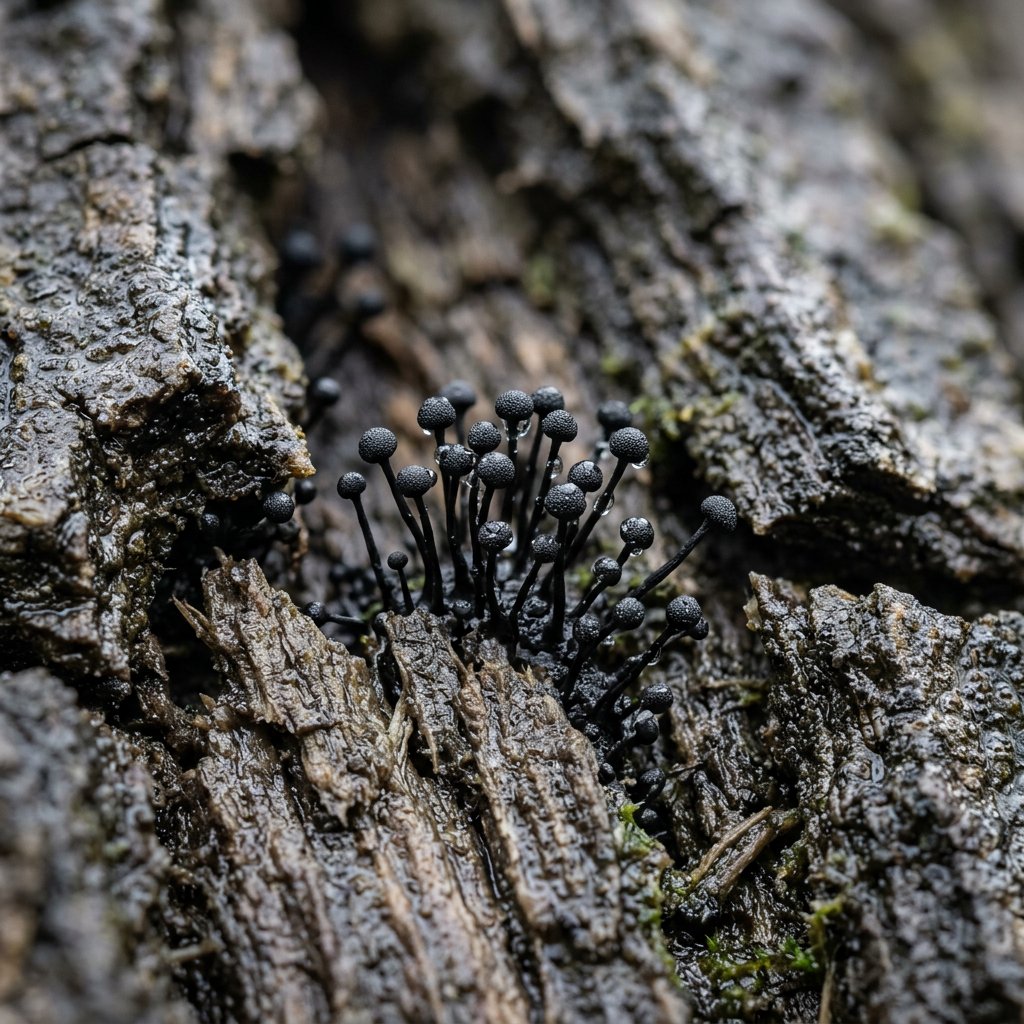
Meet the Slender Stubble Lichen, a hidden gem of the forest floor that looks like a miniature world of tiny black sewing pins. Despite its common name, it is actually a non-lichenized fungus, meaning it doesn't partner with algae like "true" lichens do. Instead, it lives a quiet life as a specialist, reclaiming the energy from ancient, weathered wood.
🔍 How to Identify
- 📍 The Stalked Head: It appears as a tiny, erect black stalk (stipe) topped with a small, rounded or cup-shaped head (apothecium).
- ⚫ Uniform Color: The entire structure is matte black or dark brown, standing barely 0.5 to 1.5 millimeters tall—often requiring a magnifying glass to see clearly.
- 🔬 Slim Profile: Unlike some of its "stubble" cousins, this species is exceptionally slender and lacks a "bloom" (pruina) on the head, giving it a clean, dark silhouette.
🌲 Habitat & Ecology
- 🪵 The Wood Whisperer: You will almost always find it on firm, decorticated (barkless) wood. It prefers the dry, weathered snags of conifers like pine or hemlock, but occasionally settles on hardwoods.
- ♻️ A Saprobic Lifestyle: It plays a vital role in forest ecosystems by breaking down complex lignins in dead wood, helping turn old trees back into nutrient-rich soil over decades.
⚠️ Safety & Toxicity
- 🚨 WARNING: While not considered "poisonous" in the sense of causing immediate harm upon touch, Mycocalicium subtile is NOT edible.
- 🚫 No Nutritional Value: Because of its microscopic size and tough, carbonaceous structure, it is of no culinary interest. As with all forest fungi, never consume anything unless you are 100% certain of its identity and safety.
✨ Fun Fact
Even though it is technically a fungus and not a lichen, it is almost exclusively studied by lichenologists. Because it looks so much like "true" pin-lichens (Caliciales), it is often treated as an "honorary lichen" in scientific textbooks!
More Details







