Info
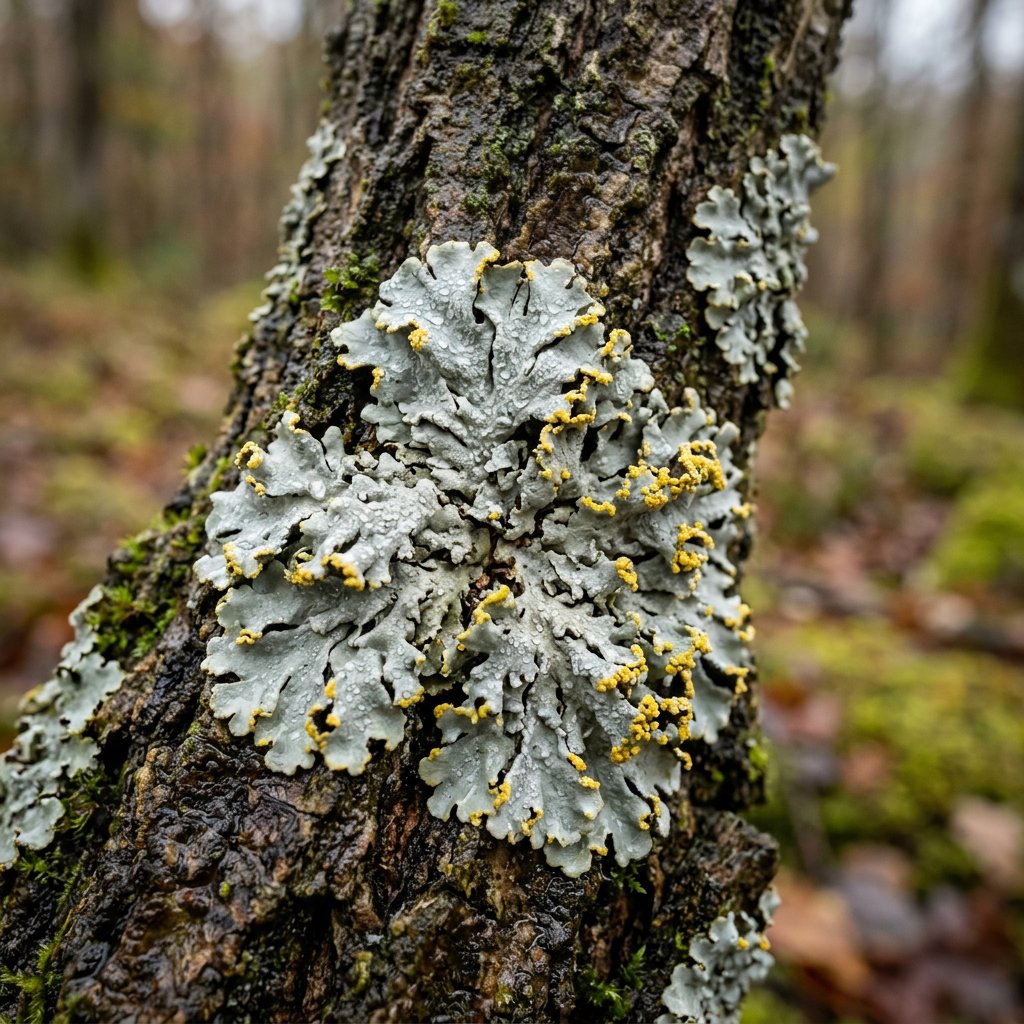
Known as the Powdery Medullary Lichen, Myelochroa aurulenta is a subtle but stunning "beard" often found hugging the bark of ancient hardwood trees. While it doesn't have the traditional cap-and-stem look of a mushroom, it is a complex symbiotic partnership where a fungus provides the structure and an alga provides the food. In many cultures, these types of lichens are viewed as "nature’s lungs," as they are highly sensitive to the quality of the air we breathe.
🔍 How to Identify
- 🎨 The Upper Surface: It features a leaf-like (foliose) body that is typically a pale mineral-grey or seafoam green, often appearing slightly wrinkled or textured.
- 🟡 The "Golden" Secret: If you gently scratch the top layer, you’ll reveal a bright yellow or orange-yellow "medulla" (inner tissue). This hidden splash of color is its most distinctive giveaway.
- ❄️ Powdery Patches: You will notice small, granular, or powdery-looking spots called soredia. These are essentially tiny "starter kits" the lichen sends out to grow new colonies elsewhere.
🌲 Habitat & Ecology
- 🌳 Bark Dweller: This species primarily anchors itself to the bark of deciduous trees, such as Oaks, Maples, and Hickories. It prefers the stable, textured surface of mature trees in temperate forests.
- 🌬️ Air Quality Indicator: Like many lichens, Myelochroa aurulenta is a bio-indicator. It struggles to survive in areas with high sulfur dioxide pollution, so seeing it in your woods is a sign of clean, healthy air.
⚠️ Safety & Toxicity
- 🚫 WARNING: While not categorized as a "deadly" fungus, this is not edible. Lichens are generally indigestible for humans and can contain acids that cause stomach upset.
- 🧪 Bio-Accumulator: Lichens act like sponges for the atmosphere. They can concentrate heavy metals and pollutants from the air, making them toxic if ingested or handled excessively in urban areas.
✨ Fun Fact
[The name aurulenta translates to "golden," referring to that hidden yellow interior. Scientists use specific chemicals, like potassium hydroxide, to turn that yellow layer deep red in a "color test" to confirm its identity under the microscope!]
More Details