Info
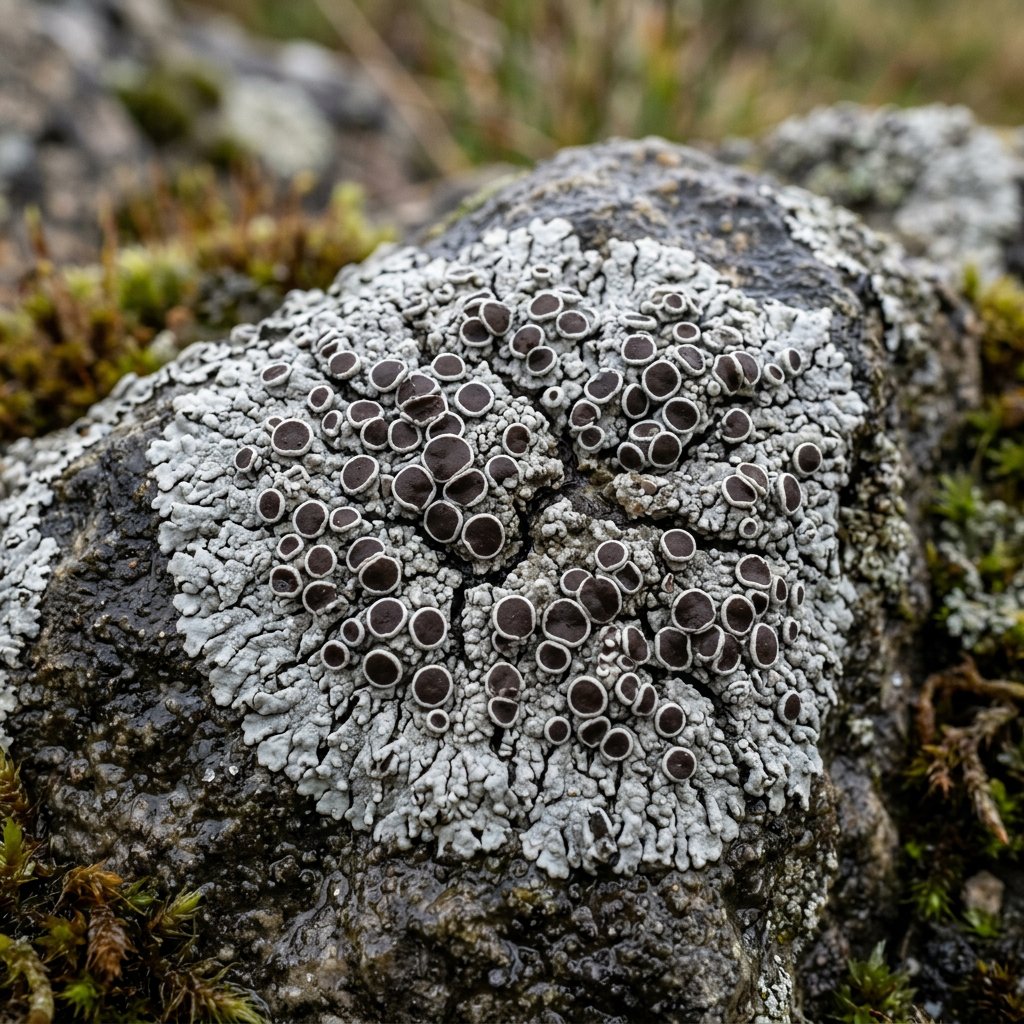
Known as the Scattered Rim-lichen, Myriolecis dispersa is the ultimate urban survivor of the fungi kingdom. While many lichens flee the city in search of pristine air, this resilient species thrives on the very concrete and mortar that defines our modern landscape. It often goes unnoticed, appearing as tiny, waxy "donuts" scattered across old brick walls, gravestones, and pavements.
🔍 How to Identify
- 🥣 The Apothecia: Look for tiny, disc-shaped fruiting bodies that rarely exceed 1mm in diameter. These look like miniature pale cups or saucers.
- ⚪ The Rims: Each disc is surrounded by a prominent, thick, white or greyish "rim" that gives the species its common name.
- 🌫️ The Body: The main body (thallus) is often "endolithic," meaning it lives hidden inside the tiny pores of the stone itself. This makes the fruiting cups look like they are floating or "scattered" across the surface without any visible leaves or stems.
🌲 Habitat & Ecology
- 🏙️ Concrete Jungle: Unlike forest-dwelling species, this lichen loves calcareous substrates. You will most likely find it on man-made structures like cement, mortar, brick, and limestone monuments.
- 💨 Pollution Pioneer: It is remarkably tolerant of nitrogen and urban air pollution. Its presence on a city wall is a testament to its ability to filter nutrients from dust and rainwater where other life forms would perish.
⚠️ Safety & Toxicity
- 🛑 WARNING: While not categorized as "poisonous" in the traditional sense, Myriolecis dispersa is strictly inedible.
- ☢️ Pollution Sponges: Because lichens absorb everything from the atmosphere, urban specimens often contain high concentrations of heavy metals and pollutants from car exhaust and industrial runoff.
- 🐾 General Safety: It is safe to touch and poses no threat to curious pets or children playing near garden walls.
✨ Fun Fact
- 🤝 The Ultimate Partnership: Lichens are not a single organism! They are a "stable marriage" between a fungus and an alga. The fungus (the Myriolecis) provides the sturdy housing, while the alga lives inside, performing photosynthesis to provide sugar for the pair. In this specific species, the partnership is so efficient it can survive on a bare concrete slab for decades!
More Details







