Info
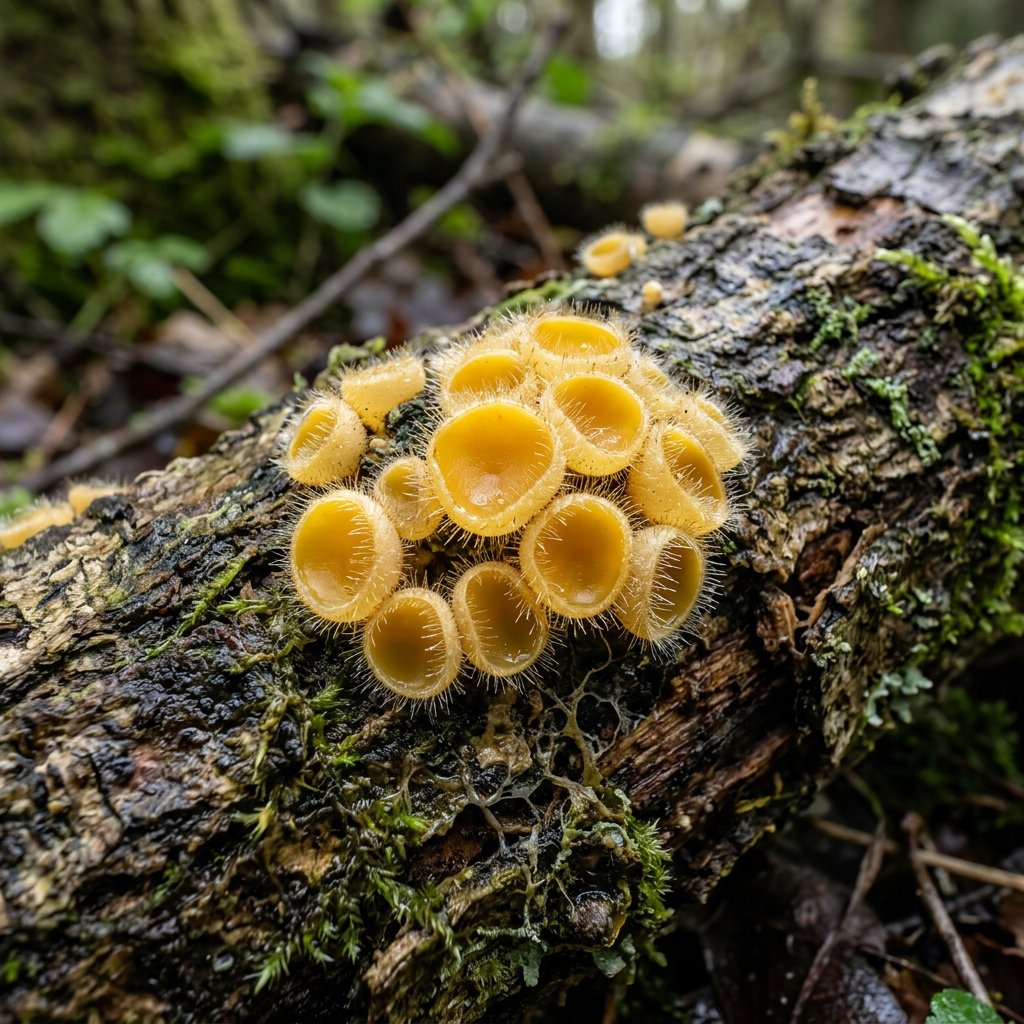
Often overlooked because of its miniature scale, Neodasyscypha cerina is like a tiny, gilded chalice hidden in the shadows of the forest floor. These "Fringed Cups" appear as brilliant yellow specks on decaying wood, looking like something out of a miniature fairytale banquet. While it lacks a grand history in folklore, its sudden appearance after rain makes it a treasure for macro photographers and those who enjoy exploring the "micro-wilderness" beneath their feet.
🔍 How to Identify
- 🍄 The Cup: It grows as a tiny, disc-like or shallow cup-shaped body (apothecia), usually measuring only 1 to 3 millimeters in diameter.
- 🎨 Inner Surface: The "face" or inner bowl of the cup is smooth and ranges from a pale waxy yellow to a deep, vibrant orange-yellow.
- 🧥 The Fuzzy Coat: The outer surface and the rim are covered in fine, short, brownish or tan-colored hairs, which give the mushroom a distinct velvety or "fringed" texture.
- 🪵 The Base: It usually lacks a visible stem (sessile) or has a very short, stout base that attaches it firmly to the wood.
🌲 Habitat & Ecology
- 🍂 Woodland Recycler: This fungus is saprobic, meaning it feeds on dead organic matter. You will find it almost exclusively on the barkless, decaying wood of deciduous trees like Oak, Beech, and Willow.
- 💧 Moisture Seeker: It thrives in damp, shaded environments. Look for it on the undersides of fallen branches or inside hollow logs where the humidity remains high even when the sun is out.
⚠️ Safety & Toxicity
- 🚫 WARNING: Do not consume. While Neodasyscypha cerina is not explicitly listed as a "deadly" species, its microscopic size makes it entirely irrelevant for culinary use.
- 🧪 Unknown Profile: Many small cup fungi have not been thoroughly tested for chemical toxins. As a general rule in mycology, "LBMs" (Little Brown Mushrooms) and "Little Yellow Cups" should be treated as inedible to avoid potential digestive distress.
- 🐾 Pet Safety: Because they grow on rotting wood at ground level, keep an eye on curious pets who might sniff or lick the wood, though the fungus itself is generally not considered an attractant.
✨ Fun Fact
Under a high-powered microscope, the hairs on the edge of this mushroom are revealed to be encrusted with tiny, sparkling crystals of calcium oxalate! These crystals are thought to help the fungus retain moisture or perhaps deter tiny insects from grazing on its reproductive surface.
More Details