Info
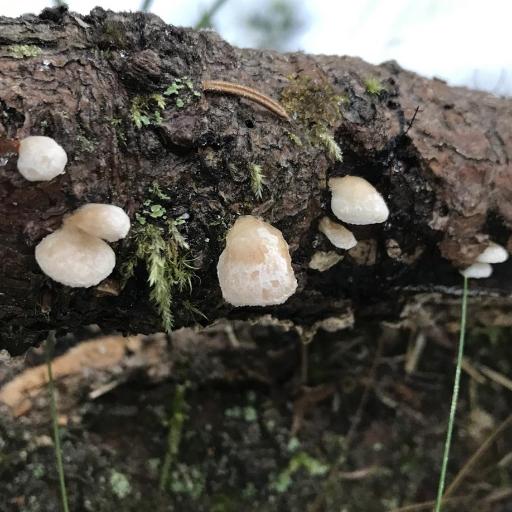
Often found huddling together on fallen pine needles and conifer branches, the Soft Slipper looks like tiny, ghostly fans lost in the woods. Unlike the grand Oyster mushrooms found in gourmet kitchens, these little "slippers" are tough survivors of the winter cold. They are prized by nature observers not for the plate, but for their delicate beauty and their ability to decorate the forest floor when most other fungi have gone dormant.
🔍 How to Identify
- ☁️ The Cap: Small (1–3 cm wide), kidney-shaped or shell-like. It is typically white to pale ivory, with a smooth, slightly waxy surface that can feel tacky when damp.
- 📏 Side-Stalk: It lacks a traditional central stem. Instead, it attaches to wood via a very short, lateral stalk that is usually fuzzy or "tomentose" at the base.
- 🎞️ Elastic Skin: One of its most unique traits is a thin, rubbery pellicle (skin) on the cap that can be peeled away. This elasticity helps the mushroom withstand freezing temperatures.
🌲 Habitat & Ecology
- ❄️ Winter Specialist: While most mushrooms disappear when the frost hits, the Soft Slipper thrives in the cold. It is most commonly spotted from late autumn through mid-winter, providing a splash of white against dark, damp bark.
- 🌲 Conifer Specialist: This species is a saprobe, meaning it breaks down dead organic matter. You will almost exclusively find it growing in overlapping clusters on the fallen twigs and branches of coniferous trees, especially Pine, Spruce, and Larch.
⚠️ Safety & Toxicity
- 🛑 WARNING: Never consume a wild mushroom unless you have had it identified in person by a professional mycologist.
- 🚫 Status: The Soft Slipper is considered inedible. While it is not known to be "deadly" like some of its forest neighbors, its flesh is extremely tough, rubbery, and lacks any culinary value or pleasant flavor.
- 🐾 Pets & Kids: Because of its small size and rubbery texture, it is not a high-risk for accidental ingestion, but it should still be kept out of reach of curious pets to avoid digestive distress.
✨ Fun Fact
The specific epithet mitis translates from Latin to "mild" or "soft." This is a bit of a mycological irony—while it looks soft and delicate, the mushroom is structurally reinforced with "skeletal hyphae," making it tough enough to freeze solid and thaw out without losing its shape!
More Details