Info
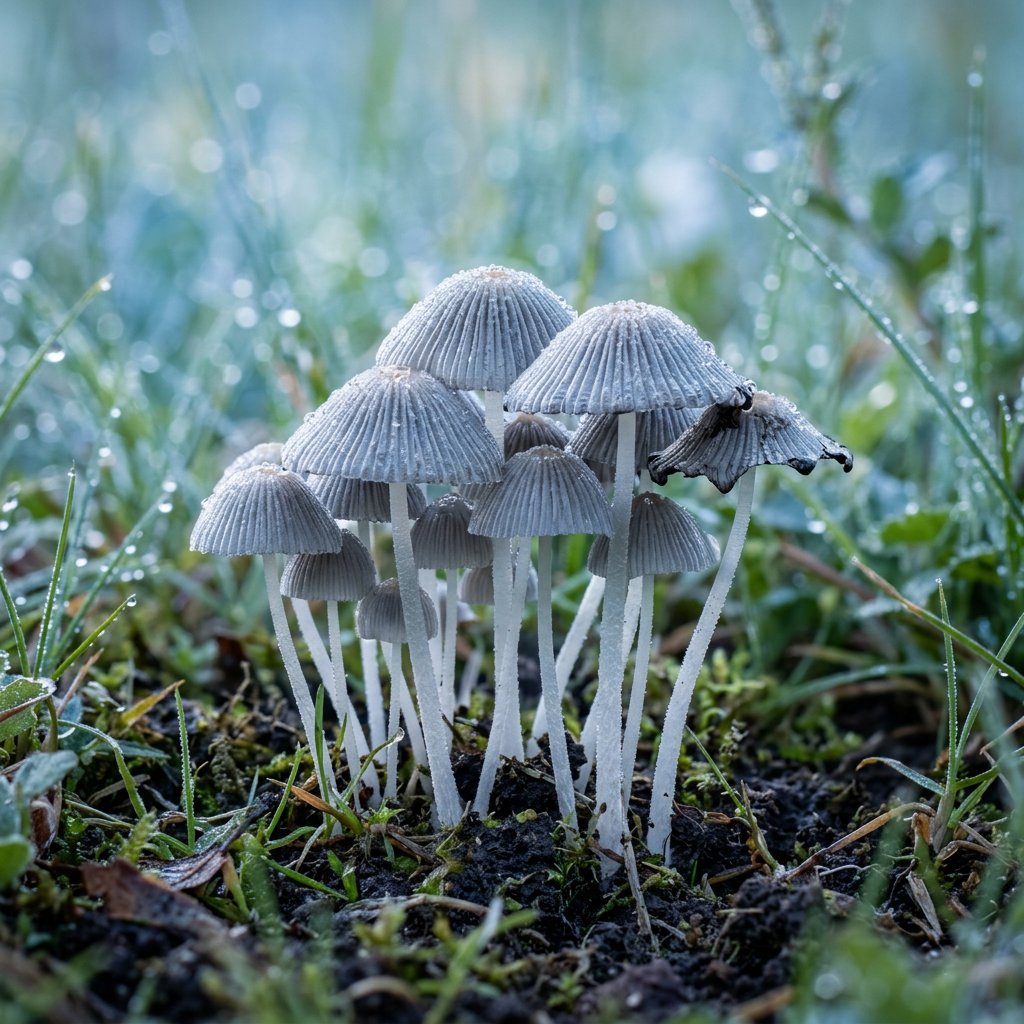
Often called the "Japanese Parasol" or "Pleated Inkcap," this delicate fungus is a master of the "here today, gone tomorrow" lifestyle. Looking like a tiny, silver-grey umbrella abandoned in the grass, it typically emerges overnight after a refreshing rain. By the time the midday sun hits its peak, this fragile beauty has usually shrivelled away into nothingness.
🔍 How to Identify
- ⛱️ The Cap: Measuring only 1–2 cm, the cap is deeply pleated (like a folded fan) with a distinct brownish-orange "button" at the very center.
- 🖤 The Gills: Underneath, the gills are thin and grey, eventually turning black as the spores mature, though they do not dissolve into "ink" as dramatically as other inkcaps.
- ❄️ The Stem: The stalk is incredibly thin, translucent white, and very brittle—it will often snap at the slightest touch or gust of wind.
🌲 Habitat & Ecology
- 🏡 Lawn Dweller: This is one of the most common mushrooms found in residential gardens, parks, and golf courses, specifically favoring well-manicured, nutrient-rich soil.
- ⏳ Ephemeral Life: It is a saprobic species, meaning it breaks down dead organic matter in the soil. Its entire visible life cycle—from "pop-up" to "collapse"—often lasts less than 24 hours.
⚠️ Safety & Toxicity
- 🛑 WARNING: While the Japanese Parasol is not documented as being deadly poisonous, it is universally classified as inedible.
- 🚫 Risk Factor: Because it is so tiny and fragile, it has no culinary value. More importantly, it can be easily confused with other small, "LBMs" (Little Brown Mushrooms) that may contain dangerous toxins.
- 🐾 Pets & Kids: It is best to keep curious pets and toddlers away, as any wild mushroom ingestion can lead to gastrointestinal upset.
✨ Fun Fact
Unlike its famous cousin, the Shaggy Mane, the Japanese Parasol is a "non-deliquescent" inkcap. This means it doesn't melt into a puddle of black goo to spread its spores; instead, it simply dries up and wilts like a tiny, exhausted umbrella.
More Details







