Info
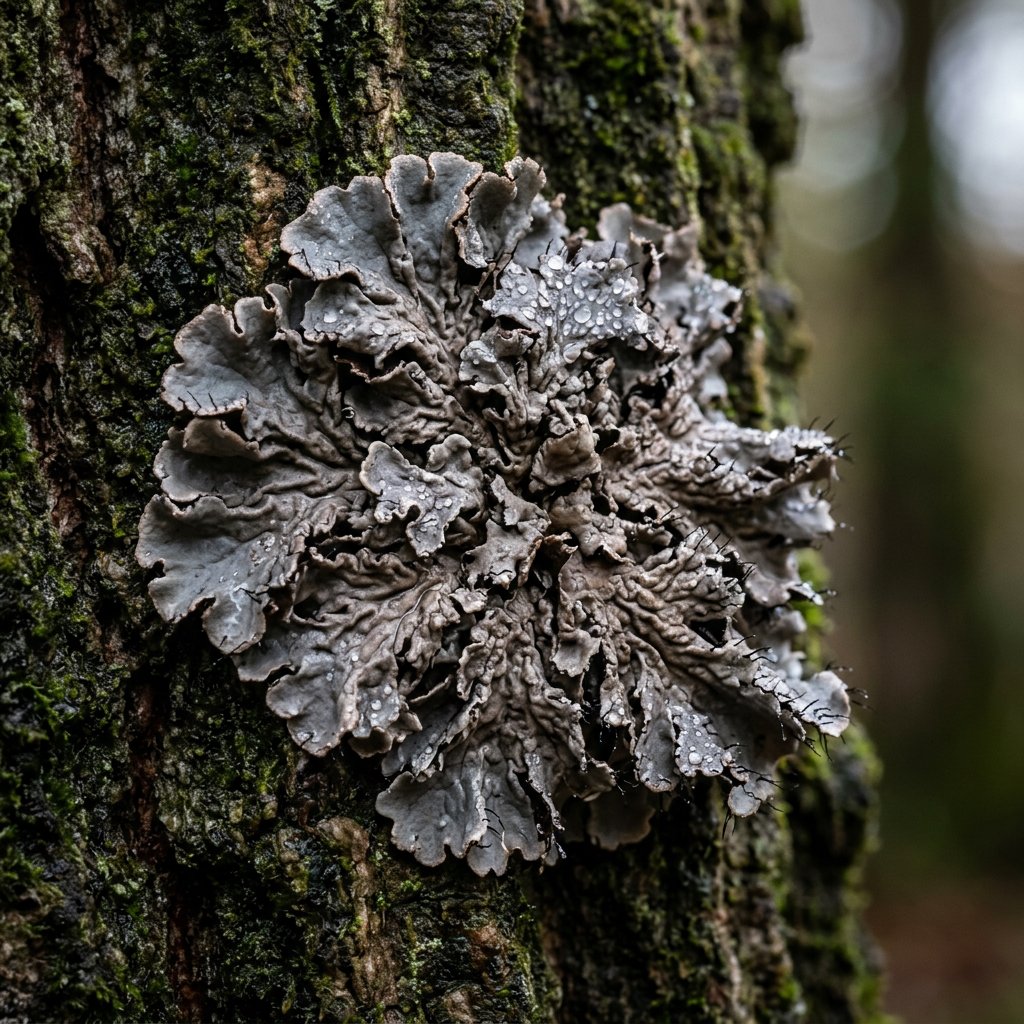
Commonly known as the Speckled Shield Lichen, this organism is a master of camouflage often found hugging the bark of ancient deciduous trees. While it looks like a crusty fungal growth, it is actually a complex symbiotic partnership between a fungus and an alga. In European folklore, these "tree skins" were often thought to be the breath of the forest frozen in time, clinging to the wood to protect the tree from the elements.
🔍 How to Identify
- 🛡️ The Thallus: It features a "leafy" (foliose) body that forms tight, circular rosettes or irregular patches, usually a striking pearly-gray or pale blue-gray color.
- 🌑 Sooty Spots: Look closely at the center of the lichen; you’ll see tiny, black, grain-like structures called isidia. These look like a dusting of soot or black sugar and are used for reproduction.
- 🕷️ Dark Underside: If you gently peel an edge, the bottom side is dark brown or jet black, covered in tiny hair-like anchors called rhizines that grip the tree bark tightly.
🌲 Habitat & Ecology
- 🌳 The Linden Lover: Its species name, tiliacea, refers to the Linden tree (Tilia), one of its favorite hosts. However, it is equally happy living on the rough bark of Oaks, Maples, and Beeches.
- 🌬️ Nature’s Air Monitor: This lichen is a biological hero. It is highly sensitive to air pollution; if you find a forest covered in Parmelina tiliacea, it is a reliable sign that the air quality in that area is excellent.
⚠️ Safety & Toxicity
- 🚫 Not Edible: While not considered "poisonous" in the same way as a deadly mushroom, lichens contain tough cellulose and lichen acids that are indigestible and can cause severe stomach upset.
- 🐾 Pet Safety: It is generally harmless to the touch, but ensure curious pets do not graze on lichen-covered bark, as the rough texture and chemical compounds can irritate their digestive tracts.
✨ Fun Fact
Lichens like the Speckled Shield are "pioneer species." They can survive in some of the harshest environments on Earth and were even sent to outer space by the European Space Agency—where they survived vacuum and radiation for nearly 15 days!
More Details