Info
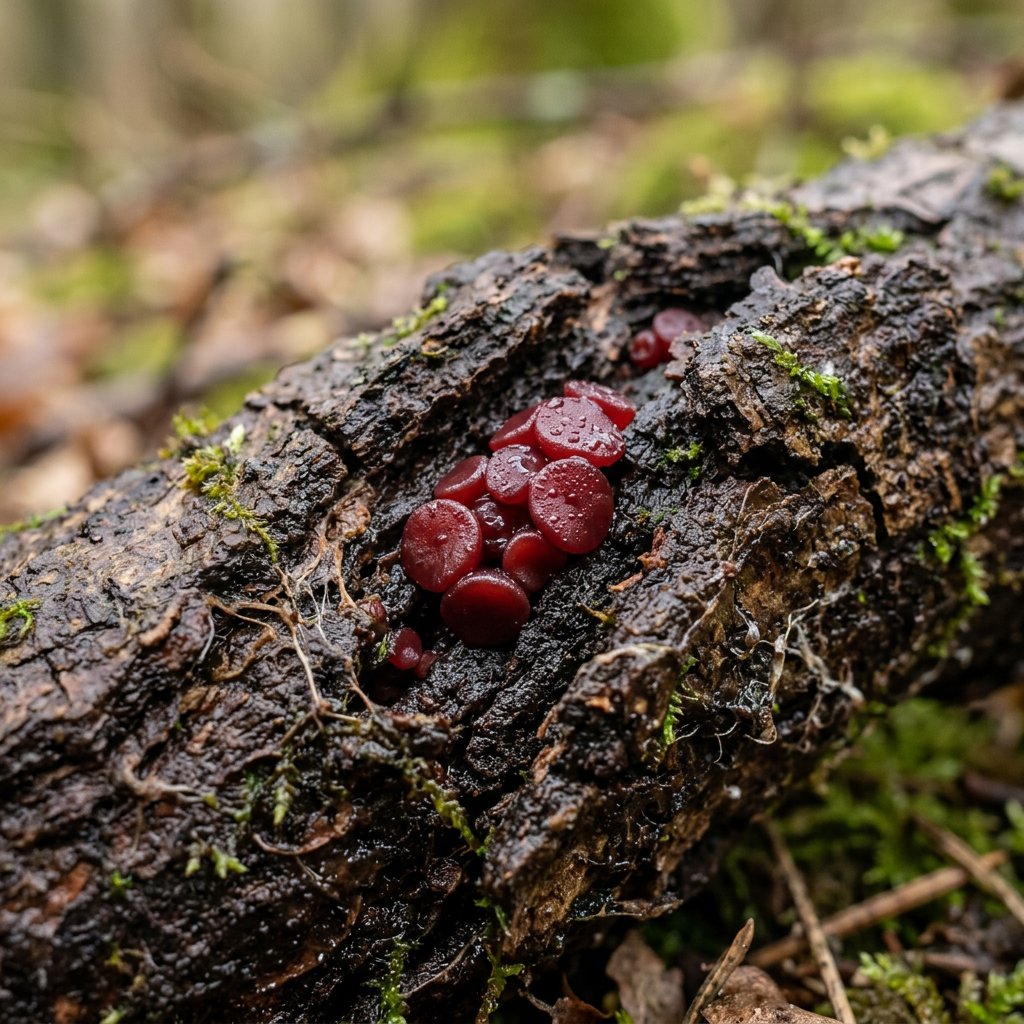
Known as the Bloody Cup, Patinellaria sanguinea is a tiny but striking inhabitant of the forest’s hidden corners. It often appears like miniature droplets of dark crimson or "blood" spilled across weathered, barkless wood. This fungus is a master of the gothic aesthetic, turning old logs into a canvas of deep reds and purples that look like something straight out of a dark fairytale.
🔍 How to Identify
- 🩸 The Appearance: These are tiny, disc-shaped or flat-topped "cups" (apothecia) that rarely exceed 1-2mm in diameter. They often grow in dense, crowded clusters.
- 🔴 The Color: A rich, deep blood-red or reddish-black. The color is most vibrant when moist; when dry, they may appear almost black.
- 🪵 The Canvas: Look closely at the wood beneath the fungus. The mycelium often stains the surrounding wood fibers a distinct reddish or pinkish hue, a tell-tale sign of this specific species.
🌲 Habitat & Ecology
- 🍂 The Wood Scavenger: This fungus is saprobic, meaning it feeds on dead organic matter. It specifically targets "decorticated" wood—logs and branches that have already lost their bark.
- 🌳 Host Preference: While it is a generalist, you are most likely to spot it on well-rotted hardwoods like Oak or Beech, though it occasionally makes a home on coniferous wood in damp, shaded woodlands.
- 💧 Moisture Lover: It thrives in high-humidity environments. After a heavy rain, the tiny cups swell and become much easier to spot against the gray, weathered wood.
⚠️ Safety & Toxicity
- 🛑 WARNING: Not for consumption.
- 🚫 Status: While not specifically listed as "deadly," the Bloody Cup is considered inedible. Due to its microscopic size, it has no culinary value, and the chemical properties of many small cup fungi are not well-studied.
- 🐾 Pets & Kids: Because it grows on rotting logs where children might play or pets might sniff, it is best to admire it visually. If ingested, it may cause gastrointestinal upset.
✨ Fun Fact
The red pigment in Patinellaria sanguinea is so potent that it was historically noted for its ability to permanently dye the wood it grows on. Even if you don't see the "cups," a mysterious red stain on a barkless log is often a sign that this fungus is living just beneath the surface!
More Details