Info
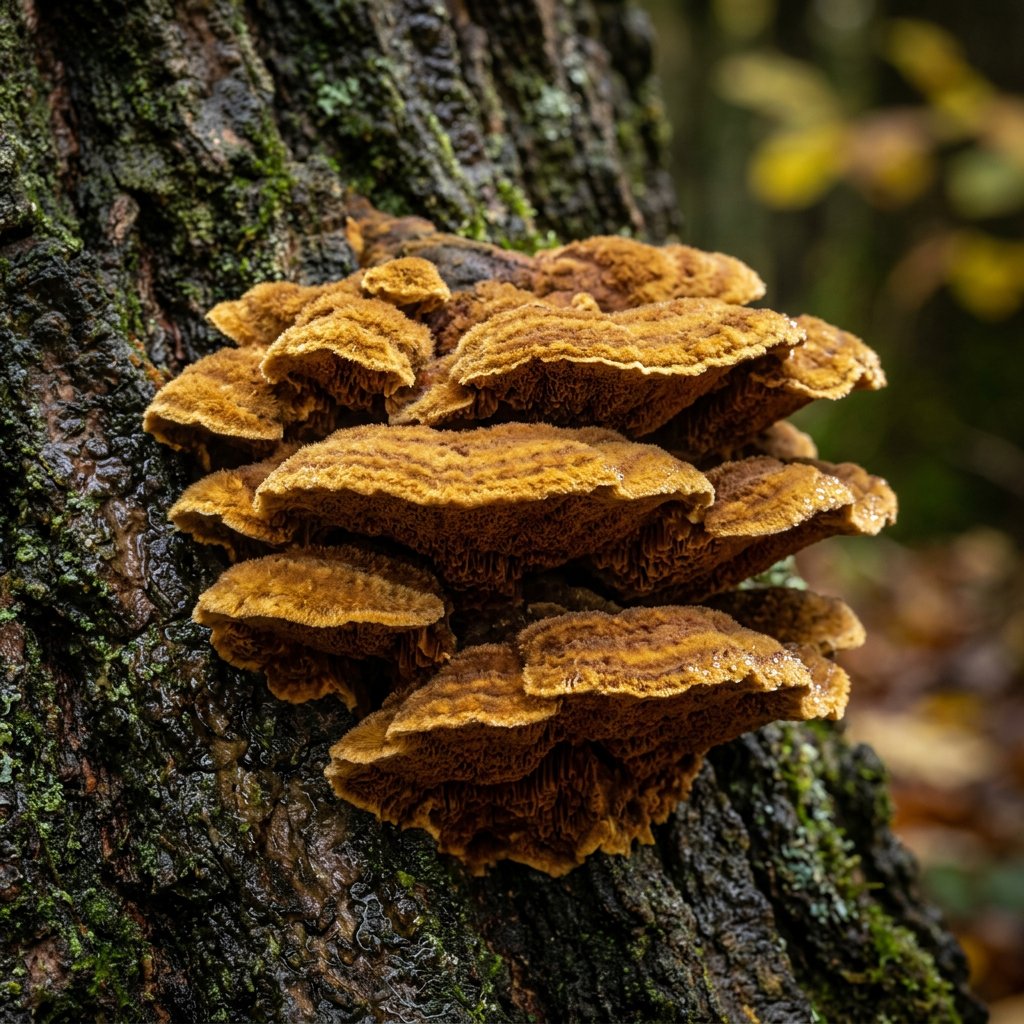
Known as the Mustard Yellow Polypore, Phellinus gilvus is a rugged survivor of the forest. It acts as a golden-hued "shelf" decorating the trunks of aging hardwood trees, slowly transitioning from a vibrant mustard yellow to a deep, rusty cinnamon as it matures. It is a vital decomposer, silently recycling the nutrients of the forest floor.
🔍 How to Identify
- 🎨 The Cap: The upper surface is typically rough, zonate (showing growth rings), and covered in fine, velvety hairs. It starts bright yellow but eventually turns a dark, burnt-umber or grayish-brown.
- 📏 Growth Habit: These mushrooms lack a stem and grow as "brackets" or shelves. They often appear in overlapping clusters, resembling a series of rugged steps climbing up a tree trunk.
- 🕳️ Pore Surface: Instead of gills, the underside features a fine layer of microscopic pores. This surface is usually a warm chocolate brown or purplish-gray, which can shimmer slightly when tilted in the light.
🌲 Habitat & Ecology
- 🌳 Hardwood Host: You will almost exclusively find this fungus on deciduous trees, especially oaks, maples, and cherries. It causes "white rot," breaking down the tough lignin in the wood to return it to the soil.
- 🌦️ Year-Round Presence: Because its body is exceptionally tough and woody, this mushroom doesn't rot away quickly. It can be found in the woods during any season, though it is most vibrant during its active growth in summer and fall.
⚠️ Safety & Toxicity
- 🚫 WARNING: Phellinus gilvus is classified as non-edible. While it is not known to contain the lethal toxins found in some other fungi, it is not a food source.
- 🪵 Indigestible Texture: The mushroom is "corky" or "woody" in consistency. Attempting to consume it would be like chewing on a piece of pressurized plywood and would likely result in severe digestive upset.
✨ Fun Fact
🔬 Microscopic Spears: This mushroom belongs to a group characterized by having "hymenial setae"—tiny, dark, thorn-like structures visible only under a microscope. These microscopic spears are so tough they help mycologists identify the species even when the mushroom is old and decayed!
More Details