Info
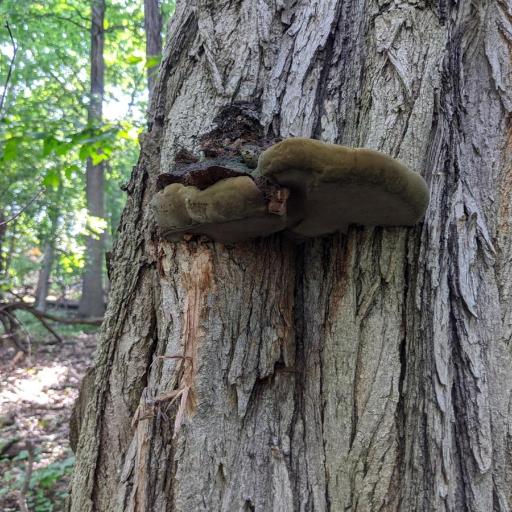
Known as the "Cracked-cap Polypore," this rugged fungus looks like a weathered horse’s hoof emerging from a tree trunk. It has a lifelong partnership—or rather, a parasitic rivalry—with the Black Locust tree. In many old-growth forests, seeing this mushroom is a signature sign that the host tree is providing a home for one of nature’s most persistent wood-decaying specialists.
🔍 How to Identify
- 🥾 The Hoof Shape: It grows as a thick, shelf-like bracket that is "ungulate," meaning it resembles a horse's hoof. It lacks a stem and attaches directly to the bark.
- 🧩 The Cracked Cap: The upper surface is dark brown to grayish-black and becomes deeply "checked" or cracked with age, looking like scorched earth or dried-out mud.
- 🍯 The Pores: The underside does not have gills; instead, it features a velvety, golden-brown pore surface. If you look closely, the pores are tiny and circular, darkening as the mushroom matures.
🌲 Habitat & Ecology
- 🌳 The Locust Specialist: You will almost exclusively find this fungus on living or dead Black Locust trees. It is a "heart rot" fungus, meaning it decays the center of the tree’s heartwood while the outer layers may continue to live for years.
- 🍂 Perennial Growth: Unlike mushrooms that disappear after a few days, this is a perennial "conk." It adds a new layer of pores every year, becoming thicker and more rugged over time, often surviving for decades on the same trunk.
⚠️ Safety & Toxicity
- 🚫 WARNING: While not typically classified as a "deadly" poisonous mushroom, the Cracked-cap Polypore is strictly inedible.
- 🪵 Woody Texture: The body is extremely hard and corky. Attempting to eat it would be like chewing on a piece of seasoned timber. It is not used for culinary purposes, though it is sometimes studied for medicinal compounds in lab settings.
✨ Fun Fact
Because of its dense, woody structure, dried conks from this family were historically used as "slow matches." They can smolder for hours without fully igniting, allowing ancient travelers to carry fire from one camp to the next!
More Details







