Info
Often referred to as the Slender Pholiota, Pholiota spumosa is a golden-hued forest dweller commonly found hugging the bases of pine trees. Its name, derived from the Latin word for "foamy," refers to the glistening, sticky coating that covers its cap during damp weather. While it lacks the fame of flamboyant toadstools, it plays a vital role in the woodland ecosystem as a master of wood-decay.
🔍 How to Identify
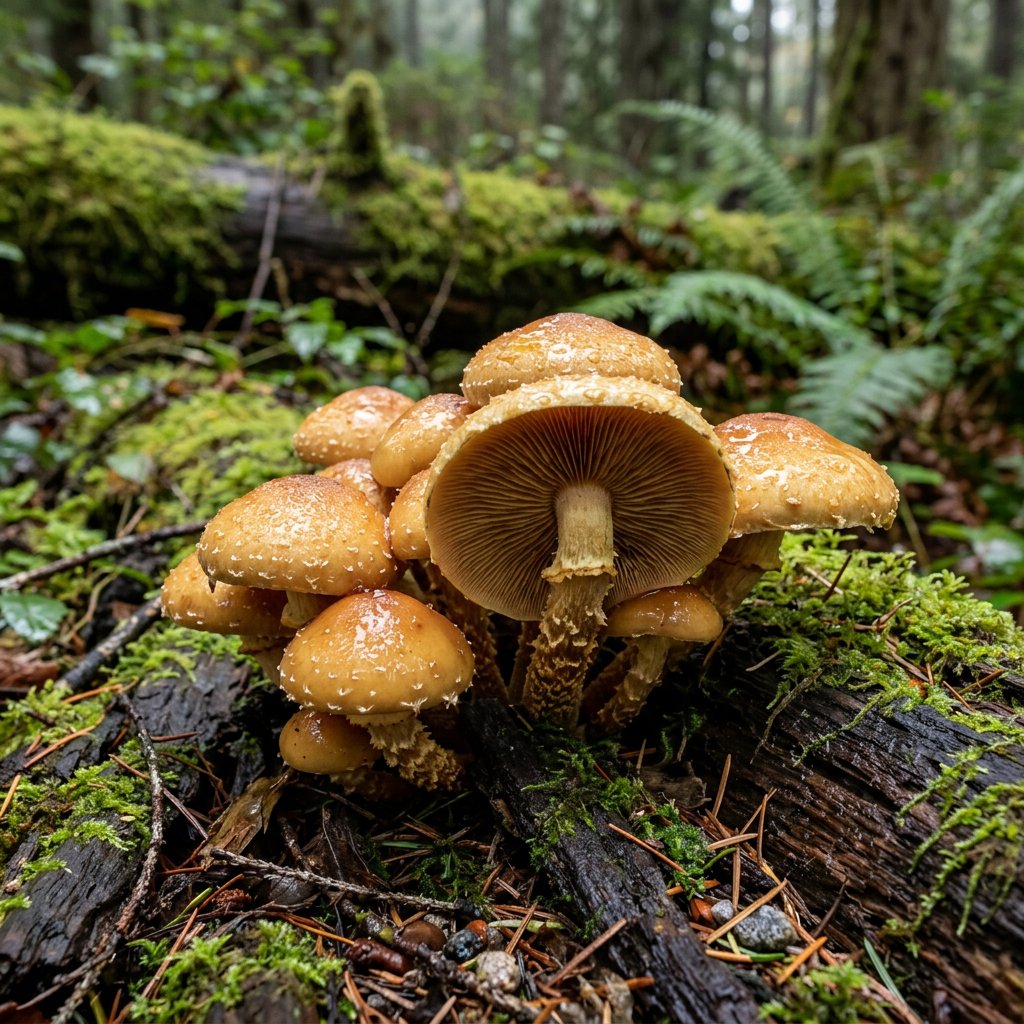
- 🍄 The Cap: Smooth and distinctly sticky (viscid) when moist. It transitions from a bright sulfur-yellow or olive-yellow at the edges to a deeper, rusty-orange or reddish-brown at the center.
- 🌿 The Gills: Look for crowded gills underneath that start as a pale, greenish-yellow. As the mushroom matures and releases its spores, the gills turn a dull cinnamon-brown.
- 🪵 The Stem: The stalk is slender, flexible, and often hollow with age. It usually matches the yellow of the cap near the top but becomes brownish and slightly "hairy" or fibrous toward the base.
🌲 Habitat & Ecology
- 🍂 Woodland Recycler: This mushroom is a saprobe, meaning it breaks down dead organic matter. You will most likely find it growing in clusters on woody debris, buried wood, or around the stumps of coniferous trees, particularly pine.
- 📅 Late Bloomer: It prefers the cooling temperatures of late summer and autumn. In milder climates, it can continue to fruit well into the winter months if the ground remains moist.
⚠️ Safety & Toxicity
- 🚨 WARNING: Inedible/Unknown. While not classified as "deadly," Pholiota spumosa is generally considered inedible. Many species in the Pholiota genus contain compounds that cause significant gastrointestinal distress, including nausea and vomiting.
- 🛑 Identification Risk: This mushroom is a "Little Brown Mushroom" (LBM) lookalike. Because it can be easily confused with toxic species by an untrained eye, it should never be consumed. Keep pets away from clusters growing in landscaped mulch or garden beds.
✨ Fun Fact
The "sticky" substance on the cap isn't just for show—it actually helps protect the mushroom's developing spores from drying out and can even deter certain crawling insects from reaching the gills!
More Details







