Info
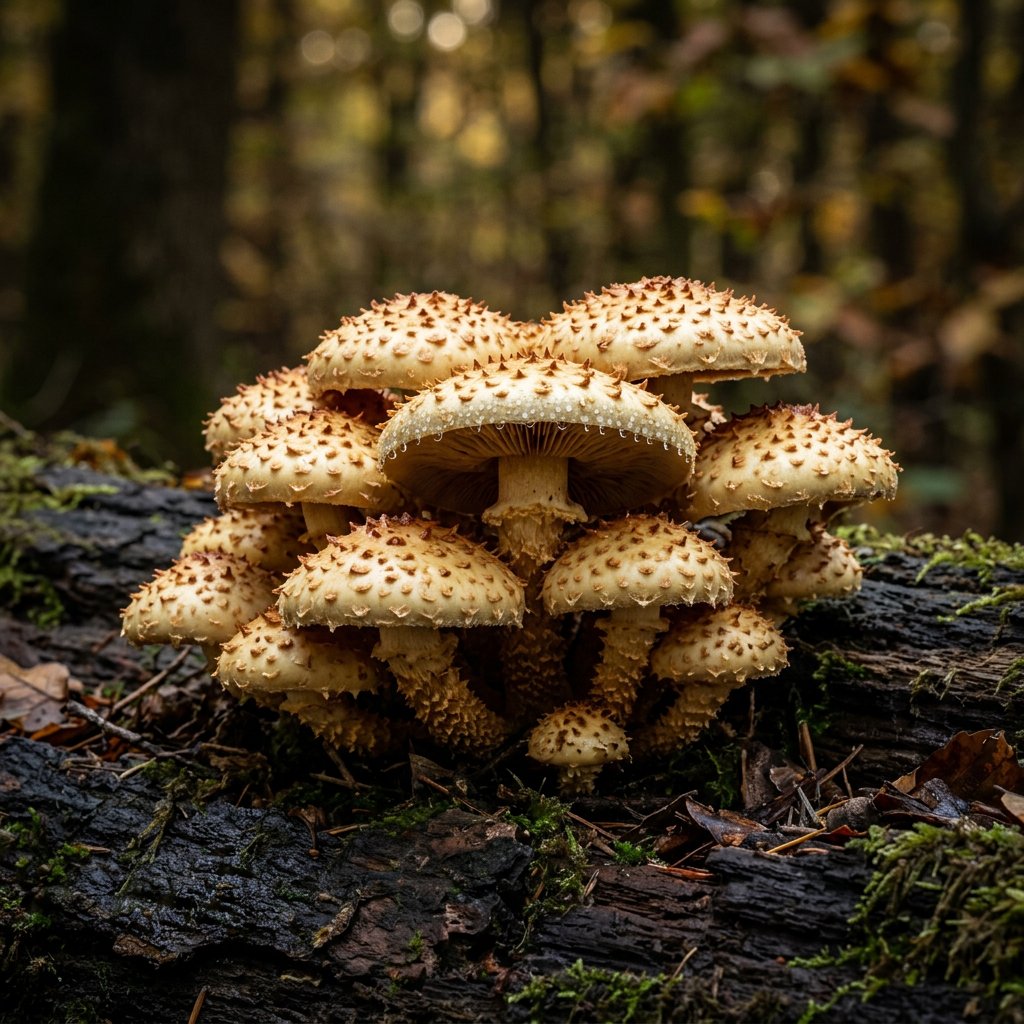
Often appearing in dramatic, bristly clusters at the base of hardwood trees, the Sharp-scaly Pholiota (Pholiota squarrosoides) looks like a collection of toasted marshmallows covered in wood shavings. This fungus is a favorite for nature photographers because of its intricate, "spiky" texture and tendency to grow in large, photogenic bouquets. While it looks charming and almost decorative, it is a master of disguise, frequently confused with more troublesome look-alikes.
🔍 How to Identify
- 🍄 The Cap: The cap is dry and pale (whitish to cream), densely covered in distinct, recurved (upturned) brownish scales that give it a "sharp" or "shaggy" appearance.
- 🌿 The Gills: Tightly packed underneath, the gills start as a pale yellowish-white and eventually turn a rusty, cinnamon-brown as the spores mature.
- 🌲 The Stem: The stalk is stout and "clothed" in the same shaggy, brownish scales as the cap up to a faint ring, while the area above the ring remains smooth and pale.
🌲 Habitat & Ecology
- 🍂 Hardwood Specialist: This species is a saprobic decomposer, meaning it plays a vital role in the forest by breaking down dead wood. It has a particular fondness for the logs and stumps of Sugar Maples and Birches.
- 👯 Crowded Clusters: You will rarely find a "lonely" Sharp-scaly Pholiota. They almost always grow in dense, overlapping groups (caespitose), creating a striking visual "explosion" of mushrooms from a single point in the wood.
- 📅 Autumn Arrival: While they can appear in late summer, they are most prolific during the cool, damp days of autumn, decorating the forest floor just as the leaves begin to turn.
⚠️ Safety & Toxicity
- 🚫 WARNING: Even though some historical texts list this species as edible, consumption is not recommended. It is extremely difficult for a hobbyist to distinguish it from the Pholiota squarrosa, which is known to cause severe gastric upset and vomiting, especially when consumed with alcohol.
- 🤢 Gastrointestinal Risk: Ingesting mushrooms in the Pholiota genus often leads to stomach cramps and nausea in many individuals.
- 🐾 Pets & Kids: Because these often grow at ground level on stumps, keep a close watch on dogs and toddlers; the bristly scales can be an enticing but dangerous "texture" for them to explore with their mouths.
✨ Fun Fact
One of the most reliable ways to tell this mushroom apart from its "stinky" cousins is to use your nose! While its look-alikes often smell like pungent garlic or old radishes, Pholiota squarrosoides usually has a surprisingly pleasant, sweet, or slightly floral scent.
More Details