Info
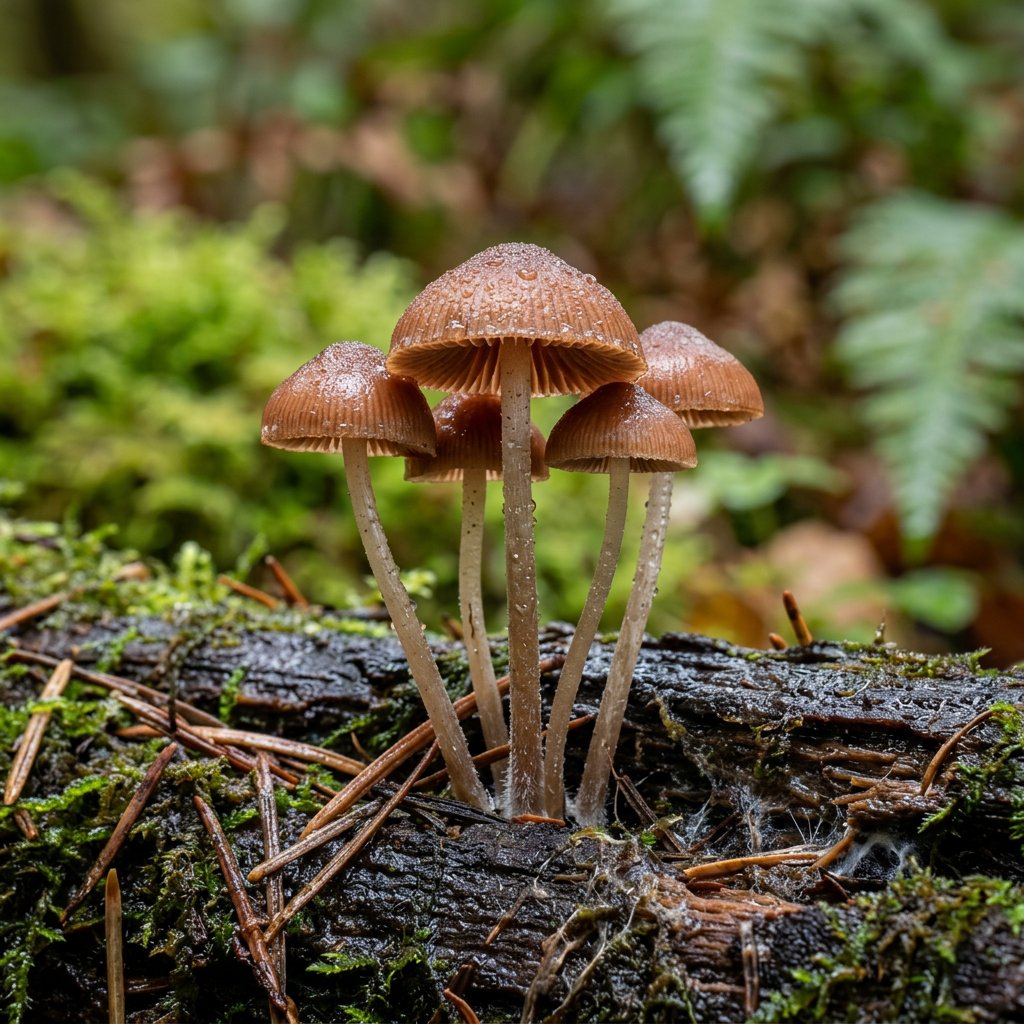
Known among mycologists as "Smith’s Pholiotina," this delicate "Little Brown Mushroom" (LBM) is a master of disguise. Named after the legendary American mycologist Alexander H. Smith, it often goes unnoticed, blending perfectly into the mossy forest floors and damp lawns where it hides. Despite its unassuming appearance, it is a species of significant interest—and high risk—due to its complex chemical makeup.
🔍 How to Identify
- 🍄 The Cap: Small and fragile, usually measuring only 0.5 to 2 cm across. It starts as a sharp cone or bell shape, colored a warm ochre or cinnamon brown that fades to a pale tan as it dries.
- 🍂 The Gills: The gills are crowded and "adnate" (attached directly to the stem). They begin as a pale yellowish hue but mature into a deep rusty brown as the spores develop.
- 📏 The Stem: Thin, hollow, and incredibly brittle. The stem is typically whitish or pale yellow and lacks a persistent ring, though it may have a faint "frosty" texture near the top.
🌲 Habitat & Ecology
- 🌿 Moss & Moisture: This mushroom is a lover of dampness. You are most likely to find it tucked away in thick carpets of moss, boggy areas, or even in well-irrigated garden mulch and lawns during late summer and autumn.
- 🗺️ Regional Presence: While it pops up in various temperate climates, it is most frequently documented in the Pacific Northwest of North America, where the cool, misty environment provides the perfect stage for its short-lived fruiting.
⚠️ Safety & Toxicity
- 🚨 WARNING: STRICT AVOIDANCE RECOMMENDED. Pholiotina smithii is known to contain psilocybin, but it is considered an advanced-level mushroom that should never be handled by beginners.
- 💀 The Deadly Lookalike: Its greatest danger lies in its resemblance to the "Deadly Galerina" (Galerina marginata) and other Pholiotina species that contain amatoxins—the same poisons found in the Death Cap. Ingesting a lookalike can lead to permanent liver failure or death.
- 🐾 Risk Factor: Because they grow in lawns and gardens, they pose a significant risk to curious toddlers and pets. Even non-lethal ingestions can cause severe stomach upset and frightening neurological symptoms.
✨ Fun Fact
- 📚 A Namesake's Legacy: Alexander H. Smith, for whom this mushroom is named, was so influential in the study of fungi that he is often called the "Father of Modern North American Mycology." He spent decades demystifying the "Little Brown Mushrooms" that most people are too afraid to touch!
More Details
| Hymenium Type | Lamella |
| Stipe Character | Bare Stipe |
| Spore Print Color | Brown |
| Mushroom Cap Shape | Conical Mushroom Cap |
| Hymenium Attachment | Adnate Hymenium Attachment |
| Mushroom Ecological Type | Saprobiont |







