Info
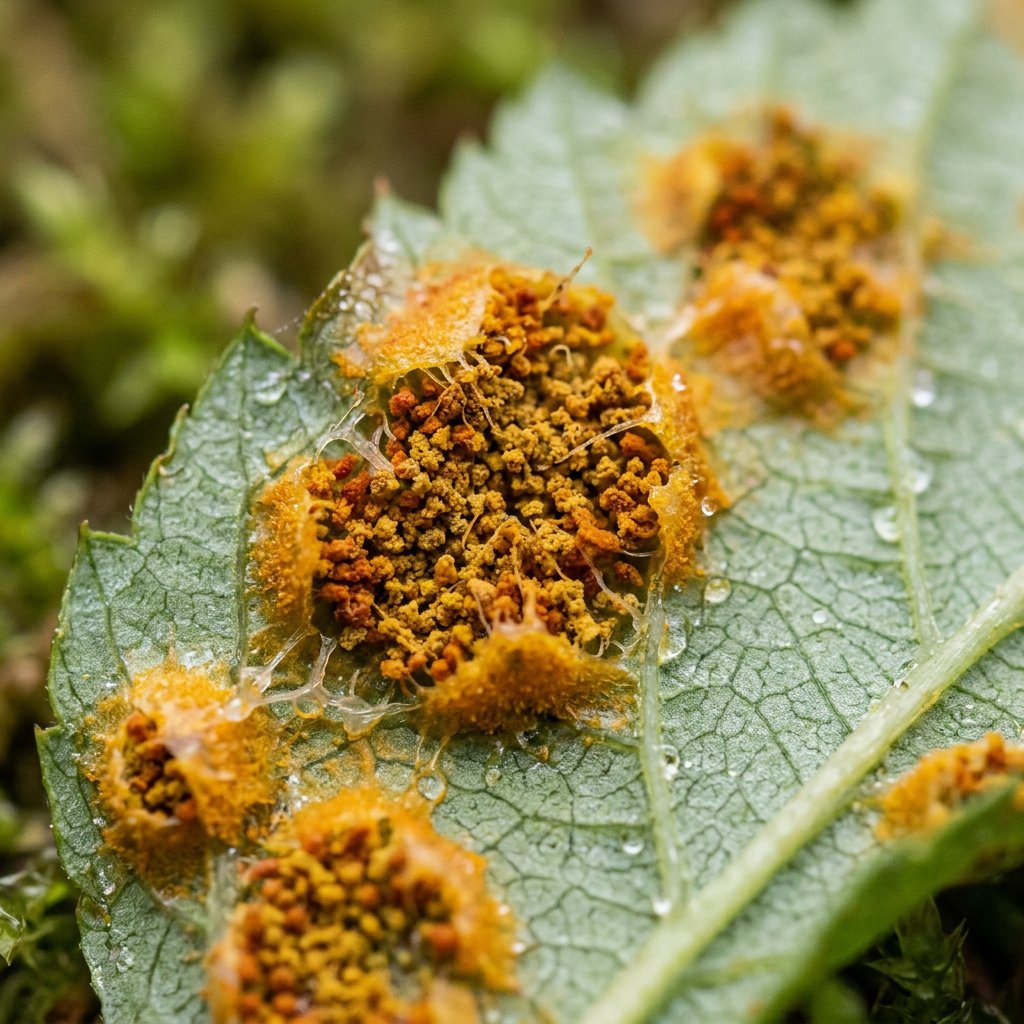
Often called "Raspberry Yellow Rust," this specialized fungus is a colorful hitchhiker that turns your garden brambles into a vibrant, spotted display. Unlike the mushrooms you might find in a fairy tale, this fungus lives as a parasite, weaving its lifecycle entirely within the leaves of the red raspberry. While it might look like a dusting of gold or orange paint, it is actually a complex organism that has evolved to thrive alongside one of our favorite summer fruits.
🔍 How to Identify
- 🧡 The Golden Pustules: In early summer, look for tiny, bright orange-to-yellow powdery spots (uredinia) clustered primarily on the undersides of the leaves.
- 🎨 Leaf Staining: On the upper side of the leaf, directly above the orange spots, you will often see yellow or reddish-purple discolorations that look like tiny ink stains.
- 🌑 The Winter Shift: As autumn approaches, the bright orange spots turn into dark, crusty black dots (telia), which are the fungus's "hibernation mode" for surviving the cold.
🌲 Habitat & Ecology
- 🫐 The Perfect Host: This fungus is highly specific; it almost exclusively targets the Red Raspberry (Rubus idaeus), ignoring other nearby garden plants.
- 💦 Wet Weather Lover: It spreads most aggressively during wet, humid springs. Rain splashes and wind carry the microscopic spores from the old fallen leaves onto the fresh, new growth of the season.
⚠️ Safety & Toxicity
- 🚫 WARNING: While Phragmidium rubi-idaei is a plant pathogen and not a "poisonous mushroom" in the traditional sense, it is not edible.
- 🐾 Pet & Human Safety: It is generally harmless to touch and is not known to be toxic to pets or humans. However, eating raspberries heavily covered in fungal spores is not recommended as it may cause digestive upset or allergic reactions in sensitive individuals.
✨ Fun Fact
This fungus is an "autoecious" rust, meaning it’s a total homebody! While many other rust fungi need two completely different plant species to finish their life cycle (like Cedar-Apple rust), the Raspberry Rust completes all five of its life stages on the very same raspberry bush.
More Details







