Info
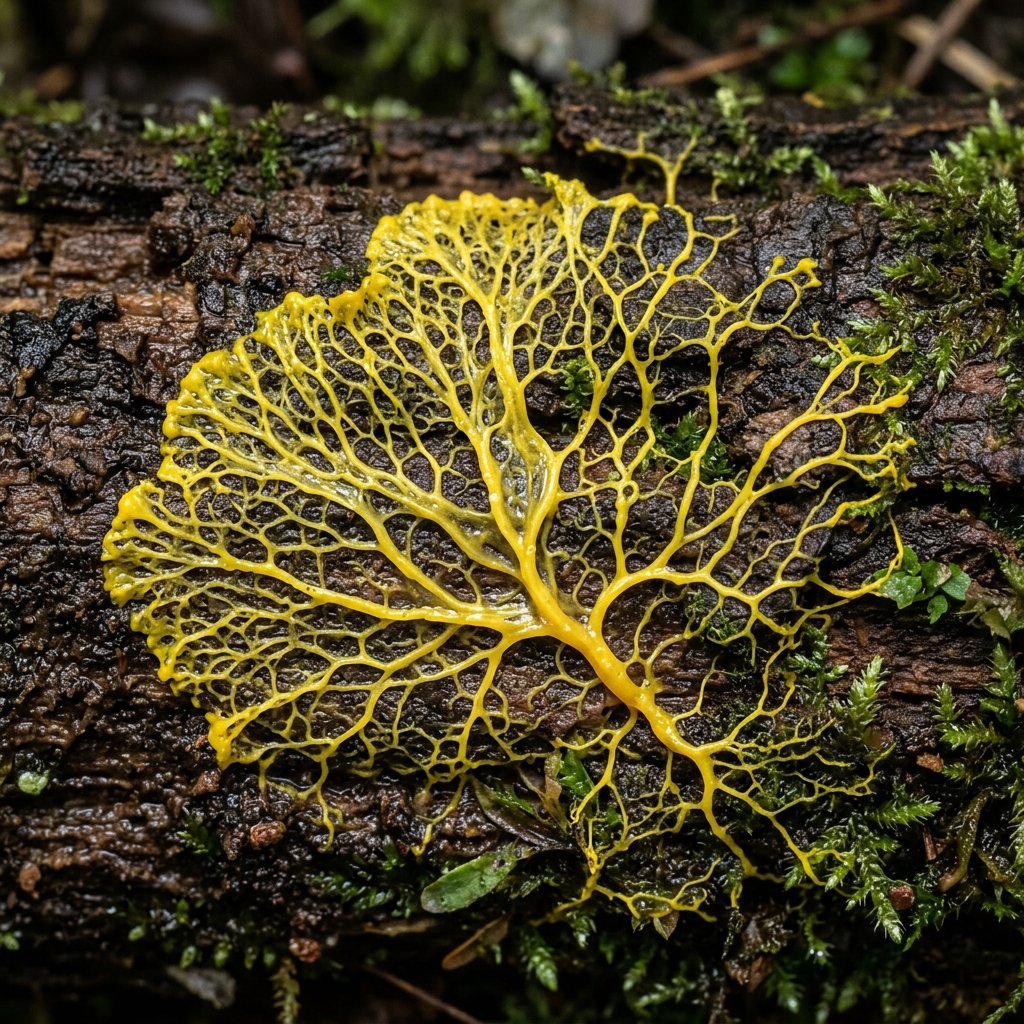
Often called "The Blob," Physarum polycephalum is one of nature’s most bizarre wonders. Though it is often grouped with fungi, it is actually a Myxomycete, or "plasmodial slime mold"—a single-celled organism that can grow to be several square feet in size. It has gained worldwide fame for its "alien intelligence," capable of solving mazes and finding the most efficient routes between food sources despite having no brain or nervous system.
🔍 How to Identify
- 🧬 The Plasmodium: It appears as a bright, creeping network of vein-like structures called "protoplasmic streaming." It looks less like a mushroom and more like a pulsating web of neon lace.
- 🎨 Vibrant Color: Most commonly found in a striking lemon-yellow or golden-orange hue, making it stand out vividly against dark, decaying wood.
- 🕒 Movement: If you mark its position and return a few hours later, you will see it has moved! It crawls along surfaces at about one centimeter per hour in search of its next meal.
🌲 Habitat & Ecology
- 🪵 The Forest Recycler: You will typically find "The Blob" in cool, moist, and shaded environments. It thrives on rotting logs, decaying leaf litter, and various types of tree bark.
- 🍴 Microscopic Diet: It doesn't "eat" like we do; instead, it engulfs bacteria, fungal spores, and other organic matter as it slowly flows across the forest floor, playing a vital role in nutrient cycling.
⚠️ Safety & Toxicity
- ⚠️ WARNING: While Physarum polycephalum is not known to be poisonous or infectious, it is not edible. It should be treated as a biological curiosity rather than a food source.
- 🐾 General Safety: It is considered non-toxic to humans and pets. However, because it thrives in very damp environments, its presence may indicate high humidity levels that could encourage the growth of other, potentially allergenic molds.
✨ Fun Fact
In a famous experiment, researchers placed oat flakes on a map of Tokyo in the locations of major cities; the slime mold grew a network between them that was almost identical to the layout of the actual Tokyo rail system, proving it is a master of structural engineering!
More Details







