Info
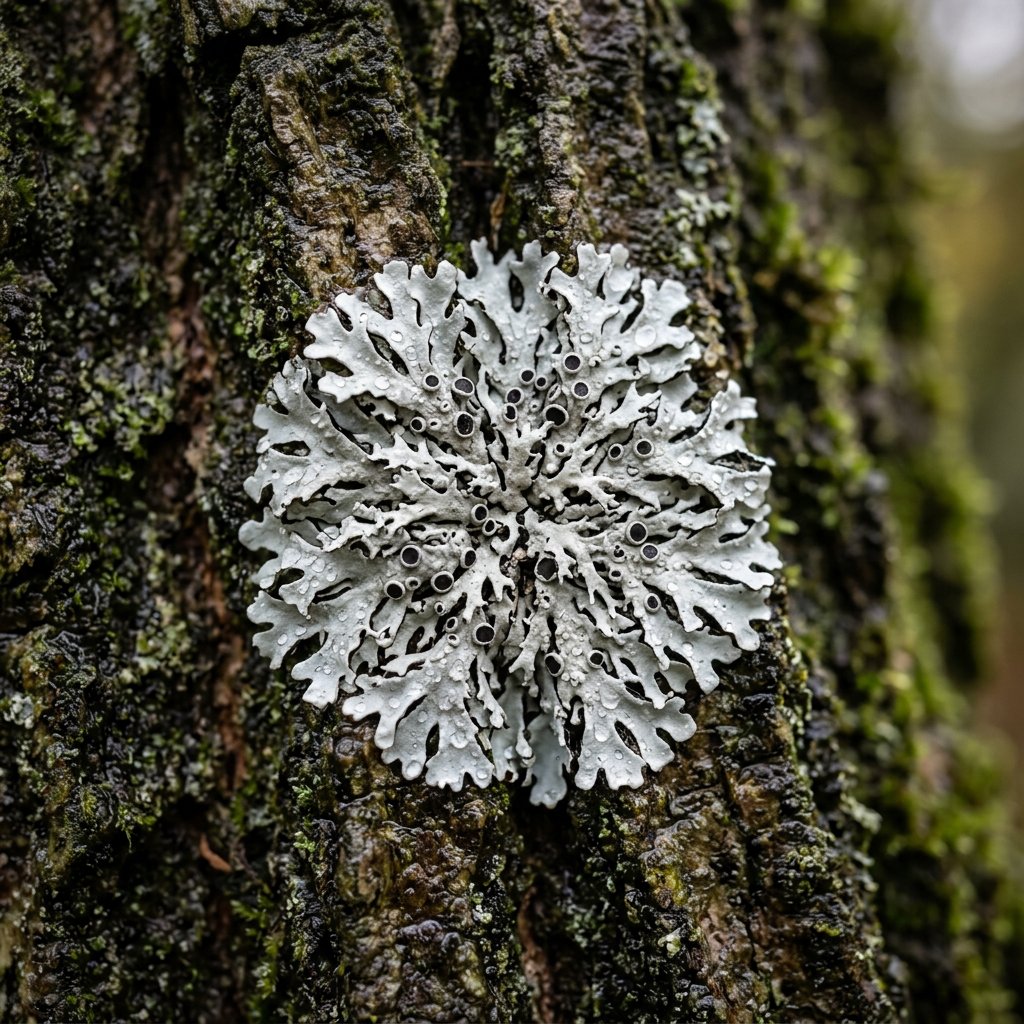
Often called the Star Rosette Lichen, Physcia stellaris is a tiny, celestial masterpiece found clinging to the bark of trees. While it looks like a single organism, it is actually a complex "symbiotic team-up" between a fungus and an algae. Its name comes from its stunning starburst growth pattern, which can turn an ordinary tree branch into a gallery of silvery-gray constellations.
🔍 How to Identify
- 🌟 Star-Shaped Body: The main body (thallus) grows in a radiating, circular pattern that resembles a star or a small explosion, usually measuring about 1 to 3 centimeters across.
- ❄️ Silvery Surface: The color is typically a pale, frosty gray or whitish-green, which stands out sharply against the dark, wet bark of hardwood trees.
- 🔘 Dark "Buttons": Near the center, you will often see many tiny, cup-like structures called apothecia. These have dark brown or black centers with a pale rim, looking like miniature craters or buttons.
🌲 Habitat & Ecology
- 🌳 Hardwood Preferences: This lichen is a "bark-dweller" that specifically loves deciduous trees with alkaline bark, such as Poplar, Ash, Walnut, and Willow.
- ☀️ Sun Enthusiast: Unlike many mosses that prefer deep shade, the Star Rosette thrives in bright, open areas. You are most likely to find it on branches at the edge of a forest or on isolated trees in a sunny park.
- 🌬️ Nitrogen Lover: This species is quite hardy and can tolerate higher levels of nitrogen than other lichens, meaning it often thrives near farms or in urban areas where air quality might affect more sensitive species.
⚠️ Safety & Toxicity
- 🚫 WARNING: While technically a fungus (in a symbiotic relationship), Physcia stellaris is not edible. It is tough, woody, and holds no nutritional value for humans.
- 🐾 Pet Safety: It is generally considered non-toxic to touch for both humans and pets. However, it should not be ingested, as many lichens can accumulate pollutants or heavy metals from the air.
✨ Fun Fact
Lichens like the Star Rosette are nature’s "air quality sensors." Because they absorb everything directly from the atmosphere rather than through roots, scientists study their health and growth to determine how clean or polluted the air is in a specific neighborhood!
More Details







