Info
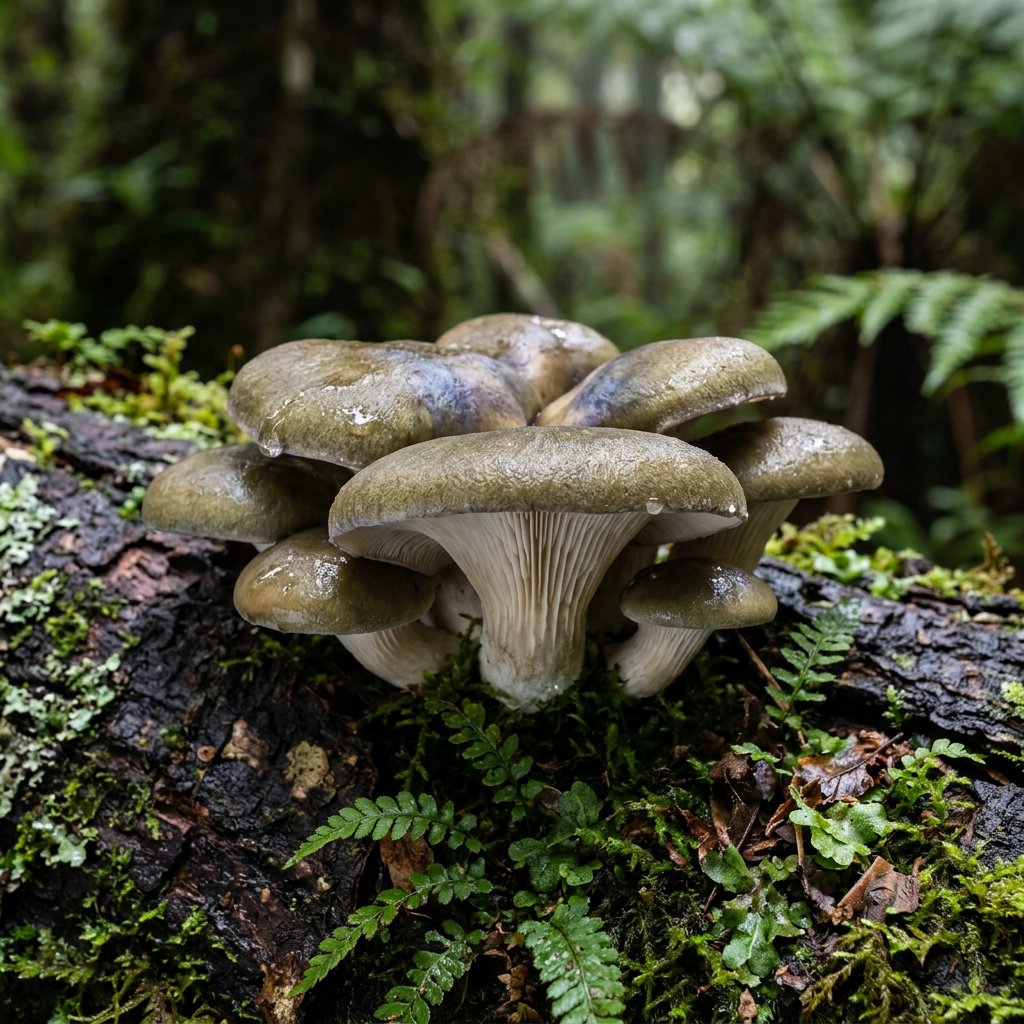
Commonly known as the Olive-Purple Oyster, this mushroom is a moody, artistic relative of the familiar white oyster mushroom found in grocery stores. Draped in deep earthy tones, it looks like something plucked from a dark fairytale, often appearing in the ancient forests of Australia and New Zealand. It plays a vital role in the circle of life, acting as a master recycler that breaks down fallen timber.
🔍 How to Identify
- 🎨 The Cap: A striking mixture of olive-green, brownish-grey, and deep violet-purple. The surface is often slightly velvety or "suede-like" when young, becoming smoother as it matures.
- 📉 The Gills: The gills are creamy white to pale yellow and are "decurrent," meaning they travel a significant way down the stem rather than stopping at the cap edge.
- 🍄 The Growth Habit: It typically grows in overlapping shelves or clusters, often lacking a distinct central stem, instead attaching sideways to its woody host.
🌲 Habitat & Ecology
- 🪵 Woodland Recycler: This fungus is saprobic, meaning it feeds on dead and decaying wood. It is particularly fond of fallen Eucalyptus logs and Nothofagus (Southern Beech) trees.
- 🌧️ Seasonal Appearance: You are most likely to spot these "shelves" during the wetter, cooler months of autumn and winter, when the humidity allows the delicate gill structures to thrive without drying out.
⚠️ Safety & Toxicity
- 🛑 WARNING: While many members of the Pleurotus genus are edible, wild foraging is extremely dangerous for beginners. Never consume any wild mushroom unless identified by a professional mycologist.
- 🔦 The Look-Alike: In its native range, it can be confused with the toxic Omphalotus nidiformis (Ghost Fungus). While the Ghost Fungus glows in the dark and the Olive-Purple Oyster does not, they can look remarkably similar in daylight to the untrained eye.
- 🤢 Reaction Risk: Even for known edible wild mushrooms, some individuals may experience gastric upset or allergic reactions upon their first time eating them.
✨ Fun Fact
Unlike many mushrooms that only break down soft plant matter, Pleurotus purpureo-olivaceus is a "white rot" fungus. This means it has the incredible ability to break down lignin, the incredibly tough organic polymer that gives trees their rigid, woody strength!
More Details