Info
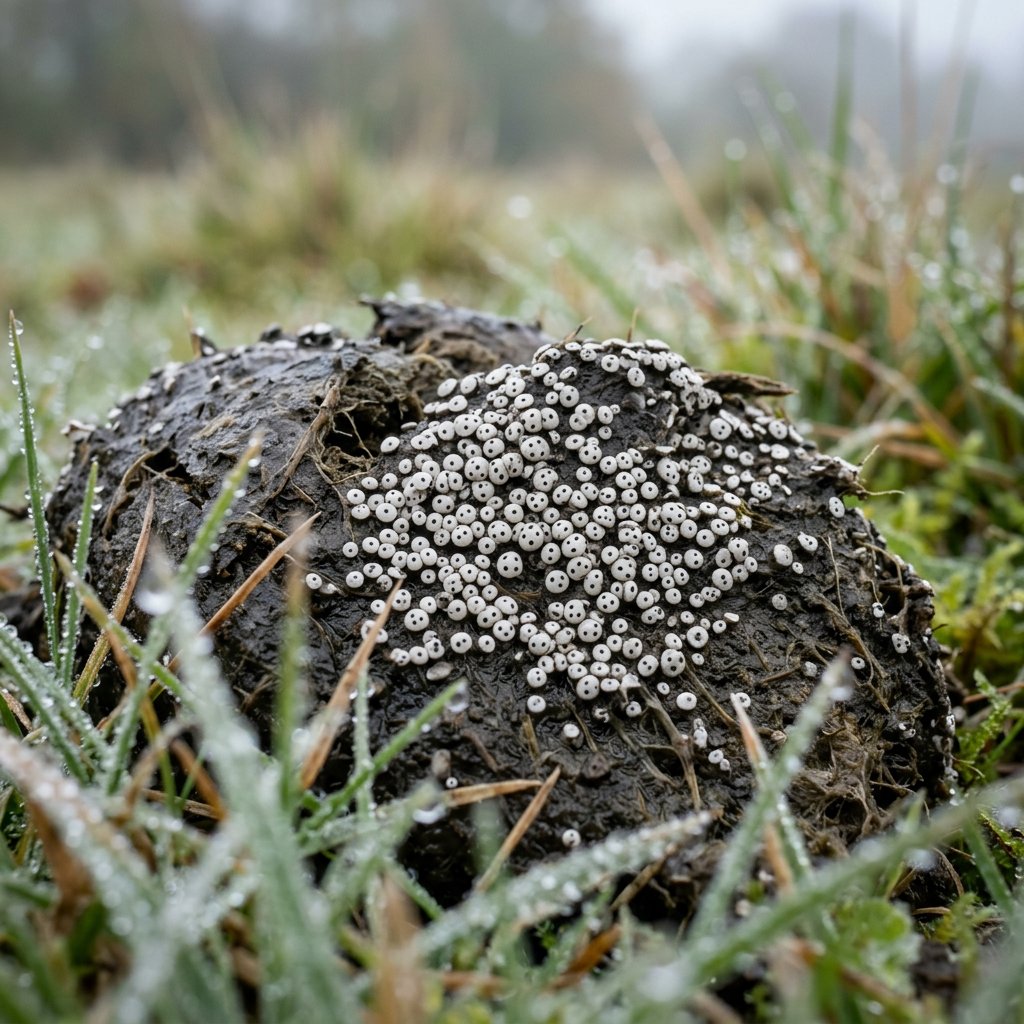
Often called the Nail Fungus, this quirky little mushroom looks like a tiny, flat-headed upholstery nail driven into the earth. Once widespread across Europe, it has become a "ghost" in many modern landscapes, appearing only in ancient, chemical-free pastures where horses roam freely. It carries a certain mystery, as its presence tells a story of a healthy, undisturbed ecosystem.
🔍 How to Identify
- 📍 The Cap: It features a flat, circular disc (usually 5–15mm) that is creamy white to light grey. It looks remarkably like a tiny button or a "nail head."
- 🕳️ The Punctures: The surface is peppered with distinct black dots. These are actually the openings (ostioles) of the spore-producing chambers embedded in the flesh.
- 🌱 The Stem: The mushroom has a short, dark, tapering stalk that is often buried deep within its specific substrate, making the disc appear to sit directly on the surface.
🌲 Habitat & Ecology
- 🐎 The "Pony" Connection: This fungus is strictly coprophilous, meaning it grows on dung—specifically horse or pony dung. However, it is very picky; it will not grow if the horses have been treated with modern chemical dewormers (anthelmintics).
- 🌾 Ecological Indicator: Because it is so sensitive to chemicals, finding the Nail Fungus is a badge of honor for a landscape. It indicates an "unimproved" grassland that hasn't been touched by modern intensive farming.
⚠️ Safety & Toxicity
- 🚫 WARNING: While not known to be deadly, the Nail Fungus is not edible.
- 🤚 Texture: It has a tough, corky, or leathery texture that makes it completely unpalatable.
- 🐾 Pet Safety: While it is unlikely to attract pets due to its size and habitat, it should not be consumed. Its primary interest to humans is ecological, not culinary.
✨ Fun Fact
The Nail Fungus is a world traveler with a tragic history. It was once common throughout the UK and Europe, but as the "internal combustion engine" replaced the horse, and modern medicine changed how we treat livestock, the fungus vanished from most of its former home, earning it a spot on several "Red Lists" of endangered species.
More Details







