Info
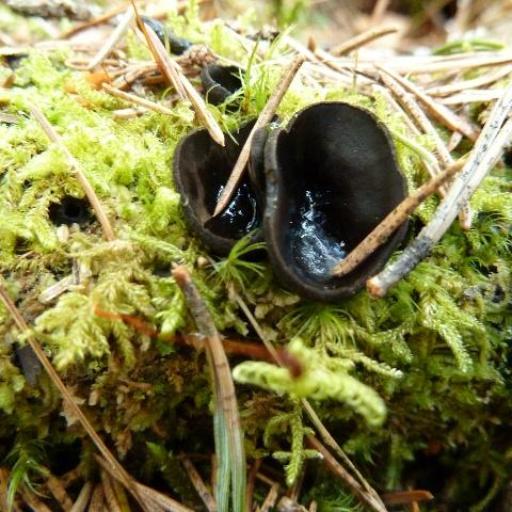
Often called the Ebony Cup, this mushroom looks like a small, discarded piece of velvet charcoal nestled in the forest floor. Emerging early in the spring, it is one of the first signs of life as the snow melts, appearing like a gothic treasure hidden among bright green moss. It is a favorite for nature photographers because its deep, light-absorbing black provides a stunning contrast against the damp earth.
🔍 How to Identify
- 🖤 The Cup: It starts as a tiny, closed sphere, eventually opening into a deep, saucer-like cup that usually spans 1 to 3 centimeters in width.
- 🌑 Color & Surface: The inner "disc" is a smooth, coal-black color, while the outer surface is covered in fine, soot-colored hairs that give it a matte, velvety texture.
- 🪵 The Base: It features a very short, rooting stem (pseudostipe) that is often buried deep in moss or attached directly to decaying wood, making the cup appear to sit flush on the ground.
🌲 Habitat & Ecology
- 🌲 Conifer Companion: This fungus is "saprobic," meaning it survives by breaking down dead organic matter. It is almost exclusively found in coniferous forests, specifically growing on or near decaying spruce and pine needles.
- 🌱 The Spring Sentinel: While many mushrooms wait for the warmth of autumn, the Ebony Cup is a "snowbank fungus." It is most frequently spotted in late winter or early spring, often while patches of snow are still visible on the ground nearby.
⚠️ Safety & Toxicity
- 🚫 STATUS: Inedible.
- ⚠️ The Details: While not documented as a deadly species, the Ebony Cup is considered inedible due to its tough, rubbery texture and lack of flavor. Because it is difficult for many to distinguish from other black cup fungi (some of which may cause stomach upset), it should be admired for its beauty rather than harvested for the kitchen.
✨ Fun Fact
🔬 Microscopic Coils: If you were to look at the tiny "hairs" on the outside of the Ebony Cup under a microscope, you would see they are not straight; they are actually tightly coiled and twisted, a unique feature that helps the mushroom trap air and retain moisture in the dry, chilly spring winds.
More Details







