Info
Named for the misty cloud forests surrounding Xalapa, Mexico, Psilocybe neoxalapensis is a rare and intriguing member of the "Zapotecorum" group. This mushroom is often called a "landslide species" because of its unique tendency to colonize disturbed, clay-heavy earth where the forest floor has been torn open. It carries a heavy cultural weight, belonging to a lineage of fungi historically used in sacred rituals across Mesoamerica.
🔍 How to Identify
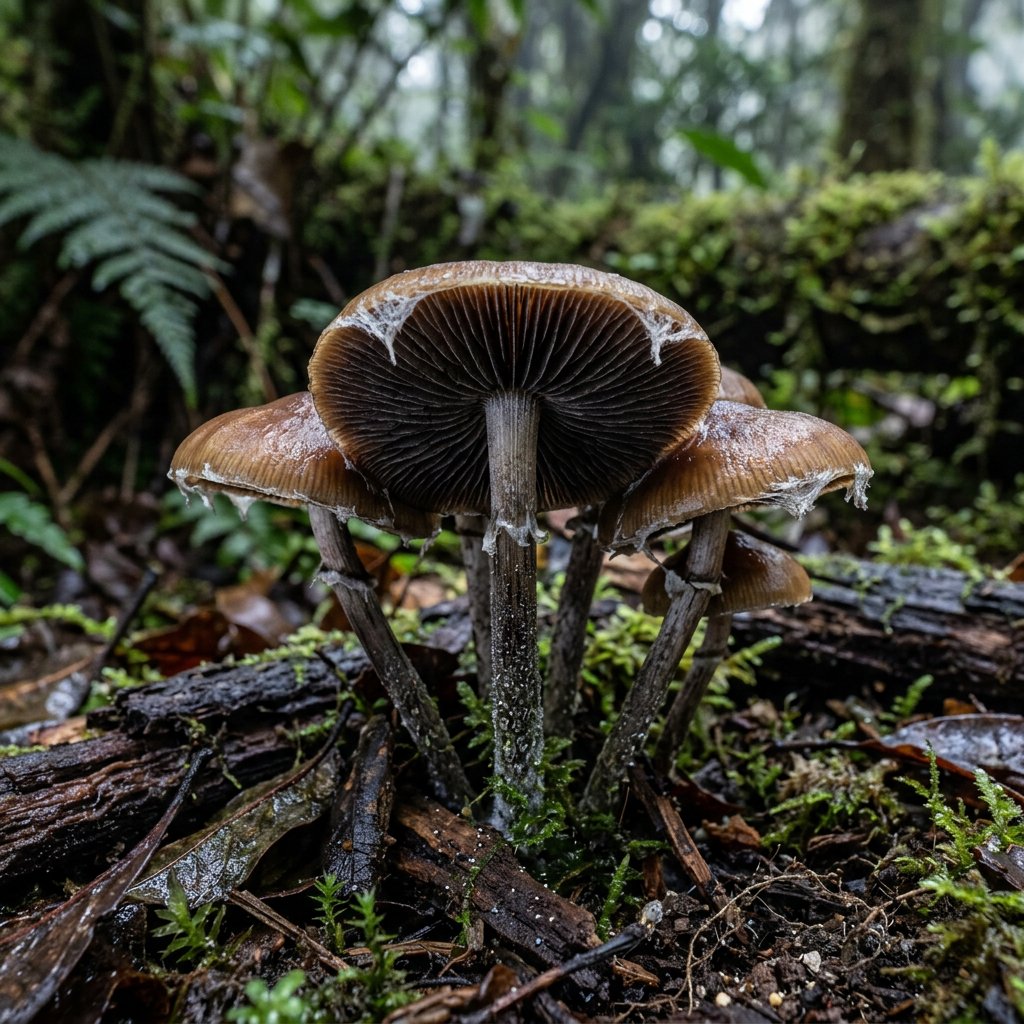
- 🍄 The Cap: Usually conical to convex, it features a distinct "hygrophanous" nature, meaning it changes color drastically from a deep orange-brown when wet to a pale straw-yellow as it dries.
- 🟣 The Gills: When young, the gills are pale, but they eventually turn a dark, smoky purple-brown as the spores mature.
- 💎 Bruising Reaction: One of its most striking features is that the stem and cap will turn a vivid blue or blue-green almost immediately when bruised or handled, indicating the presence of specific alkaloids.
- 🌀 The Stem: The stalk is often thick and fibrous, sometimes featuring a slightly bulbous base that anchors it firmly into the mossy or clay-filled ground.
🌲 Habitat & Ecology
- ⛰️ Landslide Specialist: Unlike many mushrooms that prefer rotting logs, this species loves "disturbed" soil. You are most likely to find it on steep embankments, near trails, or in areas where a landslide has recently exposed fresh, mineral-rich clay.
- ☁️ Cloud Forest Native: It thrives in high-altitude, humid environments (specifically in Mexico), where the air is thick with mist and the ground stays perpetually damp. It plays a vital role as a decomposer, breaking down organic matter within the soil.
⚠️ Safety & Toxicity
- 🚨 WARNING: This mushroom is highly psychoactive. It contains significant levels of psilocybin and psilocin, which induce potent hallucinogenic effects and altered states of consciousness.
- ⚖️ Legal Status: In many jurisdictions, the possession or cultivation of this mushroom is strictly illegal.
- 🚫 Look-alike Danger: Foraging for this species is extremely dangerous for amateurs, as it can be easily confused with deadly Galerina species or other toxic "Little Brown Mushrooms" (LBMs) that cause permanent liver failure.
- 🐾 Pets & Children: Ingestion by pets or children is a medical emergency and can lead to severe disorientation, seizures, and physiological distress.
✨ Fun Fact
This mushroom belongs to the Psilocybe zapotecorum complex. For centuries, the Zapotec people of Oaxaca referred to these types of mushrooms as "Crown of Thorns" or "Landslide Mushrooms," viewing their sudden appearance after storms as a spiritual gift from the earth.
More Details







