Info
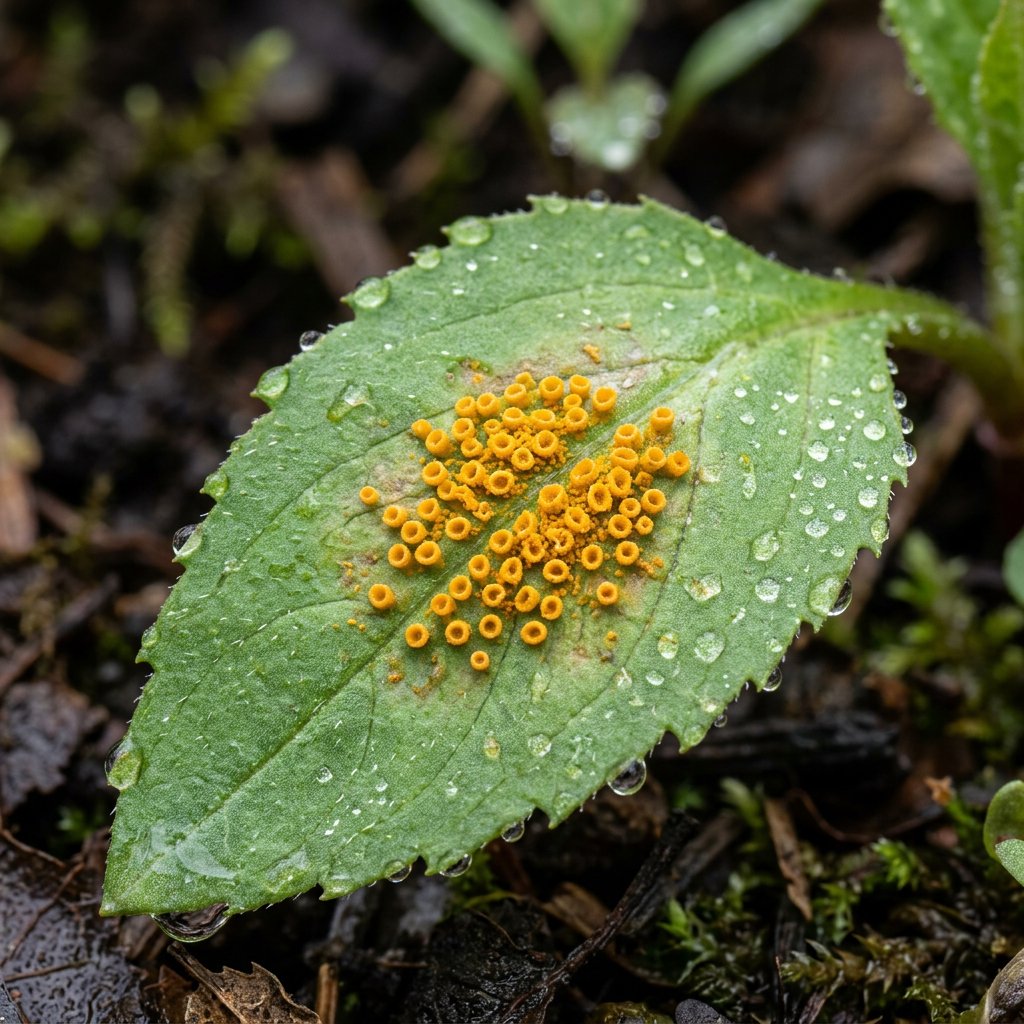
Often overlooked by those admiring the delicate "Spring Beauty" wildflowers, Puccinia mariae-wilsoniae is a tiny architect of the fungal world. Known commonly as Spring Beauty Rust, this fungus transforms its host plant's greenery into a canvas of vivid, fiery orange spots. While it may seem like a simple plant disease, it is a master of survival, timing its emergence perfectly with the short-lived blooming window of early spring.
🔍 How to Identify
- 🧡 Pustule Clusters: Look for "aecia"—tiny, cup-shaped structures that appear as bright orange or yellowish-gold clusters.
- 🍃 Underside Focus: These orange spots are most densely packed on the undersides of leaves, though they can also spread to the stems.
- 🌀 Stem Distortion: Infected plants often show "hypertrophy," where the stems become unnaturally swollen, twisted, or elongated compared to their healthy neighbors.
🌲 Habitat & Ecology
- 🌸 The Specialist: This fungus is an obligate parasite, meaning it cannot survive without its host. It specifically targets the Claytonia genus, particularly the Virginia Spring Beauty.
- ⏳ A Brief Appearance: Because its host is an "ephemeral" (a plant that disappears after spring), the fungus must complete its reproductive cycle quickly before the host plant withers away in the summer heat.
- 🔬 A Self-Sufficient Life: Unlike many rust fungi that require two different types of plants to finish their life cycle, this species is "autoecious," meaning it can complete its entire life journey on just one Spring Beauty plant.
⚠️ Safety & Toxicity
- 🚫 Status: WARNING! Not for consumption.
- 🤢 Details: While rust fungi aren't usually discussed in the same "deadly" context as some mushrooms, they are absolutely not edible. Consuming infected plant matter can lead to gastrointestinal distress or allergic reactions. It is always best to leave these "orange gems" in the forest.
✨ Fun Fact
The specific epithet mariae-wilsoniae was named by mycologist George Clinton in the 1870s to honor Mary L. Wilson, a prolific botanical collector. It remains one of the few fungal species named in tribute to a female naturalist from that era!
More Details







