Info
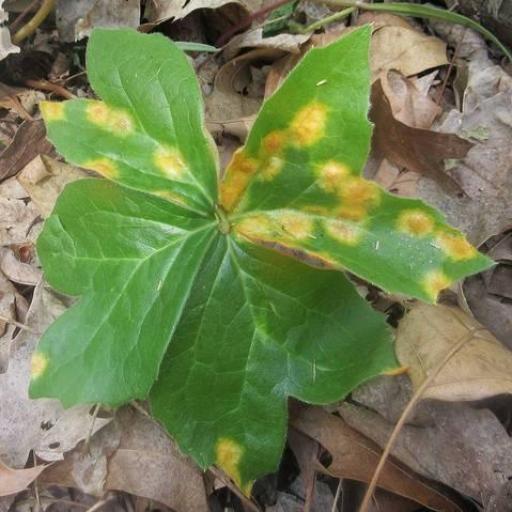
Often mistaken for a splash of neon orange paint, Puccinia podophylli—commonly known as Mayapple Rust—turns the forest floor into a miniature art gallery. This specialized fungus doesn't look like your typical cap-and-stem mushroom; instead, it lives as a vibrant parasite on the wide, umbrella-like leaves of the Mayapple plant. It is a classic sign of mid-spring in North American deciduous forests.
🔍 How to Identify
- 🟠 Bright Aecia: The most striking feature is the cluster of tiny, orange-to-yellow cup-like structures (aecia) found exclusively on the underside of the leaves.
- 🟡 Yellow Lesions: On the top side of the leaf, you will see pale yellow or light green spots that correspond directly to the orange clusters beneath.
- 🌀 Leaf Deformity: In heavy infections, the fungus causes the Mayapple leaf to pucker, curl, or develop thickened, distorted tissue around the site of the rust.
🌲 Habitat & Ecology
- 🌿 Strict Specialist: This fungus is an obligate parasite, meaning it cannot survive without its host, the Mayapple (Podophyllum peltatum). If there are no Mayapples, there is no Mayapple Rust.
- 💧 Spring Emergence: It thrives in the damp, cool conditions of the early forest canopy. As the Mayapples push through the leaf litter in April and May, the rust spores are ready to hitch a ride on the new growth.
⚠️ Safety & Toxicity
- 🛑 WARNING: Non-Edible. This is a microscopic rust fungus and is not considered food for humans or animals.
- ⚠️ Host Toxicity: It is important to remember that the Mayapple plant itself is highly toxic to humans, cats, and dogs if ingested. The presence of the rust fungus does not change this, but you should avoid handling or accidentally consuming any part of an infected plant.
✨ Fun Fact
Most rust fungi are "heteroecious," meaning they need two completely different plant species to complete their life cycle (like Wheat Rust needing Barberry). However, Mayapple Rust is "autoecious"—it is a biological homebody that can complete its entire complex life cycle on the Mayapple alone!
More Details