Info
Often referred to as Arum Rust or Wild Garlic Rust, Puccinia sessilis is a master of disguise that paints the forest floor with vibrant orange "polka dots." This fascinating fungus doesn't produce a typical mushroom cap; instead, it lives a complex double life, jumping between woodland wildflowers and marshy grasses to complete its life cycle. In folklore, finding these bright spots on a leaf was often seen as a sign that the "Lords and Ladies" (Arum plants) were wearing their finest jewelry.
🔍 How to Identify
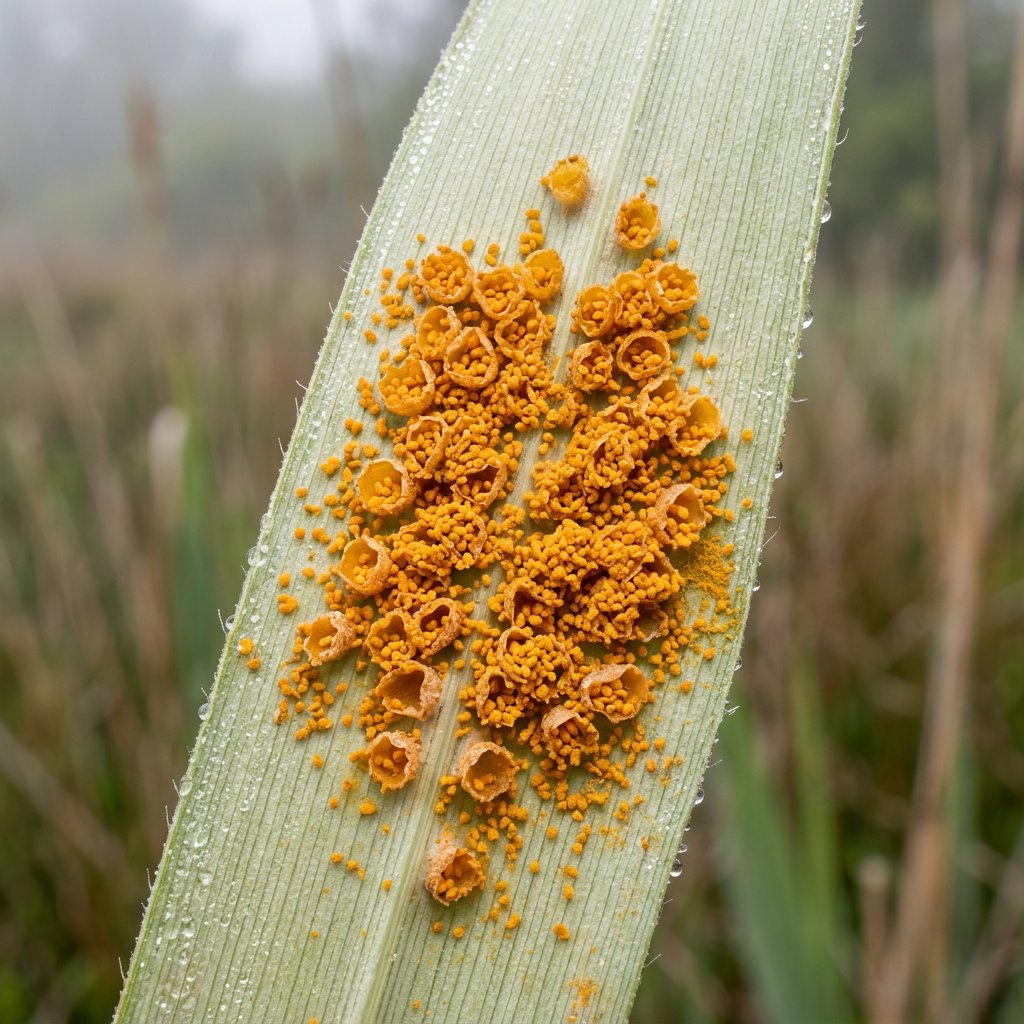
- 🍊 The Aecia (Cups): On the underside of the host leaf, look for tiny, crowded, orange-to-yellow "cups" with fringed white edges. They often look like miniature sunken volcanoes.
- 🟡 Upper Surface Spots: On the top of the leaf, the infection appears as pale yellow or chlorotic circular spots, mirroring the cluster of cups underneath.
- 🌿 Specific Hosts: You will primarily find this rust on the leaves of Arum maculatum (Cuckoo Pint) or Allium ursinum (Wild Garlic/Ramsons) during the spring.
🌲 Habitat & Ecology
- 💧 Damp Woodlands: This fungus thrives in moist, shaded environments where its primary hosts grow in abundance. It is most visible from April to June.
- 🔄 The Host Swap: This species is "heteroecious," meaning it needs two different plants to survive. After infecting woodland flowers in the spring, its spores travel on the wind to find Phalaris arundinacea (Reed Canary Grass), where it spends the winter in a much more subtle, dark-streaked form.
- 🍃 Nutrient Thief: As a parasite, it siphons energy from the host plant’s leaves, though it rarely kills the plant entirely, preferring to keep its "host" alive for as long as possible.
⚠️ Safety & Toxicity
- 🚫 WARNING: Do not consume. While rust fungi are not typically discussed in culinary terms, Puccinia sessilis grows on plants that are highly toxic to humans and pets.
- 🧪 Host Toxicity: The Arum plant (Lords and Ladies) contains needle-like calcium oxalate crystals that cause severe irritation, swelling, and burning if touched or ingested.
- 🐾 Pet Safety: Keep dogs away from infected foliage; the combination of the toxic host plant and the fungal spores can cause digestive distress or skin irritation.
✨ Fun Fact
Puccinia sessilis is a biological "shapeshifter." It produces five different types of spores throughout its life cycle, each designed for a specific task—from surviving the harsh winter on grass to aggressively colonizing wildflowers in the spring breeze!
More Details







