Info
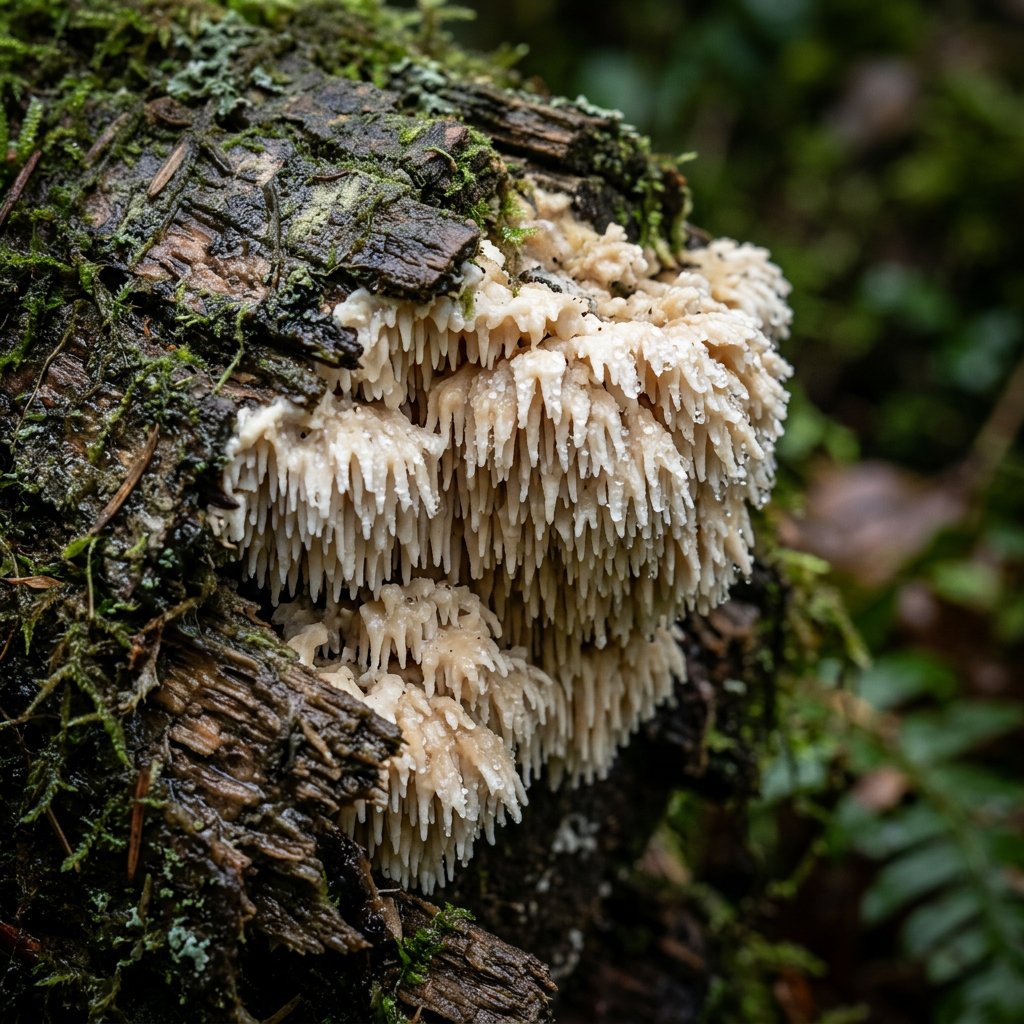
Known as the "Asian Beauty," Radulodon copelandii is a striking, toothy fungus that looks like a cascade of frozen golden icicles clinging to old wood. Originally native to East Asia, this fungus has recently become a fascinating "invader" in North American forests, spreading rapidly across hardwood logs. Its name comes from the Greek word radula, meaning "scraper," referring to its jagged, tooth-like surface.
🔍 How to Identify
- 🦷 The Teeth: Instead of traditional gills or pores, this mushroom features long, crowded spines (teeth) that hang downward, reaching up to 1 cm in length.
- 🍄 Growth Habit: It is a "resupinate" fungus, meaning it grows flat against the surface of bark like a thick, fuzzy crust, with the spines emerging from this base.
- 🎨 Color Palette: When young, it is a brilliant creamy white or pale yellow, often turning a deeper ochre or brownish-orange as it matures or dries out.
🌲 Habitat & Ecology
- 🌳 Hardwood Specialist: You will almost exclusively find the Asian Beauty on the decaying wood of deciduous trees, particularly oaks, maples, and liquidambar (sweetgum).
- 🍂 The Recycler: It is a saprobic fungus, meaning it plays a vital role in the ecosystem by causing "white rot." It breaks down the tough lignin in wood, returning essential nutrients to the forest soil.
- 🗺️ Expanding Borders: While it was first documented in the US in the early 2000s, it has quickly moved across the Eastern states, often outcompeting native crust fungi.
⚠️ Safety & Toxicity
- 🚫 Status: Inedible. While not known to be "deadly" in the way some Amanitas are, it has no culinary value.
- 👅 Texture & Taste: The flesh is tough, fibrous, and somewhat leathery. It is not considered a food source for humans and should not be consumed.
- 🐾 Pet Safety: There is little data on its effect on pets, but as with most wood-decaying fungi, ingestion can lead to digestive upset in dogs or cats.
✨ Fun Fact
Despite its delicate, "beautiful" appearance, Radulodon copelandii is a formidable colonizer; it can cover the entire underside of a fallen log in a single season, creating a spectacular "shaggy" golden carpet that glows in the damp shade of the forest floor.
More Details







