Info
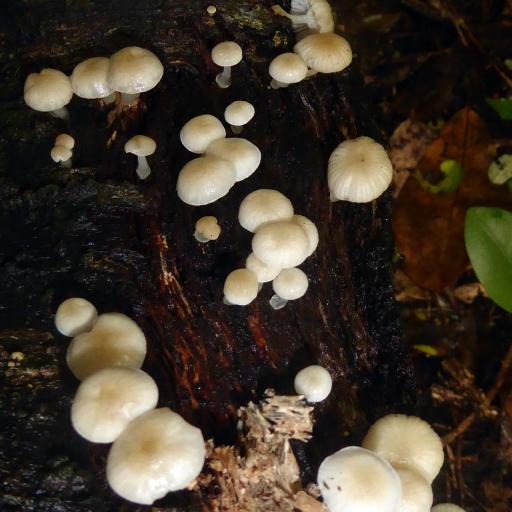
Often called the "Austromirabilis" or the "Slimy-Stemmed Mycena," this ethereal fungus looks as if it has been dipped in liquid glass. It is a jewel of the damp, mossy forests of the Southern Hemisphere, famous for its shimmering, jelly-like appearance that makes it look like it belongs in a deep-sea coral reef rather than on a fallen log.
🔍 How to Identify
- 🍄 The Cap: Small (1–2 cm), convex to flattened, and colored ivory or pale cream. It often appears slightly translucent when wet, revealing the gill patterns underneath.
- 📏 The Gills: Pure white and spaced relatively far apart. They are "decurrent," meaning they slightly run down the top of the stem.
- 💧 The Stem: The most striking feature; the stipe is entirely encased in a thick, transparent, and slippery layer of mucilage (slime) that can be several millimeters thick.
🌲 Habitat & Ecology
- 🪵 Wood Dweller: This mushroom is a saprobe, meaning it breaks down dead organic matter. You will typically find it growing in small groups on decaying logs, fallen branches, and woody debris.
- 🌧️ Rainforest Resident: It thrives in high-humidity environments, particularly in the cool-temperate rainforests of Australia, New Zealand, and parts of South America, often appearing after heavy rainfall.
⚠️ Safety & Toxicity
- 🚫 WARNING: This mushroom is considered inedible. While it is not documented as a "deadly" species, its edibility is unknown, and it is far too small and gelatinous to be of any culinary value.
- 🧪 Unknown Risks: Many small white fungi contain secondary metabolites that can cause gastrointestinal distress. It should never be handled or consumed by children or pets.
✨ Fun Fact
The name Roridomyces comes from the Latin word roridus, meaning "covered with dew." The thick slime on the stem isn't just for show—it acts as a protective barrier to keep the mushroom from drying out in the wind!
More Details
| Hymenium Type | Lamella |
| Stipe Character | Bare Stipe |
| Spore Print Color | White |
| Hymenium Attachment | Adnate Hymenium Attachment |
| Mushroom Ecological Type | Saprobiont |







