Info
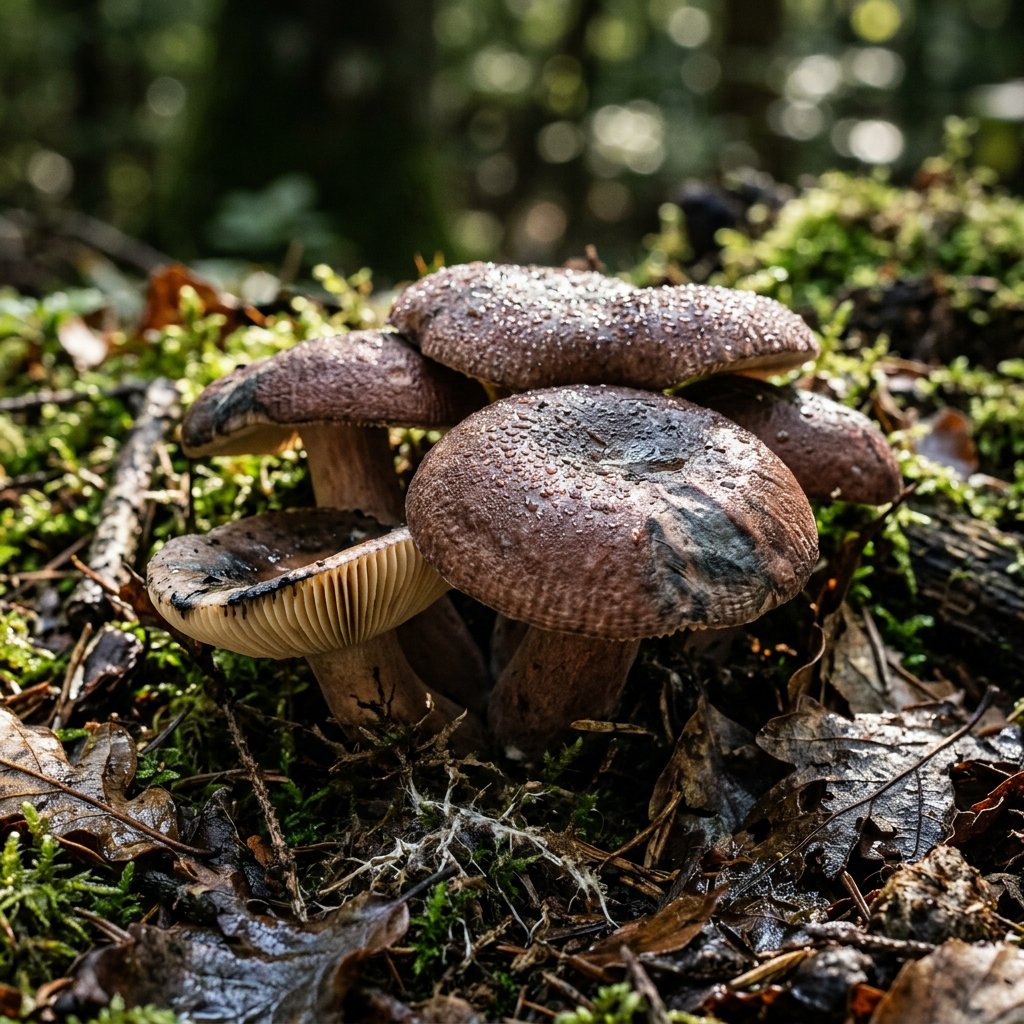
Often called the Red-fleshing Russula, this mushroom is a master of disguise and chemical drama. While it starts its life looking like a clean, stout, white-capped fungus, it hides a moody secret: its flesh blushes a deep crimson when bruised or cut, slowly fading into a dark, charcoal black. It is a robust member of the "blackening Russulas," a group known for their chunky build and startling color transitions.
🔍 How to Identify
- 🍄 The Cap: Large and heavy (up to 6 inches across), it begins as a convex white or tan dome but eventually develops a central depression, turning soot-colored or dark brown as it ages.
- 🔪 The Flesh Reaction: The most iconic trait. If you scratch the gills or slice the stem, the white interior will turn distinctly reddish within minutes, later turning completely black.
- 📏 The Gills: Unlike many other mushrooms with thin, crowded gills, these are notably thick, brittle, and spaced relatively far apart.
🌲 Habitat & Ecology
- 🌳 Forest Partners: This mushroom is "mycorrhizal," meaning it lives in a symbiotic relationship with trees. In North America, you’ll most often find it hugging the roots of oaks and other hardwoods, as well as some conifers.
- 🍂 Summer Resident: Look for it during the humid months of mid-summer through autumn. It often grows partially buried under leaf litter, pushing up large clumps of soil as it emerges.
⚠️ Safety & Toxicity
- 🛑 WARNING: While not considered "deadly," Russula dissimulans is generally classified as inedible.
- 🤢 The Risk: Many members of the blackening Russula group can cause significant gastrointestinal distress, including nausea and cramping. Furthermore, they are very difficult for amateurs to distinguish from other, more toxic species that also turn black, such as the potentially lethal Russula subnigricans. Do not consume.
✨ Fun Fact
The genus Russula is famous for having "brittle" flesh. Unlike a flexible mushroom that bends, a Russula stem will snap cleanly like a piece of chalk. This is because their tissue is made of spherical cells (sphaerocysts) rather than the typical long, fiber-like strands found in most fungi!
More Details