Info
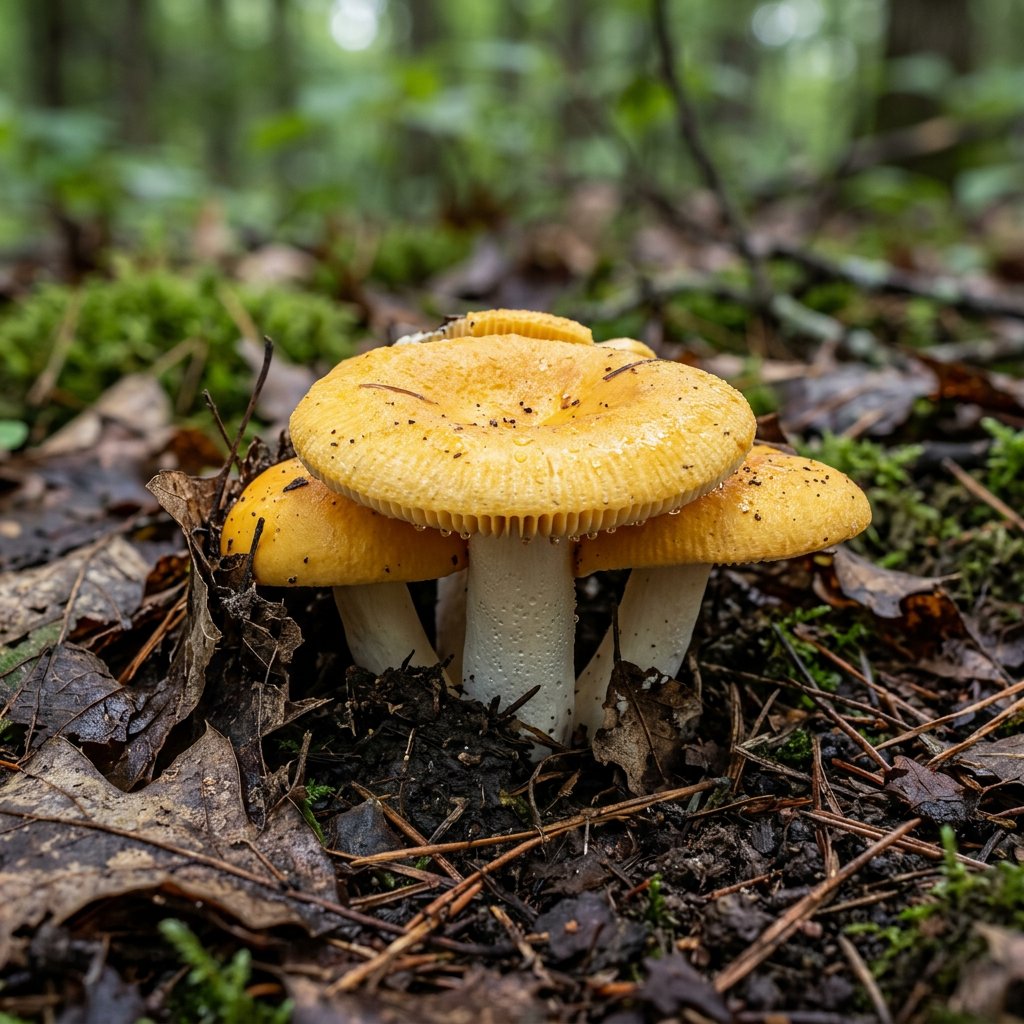
Known as a member of the diverse and often confusing "red-capped Russula" family, Russula flavisiccans is a woodland gem with a hidden secret: its name literally means "turning yellow when drying." In the dappled sunlight of a deciduous forest, it looks like a fallen piece of fruit, but its brittle nature tells a different story of complex forest chemistry.
🔍 How to Identify
- 🎨 The Cap: Displays shades of rosy-red, pinkish-orange, or even a duller brick red. As it ages or begins to dry out, it often develops distinctive yellowish or ochre patches, giving it its scientific name.
- 🍂 The Gills: These are white when the mushroom is young but may turn a creamy yellow as the spores mature. They are incredibly brittle and will shatter if you run your finger across them.
- 🪵 The Stem (Stipe): Solid and white, though it can sometimes show a faint flush of pink. True to the Russula genus, the stem snaps cleanly like a piece of sidewalk chalk rather than splintering into fibers.
🌲 Habitat & Ecology
- 🌳 Hardwood Companion: This mushroom is mycorrhizal, meaning it lives in a complex "trade agreement" with trees. It is most commonly found growing near hardwoods, particularly Oak and Hickory, where it exchanges soil nutrients for tree sugars.
- 🍄 Summer Seeker: You are most likely to spot these popping through the leaf litter during the humid months of mid-summer and early autumn, especially after a heavy rain.
⚠️ Safety & Toxicity
- 🛑 WARNING: Identifying red-capped Russulas to a species level is notoriously difficult even for experts. Many look-alikes are "emetics," meaning they cause violent gastrointestinal distress.
- 🤢 Inedible: Russula flavisiccans is generally considered inedible. While not typically "deadly," ingesting it—or its look-alikes—can lead to severe nausea, vomiting, and abdominal cramps. It is best enjoyed as a photographic subject rather than a snack.
- 🐾 Pets & Kids: Keep curious dogs and children away, as the bright "apple-like" color of the cap can be deceptively inviting.
✨ Fun Fact
- 🧪 The Snap Test: You can tell a Russula apart from other mushrooms by its unique cellular structure. Most mushrooms have long, fibrous cells, but Russulas contain round, ball-like cells called sphaerocysts. This is why the stem snaps with a crisp "pop" instead of bending or tearing!
More Details