Info
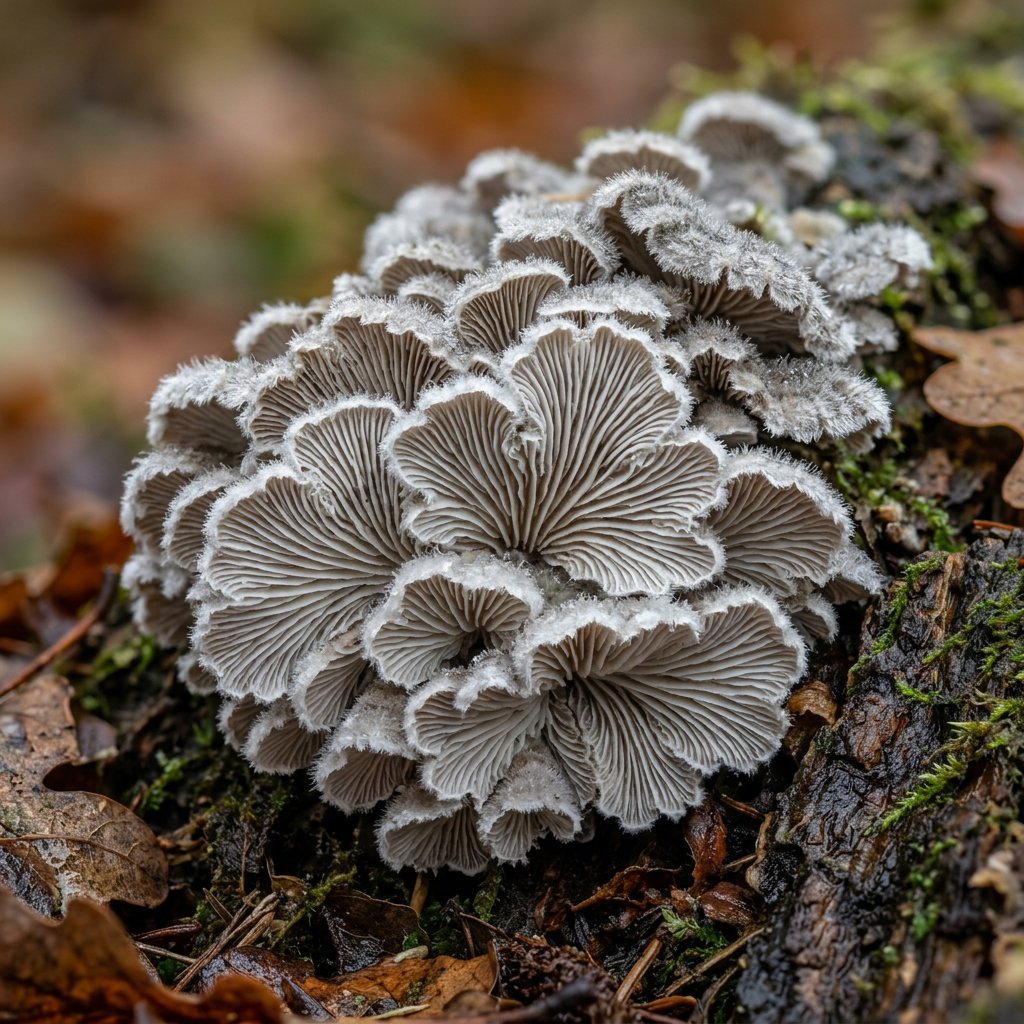
Known as the Split Gill, this mushroom is a true global traveler, found on every continent except Antarctica. While it looks like a soft, velvety fan clinging to a log, it is a master of survival, capable of drying out completely and "waking up" years later with a single drop of rain. It is often the first fungus to appear on fallen wood after a storm.
🔍 How to Identify
- 🍄 The Cap: Fan- or shell-shaped, usually 1–4 cm wide. It has a velvety, hairy texture and ranges from chalky white to pale grey, often turning a brownish hue when wet.
- 🔪 The Gills: On the underside, the gills appear "split" or doubled lengthwise. These gills curl inward to protect the spore-producing surface during dry spells, a unique adaptation among fungi.
- 🪵 The Attachment: It lacks a traditional stalk (stem). It attaches directly to the wood at a single point, often growing in overlapping, shelf-like clusters that resemble tiny, ruffled ears.
🌲 Habitat & Ecology
- 🌳 The Ultimate Recycler: You’ll almost always find it on decaying deciduous wood, like fallen logs or old stumps. It plays a vital role in the ecosystem by breaking down lignin and returning nutrients to the forest floor.
- 🌍 Global Presence: It is arguably the most widespread fungus in the world. It thrives in tropical, temperate, and even arid climates because of its ability to survive extreme dehydration and "reanimate" when moisture returns.
⚠️ Safety & Toxicity
- 🍄 WARNING: Although it is consumed in some tropical regions as a "chewing gum" mushroom due to its rubbery texture, it is generally considered inedible and poses a unique health risk.
- 🏥 Medical Note: This mushroom is one of the very few that can cause "basidiomycosis" in humans. In rare cases, the spores can germinate and grow inside the human respiratory system (sinuses or lungs), particularly in individuals with weakened immune systems.
- 🐾 Pets: It is not considered acutely toxic to dogs or cats, but its extremely leathery, "indestructible" texture makes it a significant choking hazard and can cause intestinal blockage if swallowed.
✨ Fun Fact
While humans generally have two biological sexes, the Schizophyllum commune has over 23,000 different mating types (sexes). This genetic diversity ensures that almost any two individuals of the species that meet in the wild are compatible and can successfully reproduce!
More Details
| Hymenium Type | Pores |
| Spore Print Color | White |
| Mushroom Cap Shape | Offset Mushroom Cap |
| Hymenium Attachment | Decurrent Hymenium Attachment |
| Mushroom Ecological Type | Saprobiont |







