Info
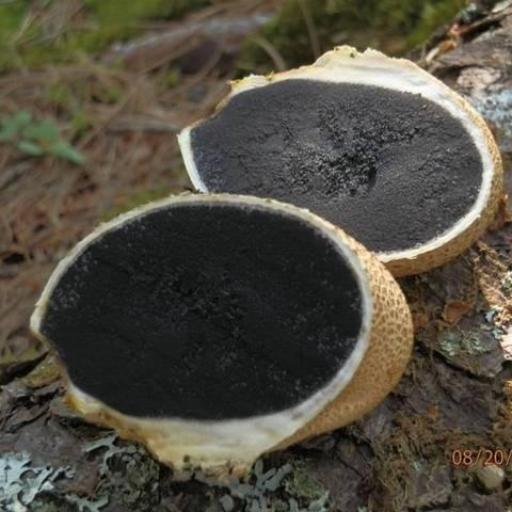
Commonly known as the Common Earthball or the "Pigskin Poison Puffball," this mushroom looks less like a fungus and more like a wayward potato half-buried in the moss. Unlike the soft, marshmallow-like edible puffballs, the Earthball is tough, leathery, and hides a dark, dusty secret within its golden exterior. It is a staple of autumn woodlands, often found lining mossy paths in temperate forests.
🔍 How to Identify
- 🍄 The Skin (Peridium): The outer surface is thick, tough, and scaly, ranging from lemon-yellow to dirty tan. It is covered in coarse, wart-like bumps that give it a distinct "pigskin" texture.
- 🌑 Internal Color (Gleba): When sliced open, young specimens have a firm, marbled white interior that quickly turns a deep, purplish-black. In maturity, this center becomes a dense mass of dark spores.
- 🌱 The Base: It lacks a true stem. Instead, it is attached to the ground by a thick, tangled mass of yellow mycelial cords that look like tiny roots.
🌲 Habitat & Ecology
- 🌳 Tree Partners: This mushroom is mycorrhizal, meaning it forms a symbiotic relationship with trees. It is particularly fond of acidic soils near Birch, Oak, and Pine trees.
- 🌿 Mossy Ground: You will most frequently spot them in late summer and autumn, nestled among moss, leaf litter, or even growing on very decayed, moss-covered wood.
- 🍂 Spore Release: Unlike true puffballs that have a single hole at the top, the Earthball’s skin simply cracks and ruptures irregularly to let the wind carry its dark spores away.
⚠️ Safety & Toxicity
- 🚫 Status: TOXIC. This mushroom is poisonous and should never be consumed.
- 🤢 The Risk: Ingestion causes severe gastrointestinal distress, including vomiting, diarrhea, and stomach cramps. Some individuals may also experience sweating or a drop in blood pressure.
- 🕵️ The "Lookalike" Danger: It is frequently confused with edible Common Puffballs (Lycoperdon). Remember: edible puffballs are pure white and soft inside; the Earthball is tough and has a dark purple/black interior.
✨ Fun Fact
The Common Earthball is the favorite host of a specific "vampire" mushroom called the Parasitic Bolete (Pseudoboletus parasiticus). If you see a small, traditional-looking mushroom with a cap and stem growing directly out of the side of an Earthball, you’ve found one of nature’s strangest heists!
More Details
| Hymenium Type | Gleba |
| Spore Print Color | Purple-Black |
| Mushroom Cap Shape | No Mushroom Cap |
| Mushroom Ecological Type | Mycorrhiza |