Info
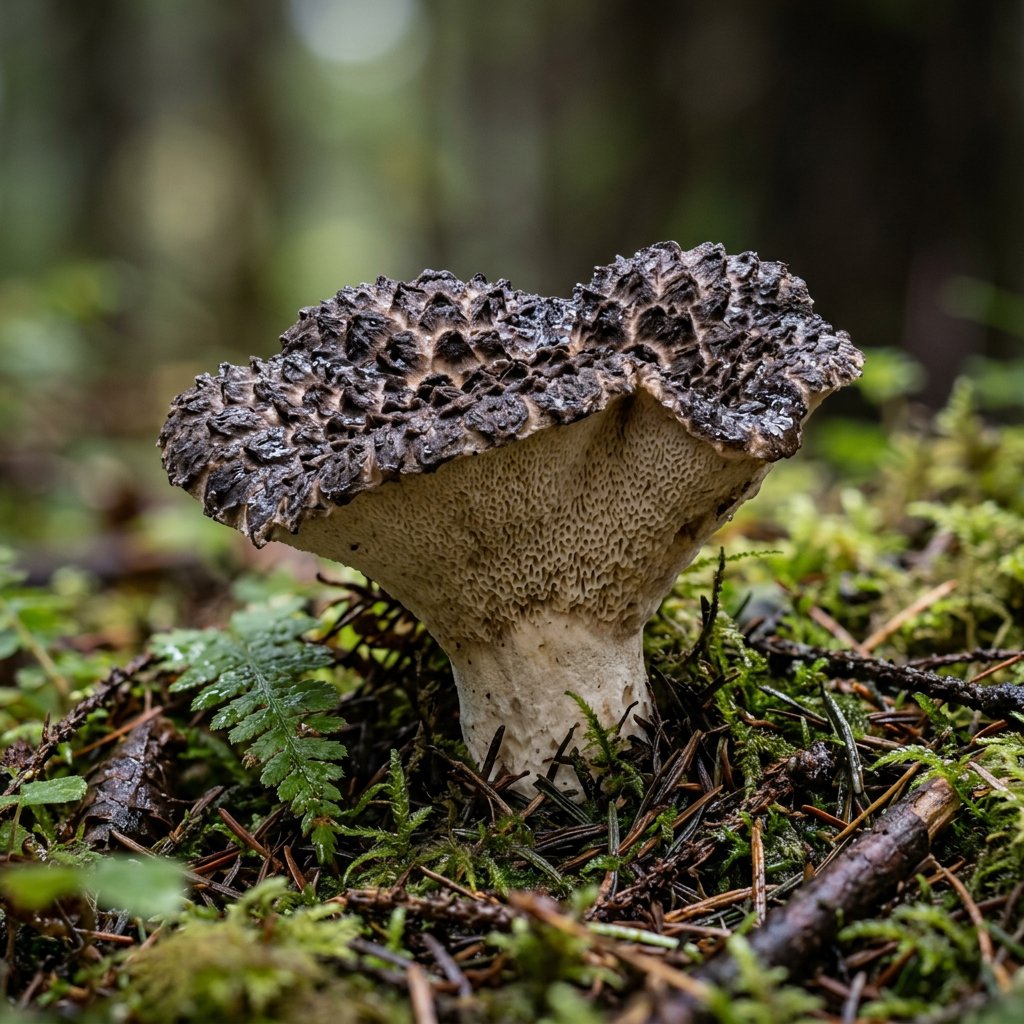
Known as the Goat’s Foot or Pig's Trotter mushroom, this peculiar fungus looks more like a misplaced animal track than a typical woodland toadstool. Its rugged, scaly appearance makes it a favorite find for foragers in high-altitude forests, where it hides among moss and pine needles. While it lacks the classic "umbrella" shape, its earthy charm and meaty texture have earned it a legendary status in traditional European kitchens.
🔍 How to Identify
- 🍄 The Cap: Distinctly asymmetrical and kidney-shaped, the top is covered in dark brown, velvety scales that give it a "shaggy" or fur-like appearance, mimicking a goat’s hoof.
- 🕳️ The Pores: Instead of gills, the underside features large, angular pores. These are creamy white when the mushroom is young but turn a rich golden yellow as it matures.
- 🦶 The Stem: The stalk is thick, short, and usually positioned off to one side (eccentric). It is often yellowish and tapers toward the base like a sturdy ankle.
🌲 Habitat & Ecology
- ⛰️ Mountain Dweller: This fungus is a "mycorrhizal" partner, meaning it lives in a symbiotic relationship with the roots of trees. It is almost exclusively found in montane forests, favoring old-growth Pines and Spruces.
- 🍃 Rare Find: It prefers acidic, mossy soils and rarely grows in large groups. Because it requires specific, undisturbed forest conditions, it is considered an indicator of a healthy, mature ecosystem and is protected by law in several European countries.
⚠️ Safety & Toxicity
- 🛑 WARNING: Never consume any wild mushroom unless you have confirmed its identity with a local expert in person. Lookalikes can be dangerous.
- 🍽️ Status: Scutiger pes-caprae is considered a choice edible with a firm, nutty texture. It does not have any "deadly" lookalikes, but it can be confused with other bitter-tasting polypores that cause stomach upset.
- 🍳 Preparation: It must be thoroughly cooked. For some, the tough scales on the cap are removed to improve the texture, though they are not toxic.
✨ Fun Fact
The name pes-caprae is literal Latin for "goat's foot." In Italy, where the mushroom is a gourmet delicacy, it is called "Piede di Capra" and is traditionally preserved in high-quality olive oil to be served as a prized winter antipasto.
More Details